Science1 publisher3 min readPublished
Archaeologists had 12 days to excavate a 400-year-old wreck before gas-pipeline dredging
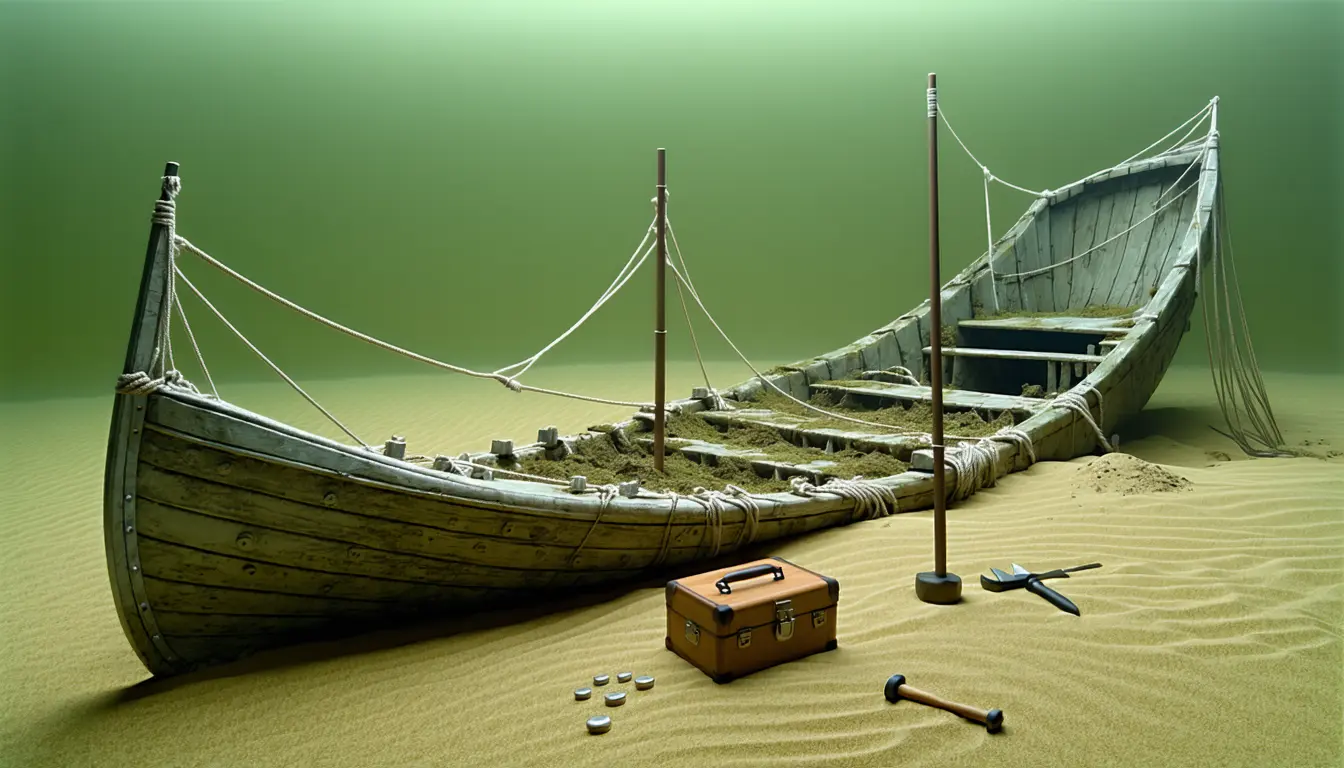
Archaeologists made 22 dives in just over 12 days to excavate a 400-year-old wreck in Germany's Bay of Greifswald ahead of pipeline dredging. The dig produced a tree-ring date and a carpentry kit, and the ship's name and home port are still unknown.
The Scientist · Science desk
What happened
- In 2023, divers clearing seabed anomalies for a planned gas pipeline in Germany's Bay of Greifswald found shoe soles, pulley blocks and a rusty anchor from an unknown wreck.
- A preliminary report on the rescue excavation has been published in the International Journal of Nautical Archaeology.
- With pipeline dredging about to start, a team of five made 22 dives in just over 12 days to recover what it could.
- Tree rings in one timber show that a tree used to build the ship was felled between 1626 and 1639.
- The team documented more than 60 objects, including wooden stocks, rope, barrel staves and a hollowed oak trunk that was probably the bilge pump.
Compiled by The ScientistSomething wrong?How this is made
Why it matters
- constraint At fewer than two dives a day, in water that clouded at the slightest movement, the team could record only part of the site before dredging started.
- cost A late find costs the archaeological record. Wrecks in this bay that were flagged early in planning got proper excavations. This one got a rescue dig of just over 12 days.
- constraint More time could not have recovered what had already decayed. Much of the hull was gone before the divers arrived, so the deadline is only part of the reason so little of the ship came up.
The schedule comes to fewer than two dives a day [1]. The site lay about 7.5 metres down on a soft, silty seabed, and the slightest movement by a diver clouded the water [4]. The team documented each find on deck and put it straight into temporary water storage nearby to prevent further damage [5].
Michał Grabowski, an underwater archaeologist at the University of Warsaw, recognised the wreck from the first objects. "When I saw the collection of artifacts in the photograph, it occurred to me that they must have come from a wreck," he said [18]. Much of that wreck had not survived [6]. The hull is one patch of outer planking about 7.5 metres long, plus loose frames and timbers scattered across the seabed [6]. The planks overlap like roof shingles. They were hammered in with iron nails and the gaps sealed with tar and animal hair, a method known as clinker construction [7].
The tree-ring window falls 384 to 397 years before the 2023 discovery [2]. That window is the basis for calling the ship roughly 400 years old [2][8]. A felling date records when the wood was cut [8]. The ship was built some time after that and sank later still, and the rings cannot say when.
Alongside the working gear, the team found carpentry tools. One is a hand-drill handle similar to those recovered from the Tudor warship Mary Rose, and the authors take the tools as a sign that the ship carried a workshop for long voyages [10]. There were few personal belongings: two shoe soles and a stitched leather strap. Bones show the crew ate pigs and either sheep or goat [11]. One object has no known parallel. It is a flat clay brick with a series of holes, lodged in a block of oak, and the report suggests it may have been an improvised aid for sharpening blunt chisels and drill bits [12]. "I had no idea what it was, but I really wanted to solve the mystery," Grabowski said. "And I still very much want to." [13]
How the ship was lost is even less clear. Some timbers were burnt, perhaps in a fire [14]. Two anchors, and a type of buoy used when an anchor was out, suggest the ship was lying at anchor when it went down [14]. Grabowski is cautious about reading much into this. "I try not to speculate," he said. "Otherwise, we risk creating an alternative history." [15]
Dozens of wrecks have now been found in the bay, as offshore gas, oil and renewable energy projects turn up seabed anomalies that prove to be wrecks [17]. According to the phys.org account, many of those were found early enough in project planning for proper excavations [17]. This one came up while divers were clearing anomalies, with dredging about to begin [1][3]. The account does not say how many of the bay's wrecks were found late. Without that number, one rushed excavation cannot show how much underwater heritage these projects put at risk [17].
What to watch
- A survey of the seabed east of the find spot, where the study suggests more of the wreck may lie and where pieces that could name the ship might turn up.
- A fuller report than this preliminary one, including whether any parallel emerges for the perforated clay brick set in oak.