Loading today’s stories
Product1 distinct publisher3 min readUpdated
Northrop Grumman's SYNOPTICS grows a record Yb:YLF boule, and DESY gets the parts
The gain crystal, not the surrounding hardware, has capped high-energy fusion lasers. SYNOPTICS says parts from this boule feed DESY's 200-joule-class module work.
The Product Desk · Product desk
What happened
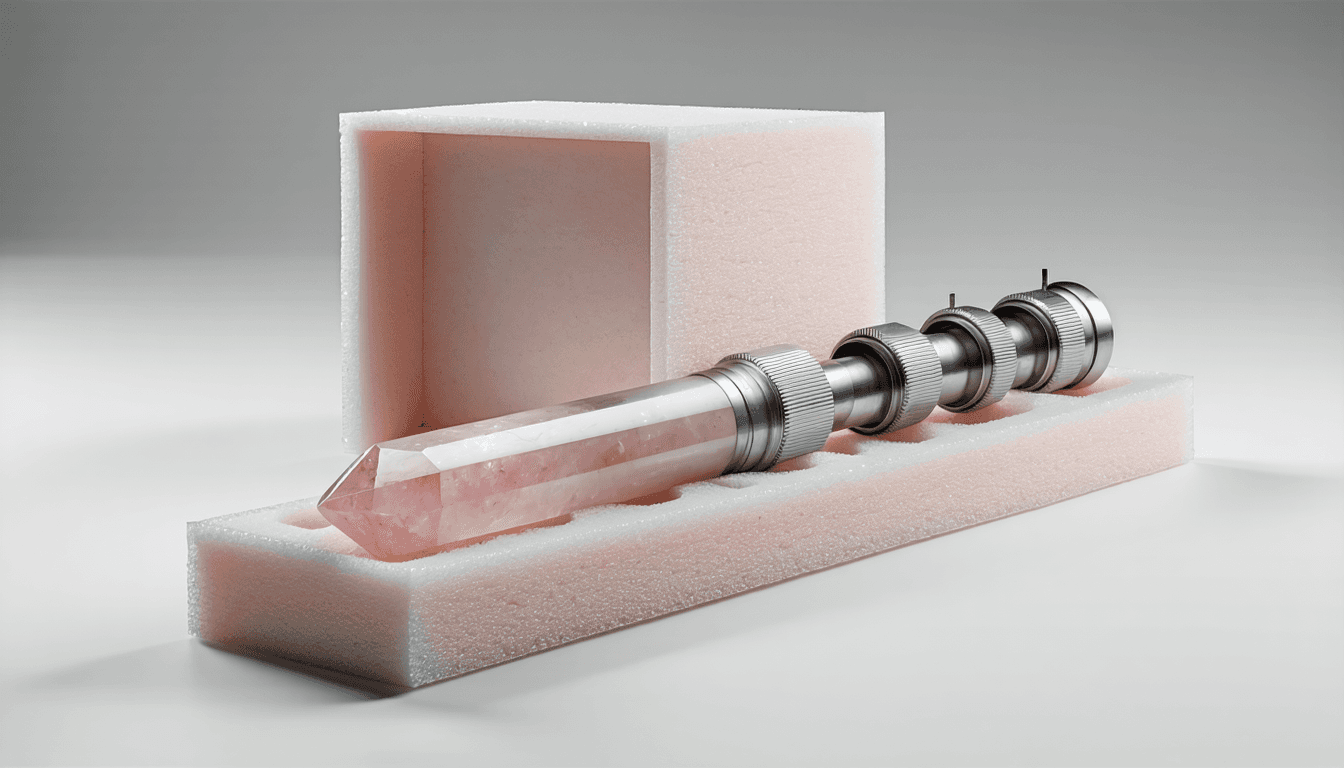
- SYNOPTICS, a North Carolina-based subsidiary of Northrop Grumman, has grown and harvested a ytterbium-doped yttrium lithium fluoride (Yb:YLF) crystal boule.
- Laser crystals such as Yb:YLF serve as the core material inside a laser that amplifies the light required to produce a laser beam; they are the heart of solid-state laser systems.
- Demanding applications such as inertial confinement fusion require high-energy laser systems, which in turn require large crystal boules.
- According to SYNOPTICS, parts from this crystal will go on to power high-energy laser systems for inertial fusion energy research at Germany's Deutsches Elektronen-Synchrotron (DESY).
- Dr. Kevin Stevens, general manager at Northrop Grumman SYNOPTICS, said: "We've just grown one of the largest and purest crystals of its kind, a landmark moment."
Compiled by The Product DeskSomething wrong?How this is made
Why it matters
Northrop Grumman subsidiary SYNOPTICS, based in North Carolina, has grown and harvested a ytterbium-doped yttrium lithium fluoride (Yb:YLF) crystal boule [1]. The company says parts cut from it will go into high-energy laser systems for inertial fusion energy research at Germany's Deutsches Elektronen-Synchrotron (DESY) [4], which matters because the boule has been the binding constraint: inertial confinement fusion needs high-energy laser systems, and those need large crystals [3].
The mechanism here is unglamorous and important. A laser crystal is the core material that amplifies light to produce the beam [2]. SYNOPTICS says the aperture and optical quality of these record-size Yb:YLF crystals are what make efficient high-energy, high-average-power operation possible [11]. In other words, the useful output of the whole system is bounded by how much clean crystal you can grow and then cut, which is a foundry problem more than a photonics problem.
On the multiplier: the "3x larger" figure sits in the publisher's headline [12]. The company's own language, from general manager Dr. Kevin Stevens, is "one of the largest and purest crystals of its kind, a landmark moment" [5], and that it opens new possibilities for the customer's laser system design [6]. The company also called the work more than a material science feat and a "gamechanger" for fusion research [7]. Nothing in the material gives the boule's dimensions, mass, doping level, growth time, or the baseline size that "3x" or "record" is measured against [13]. Operators evaluating a supply-chain claim should note that a size record without a stated prior number is not yet a specification.
The customer end is more concrete. IFuEL, or Inertial Fusion Energy Laser Development and HED Analytics, is a multi-institutional Fusion 2040 consortium that includes DESY and is funded by the German Federal Ministry of Research, Technology, and Space [8]. It builds on more than a decade of cryogenic Yb:YLF laser research at DESY and is to develop a 200-joule-class laser module as a potential building block for future fusion laser drivers [10]. Its stated central target is high wall-plug efficiency in scalable, reliable, high-energy laser systems [9]. That framing is the honest one: for a fusion plant, the number that matters is not peak joules but how much grid power it takes to get them, and that pushes work back onto the crystal, because a bigger, cleaner aperture is how you avoid stacking lossy stages.
What is not established is repeatability. The announcement describes one harvested boule and gives no production rate, yield, or schedule for the next one [14]. A single record boule relieves one experiment; a 200-joule module that becomes a repeated building block in a driver needs many matched parts, and there is no public figure yet on how many usable pieces a boule of this size yields.
Watch for three things. Whether SYNOPTICS publishes dimensions and a growth cadence rather than superlatives. Whether IFuEL reports the module's demonstrated energy and, more to the point, its measured wall-plug efficiency [9] [10]. And whether any laser house outside this consortium places an order, which is the only real test of whether the crystal ceiling has moved for the field or for one customer.
Loading topic controls
Loading related stories