Product1 publisher3 min readPublished
Agility's Digit 5 sits down and shuts off its motors so workers can walk up to it
Agility rebuilt Digit's legs, payload and safety architecture for customers who asked to run the robot without barriers between it and their staff. The OSHA field evaluation it was designed for has not happened yet.
The Product Desk · Product desk
What happened
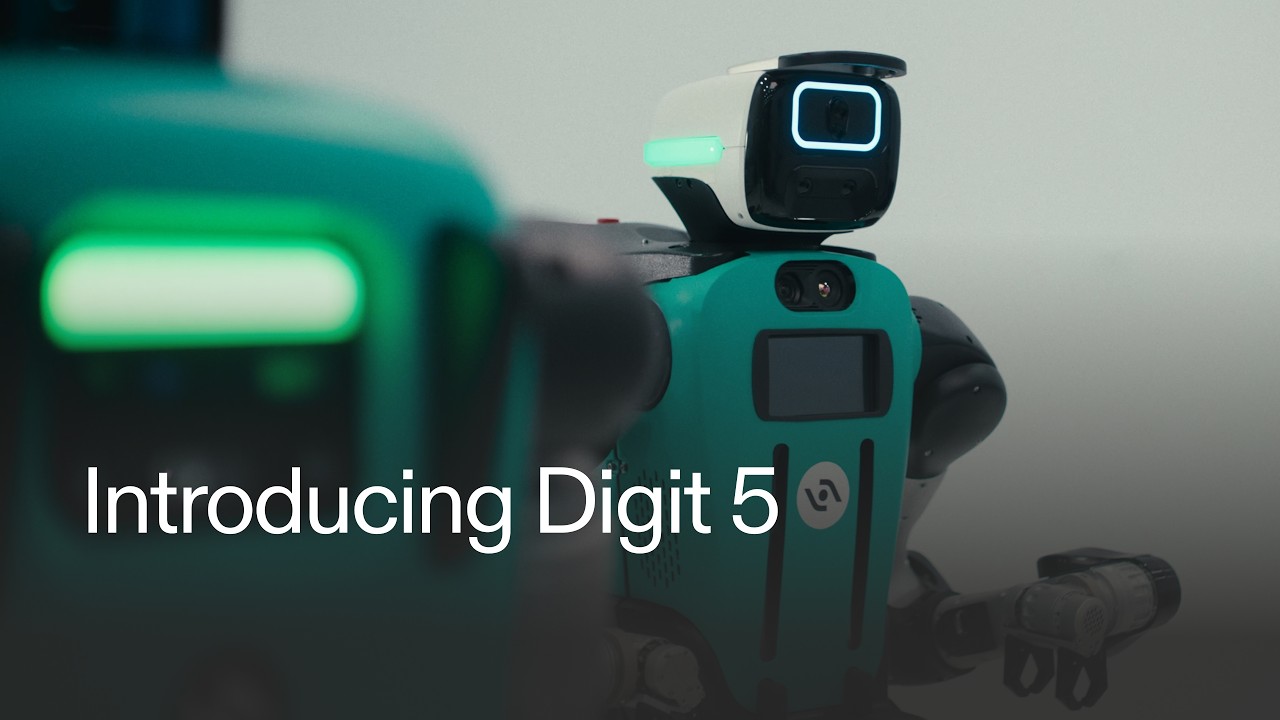
- Agility Robotics unveiled Digit 5 on September 15, a 5-foot-11-inch humanoid built to move materials alongside people in warehouses and manufacturing facilities.
- Proprietary cycloidal actuators in the redesigned joints raise payload capacity by 40 percent, letting the robot handle loads of up to 50 pounds repeatedly.
- A 90-minute battery paired with a nine-minute charging cycle could support more than 20 hours of work a day, provided the robot can regularly return to its charging dock.
Compiled by The Product DeskSomething wrong?How this is made
Why it matters
- decision Anyone underwriting the 20-hour day is underwriting dock placement, because 13 charge stops leave roughly nine minutes per cycle for the round trip to a charger.
- constraint Running the robot without barriers depends on a safety controller and certification pathway that Agility and Nvidia are still developing, so a 2027 deployment gets signed off by the site's own safety engineer.
- capability A machine that seats itself and cuts power gives a supervisor an approach procedure that can be written into a work instruction as a robot state.
- precedent Agility is helping write humanoid safety rules in three jurisdictions, so the terms it argues for become the baseline other vendors' customers inherit.
A picker walks down an aisle toward a 284-pound machine, and the machine sits down on its knee pads and shuts off its motors [2][8]. Cameras, depth sensors and inertial units let it make that call, along with the choice to change direction or stop where it is [11]. A site safety review will ask about that sequence.
Customers who ran Digit 4 across three years of deployments asked for a bigger payload, longer operating hours, and the ability to use the robot without physical barriers separating it from workers [4][5]. Agility redesigned the hardware, the power system and the safety architecture against that list [5].
The 20-hour day in the launch material is checkable with two numbers. The battery runs 90 minutes and recharges in nine [10][3]. Twenty hours of work is 1,200 minutes, or about 13 runs of the battery [1]. Thirteen charges of nine minutes each come to two hours, so work plus charging fills 22 of the day's 24 hours [2]. What is left is about nine minutes per cycle for the trip to the dock and back, plus any wait for a free charger [3]. Interesting Engineering's account makes the figure conditional on the robot returning to its dock regularly [10].
Payload rose 40 percent to a repeated 50-pound lift, which puts the previous generation near 36 pounds [7][4]. Fifty pounds is about 18 percent of what the robot itself weighs [5]. Agility gives the figure as a repeated lift, which is the form that compares against case weights on a line [2].
Digit 4's backward-bending, bird-like legs are gone. The new ones bend the way a person's do, so the robot can crouch and kneel to collect cargo without knocking its ankles into the floor [6]. Reach grew from 5.5 feet to 7.2 feet, an extra 1.7 feet, and the robot still fits through a standard doorway [9][6].
The barrier question is where the hardware stops. Agility says Digit 5 is the first humanoid designed to undergo a field evaluation against OSHA industrial safety standards, and no completed evaluation is reported [12][7]. Nvidia is the first launch partner on the safety stack, and the two companies are using Nvidia's IGX Thor and Halos for Robotics platforms to build a new safety controller and a certification pathway [14]. Agility is also taking part in humanoid safety standards work in the US, Canada and at ISO [13].
Conditional commitments passed $300 million as of May 2026, early access is planned for the first half of 2027, and wider availability follows later that year [18][19]. RoboFab, the company's 70,000-square-foot plant, can build up to 10,000 robots a year [20]. The report does not give a price, so the commitment total cannot be turned into a robot count [21].
The customer implied here already runs conveyors and autonomous mobile robots, since Agility Arc is what coordinates Digit with them [17]. For that buyer the test runs per task, in three columns: heaviest repeated lift, round-trip minutes to the nearest charger, and whether the task still works with a fence around it. The spec sheet answers the first two; the third sits with the safety controller Agility and Nvidia are still developing [14].
What to watch
- Whether the OSHA field evaluation is completed and published before early access opens in the first half of 2027.
- Whether Agility discloses a Digit 5 price, which would turn the $300 million in conditional commitments into a unit count.
- Whether the US, Canada and ISO standards work produces a rule on unfenced humanoid operation that a site safety engineer can cite.