Invest1 publisher3 min readPublished
Agility Robotics carries a going-concern warning into its $2.5 billion SPAC
The company says its Digit 5 humanoid can work safely beside people, holds more than $300 million of multiyear orders, and does not expect general availability until the end of 2027. It plans to list at $2.5 billion.
The Investor · Invest desk
What happened
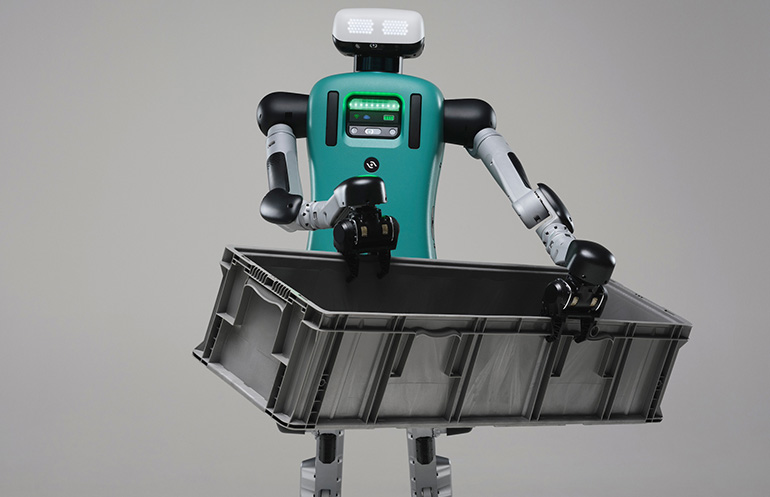
- Agility Robotics revealed Digit 5 on Tuesday, a 5-foot-11, 284-pound humanoid that reaches up to 7.2 feet and moves products with gripper hands.
- The company says an array of specialized sensors lets Digit 5 detect people nearby and slow its movements as they approach, which co-founder Jonathan Hurst calls the most consequential change.
- It intends to go public by the end of the year through a SPAC deal valuing it at $2.5 billion, which would make it the first US-listed company dedicated exclusively to humanoid robots.
Compiled by The InvestorSomething wrong?How this is made
Why it matters
- exposure Whoever buys the SPAC shares is financing survival on the company's own account of it, since the going-concern language assumes the deal closes.
- constraint With no humanoid-specific regulation in place, nobody outside Agility can grade the close-proximity claim, so insurers pricing cage-free deployments become the practical gatekeeper.
- decision Rival humanoid makers now have to decide whether to spend the redesign years Hurst describes or sell caged robots against a competitor that says it does not need a cage.
- contradiction The injury record looks small enough to make the risk sound priced, and the same source says the count is incomplete, so the base rate an underwriter would need does not exist yet.
The SPAC would value Agility at $2.5 billion, about 8.3 times the more than $300 million of multiyear orders it holds from customers including Amazon, Schaeffler and GXO Logistics [9][11][18]. The orders are described only as multiyear.
Early access to Digit 5 starts in the first half of 2027, with general availability at the end of 2027, roughly a year after the listing Agility intends to close by the end of this year [10][11][20].
The filing is blunter than the launch. Without the SPAC deal, Agility said it has "concluded there is substantial doubt about its ability to continue as a going concern," citing a history of operating losses and negative cash flows. It also said it needs "significant" additional capital that may require taking on debt [12][13]. Public shareholders would be funding the run to general availability.
"We've spent the past couple of years figuring out how to ensure that a balancing, dynamically stable robot that could fall on your foot, that can swing its arm, hit somebody in the head ... can actually be safely deployed in close proximity to people," Jonathan Hurst, Agility's co-founder and chief robot officer, told MarketWatch [5]. The engineering answer is an array of specialized sensors that detects people nearby and slows the robot as they get closer [6]. Agility did not say what that slowing costs in throughput. The Association for Advancing Automation says humanoids carry similar but potentially greater risks than traditional robots, with little in the way of tailored safety frameworks or regulation [16]. Agility is itself writing safety standards for third-party firms and insurers [7]. The first outside number on the claim will therefore come from an underwriter rather than a standards body.
The public injury record is thin. A study citing OSHA data counted 77 robot-related injuries in the United States between 2015 and 2022. Of those, 23 involved mobile robots and mostly hit workers' legs and feet [14]. That is about 30% of the total, or roughly 2.9 mobile-robot incidents a year [19]. The accounting is incomplete because there are no robot-specific safety standards to report against [15].
Last year a former head of safety at Figure AI sued the company, alleging retaliation after he warned that one of its robots could generate enough force to fracture a human skull. He cited an incident in which a robot narrowly avoided striking an employee and left a quarter-inch gash in a stainless-steel refrigerator door. Figure denied the allegations in a court filing [17].
Hurst said the safety work is a "major unlock" that competitors will need to pursue, and that he thinks it will take them a few years to redesign their robots [8]. I would price this equity on the cash bridge before the sensors: money in at close, volume revenue a year later, and a going-concern warning across the gap between them [12][10]. The counter-thesis is that taking the cage out changes how much of a warehouse floor one robot can reach. Amazon, Schaeffler and GXO have already run the previous generation, which was deployed at Amazon [2][9]. On that reading the $300 million is a floor. Conversion settles it. If those orders land as Digit 5 units on the first-half 2027 early-access schedule, the claim is worth what Agility says. If general availability slips past the end of 2027, Agility will be raising again before it has a fleet at scale [13].
What to watch
- How much primary cash the SPAC actually delivers to Agility at close, given a going-concern warning written on the assumption the deal completes.
- Whether any standards body publishes a humanoid-specific safety standard that Agility's close-proximity claim can be graded against.
- Whether the Amazon, Schaeffler and GXO orders convert into Digit 5 units on the early-access schedule or stay on the previous generation.