Science1 publisher3 min readPublished Updated
Experiments catch cracks creeping as flat patches long before the break
Yuval Paz, Jay Fineberg and colleagues watched two-dimensional broken patches creep for at least three quarters of a fracture event, a slow stage classical fracture mechanics was never built to describe.
The Scientist · Science desk
What happened
- Yuval Paz and Jay Fineberg of the Hebrew University of Jerusalem, with Meng Wang of the Beijing Institute of Technology and Mokhtar Adda-Bedia of CNRS and ENS de Lyon, report the work in Physical Review Letters.
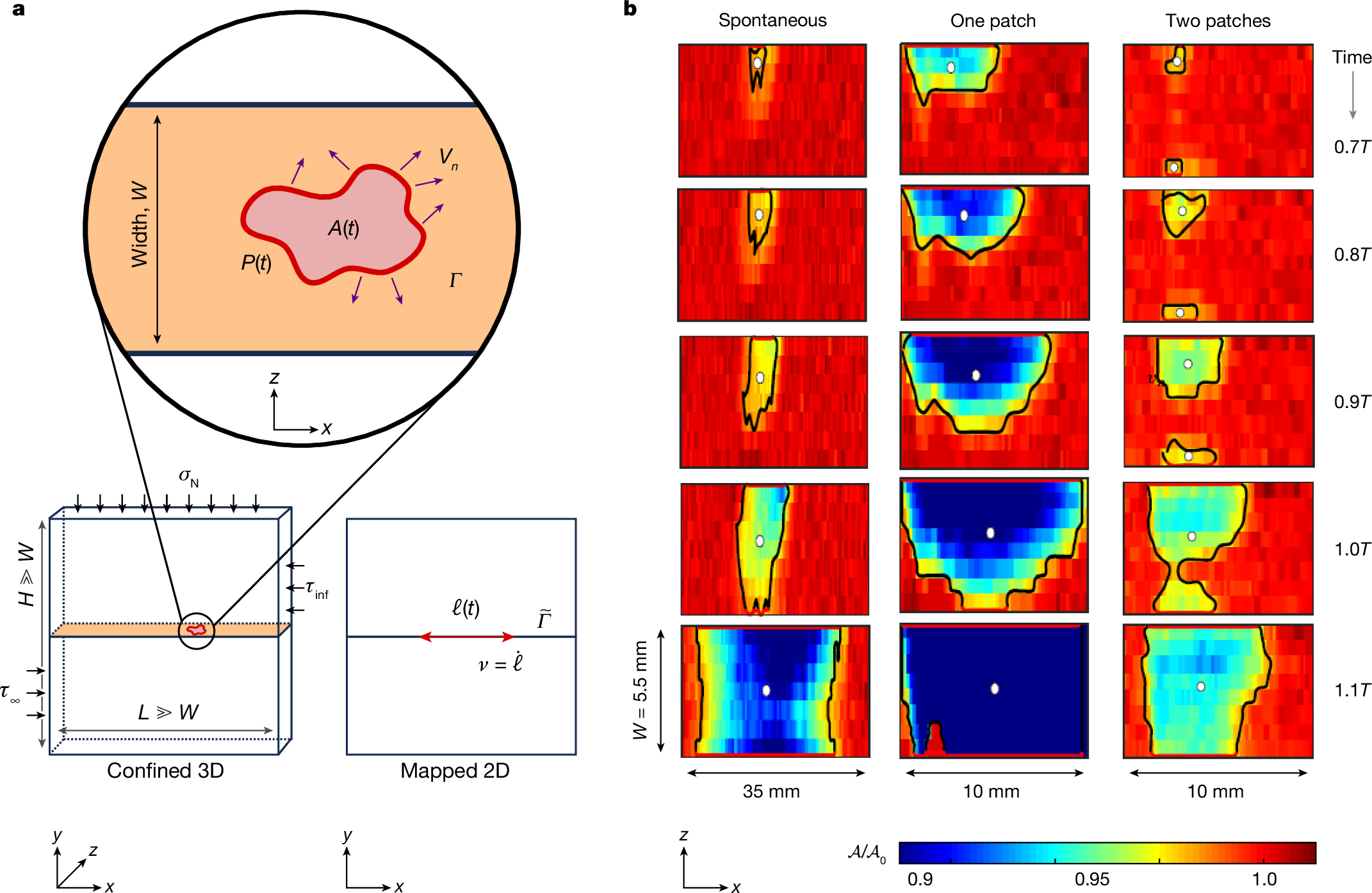
- In their account, fracture in a three-dimensional material begins when stress reaches a critical value and a broken region nucleates as a two-dimensional patch rather than the familiar line-shaped crack.
- High-speed imaging in a purpose-built system followed those patches from first appearance through creep at microns to millimetres per second and on to rupture.
- Once a patch grows to span the plate thickness it converts geometrically into a through-going crack, and only then does it accelerate explosively, finishing on microsecond-to-millisecond timescales.
- The classical Griffith length in these experiments was about 1 millimetre, but cracks were seen nucleating at roughly 0.1 millimetres, ten times smaller.
Compiled by The ScientistSomething wrong?How this is made
Why it matters
- constraint Inspection keyed to through-cracks at the millimetre scale is watching for the stage that ends in a millisecond, while the earliest visible feature sits inside the thickness at a tenth of that size.
- capability With initiation, creep and rupture under a single mechanical description, the slow stage becomes something engineers can model and instrument rather than scatter to be discounted before the real event.
- decision Anyone specifying structural health monitoring now has a sharper question to answer: whether the sensors resolve sub-millimetre subsurface patches, since through-crack detection buys very little warning.
- precedent Because the framework grows out of frictional rupture work, the staged sequence becomes the obvious thing to test against earthquake nucleation next.
Thickness is the variable doing the work. A broken patch inside a plate has a boundary free to grow in any direction along the plane it occupies; once it has eaten through the full thickness, its shape is a line, and lines are what linear elastic fracture mechanics knows how to accelerate [5][6]. The trigger for fast failure in these experiments is therefore a change of shape, not the arrival at a particular length [5][10].
That has an awkward consequence for anything you would want to inspect. The classical criterion points at a millimetre-scale feature, while the nucleation the team observed happened at about a tenth of that [11]. If the patches are geometrically similar, a tenth of the diameter is a hundredth of the area, so a method tuned to the Griffith scale is hunting something roughly a hundred times larger than the earliest thing there is to see [4].
Creep is also not one speed. Microns to millimetres per second spans a factor of about a thousand [2][2], which makes the slow stage a regime with its own internal spread rather than a rate you can put in a table. Take the slow end: growing a 0.1 mm feature at a micron per second is on the order of a hundred seconds, against a rupture that can be finished in a millisecond, about five orders of magnitude apart [3]. Counted against the rest of the event, the slow stage lasts at least three times as long as everything else combined [7][1].
The thing this does not tell you is which materials inherit the numbers. The published account is written in terms of plate thickness but names neither the material tested nor the specimen thickness [5], and the gap between a 0.1 mm nucleus and a 1 mm Griffith length is a measurement in one system rather than a constant to carry to a windscreen or a weld [11]. The authors describe the framework as an extension of classical fracture mechanics: past the geometrical transition, it returns to the LEFM behaviour that has always worked for fast cracks [9].
The detection argument sits at the same stage of maturity. The phys.org account of the work says understanding the slow stage could eventually change how researchers think about spotting failure before the final break [12], a research direction rather than a working instrument. So far a sub-millimetre subsurface patch has been found only in a purpose-built system with high-speed imaging pointed at it [4]. The earthquake connection is of the same kind: the framework grows out of work on frictional ruptures between sliding surfaces [13], a different setting from a plate under laboratory loading.
What the experiments do earn is narrower and still worth having. If most of a fracture proceeds at microns per second [7][2], a monitoring scheme that reports only through-cracks is reporting the last quarter of the process.
What to watch
- Whether the ratio between nucleation scale and Griffith length holds across other materials and thicknesses, which would show if 0.1 mm is system-specific.
- Whether anyone resolves a sub-millimetre subsurface patch in a working component rather than in a laboratory imaging rig.
- Whether the frictional rupture line of work reproduces the same initiation-creep-rupture sequence in fault-like geometries.