Published Security3 min read
Apple's spyware alerts reached 110 countries, and they land on people, not fleets
Apple's latest mercenary spyware notifications went to users in 110 countries. The response checklist is per-person, and a standard MDM baseline covers almost none of it.
Not a builder's beat, but builders have a standing stake in it.See today for builders
What happened
- Apple began sending a new wave of mercenary spyware threat notifications to iPhone users, with the alerts sent on August 13; Apple has issued such alerts since 2021 when it detects highly targeted attacks.
- Apple told TechCrunch that the latest round of threat notifications reached people in 110 countries.
- Apple states that its threat notifications are designed to inform and assist users who may have been individually targeted by mercenary spyware attacks, likely because of who they are or what they do.
- Apple says that since 2021 it has sent threat notifications multiple times a year and has to date notified users in over 150 countries in total.
- The 110 countries in the latest wave equal about 73 percent of the more than 150 countries Apple has notified cumulatively since 2021.
Compiled by The WatchSomething wrong?How this is made
Why it matters
Apple pushed another round of mercenary spyware threat notifications on 13 August, and told TechCrunch the alerts reached people in 110 countries [1][2]. The number is not the operational point. The point is the targeting model: Apple says these notifications go to users it believes were individually singled out, likely because of who they are or what they do [3].
Apple has notified users in more than 150 countries since the programme started in 2021 [4], so the latest wave alone touches roughly three quarters of the cumulative country count [5]. Apple describes the attacks as costing millions of dollars with a short shelf life, which makes them harder to detect and prevent [6], and says the vast majority of users will never be targeted [7]. The people who do get notified tend to be journalists, activists, politicians, diplomats and lawyers [8]. Per SC Media's summary of Bleeping Computer's reporting, Apple points to NSO Group's Pegasus as a historical example [9]; Malwarebytes describes the category as commercial surveillance vendors selling to government customers [10]. Apple itself attributes nothing to any attacker or region [11].
Sort the recommended response into two piles and the staffing problem becomes visible. The first pile is what a fleet policy already enforces: current software, a passcode with Touch ID or Face ID, two-factor authentication, Stolen Device Protection, App Store-only installs, strong unique passwords or passkeys, and suspicion of unexpected links [12]. If that is your whole answer, you have answered a different question.
The second pile is individual and mostly manual. Lockdown Mode has to be turned on, and Apple recommends it for recipients [13]. The notification has to be verified by signing in directly at account.apple.com, where a genuine alert appears at the top of the page [14]. The device has to be preserved, with resets and changes avoided until someone qualified has looked at it [15]. Outside help is expected: Apple points recipients to the Access Now Digital Security Helpline [16]. None of that is a configuration profile.
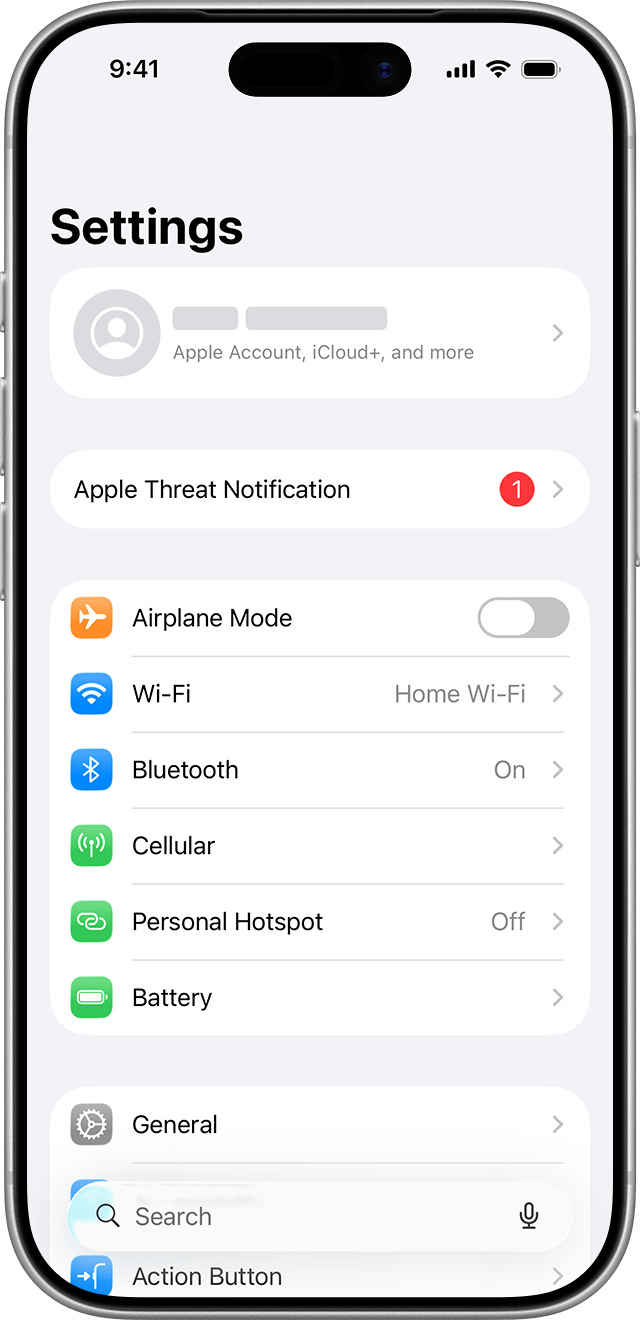
The delivery path compounds it. The alert now appears on the iPhone Lock Screen and in Settings, by email from [email protected], and as a banner in the user's Apple Account [17]. Every one of those channels terminates with the individual, on a personal account, which means a security team learns about it only if the person knows to escalate. Apple also declines to explain what triggered a notification, on the grounds that publishing detection logic would help vendors evade it [18], and says it relies solely on internal threat intelligence, cannot achieve absolute certainty, but treats the alerts as high confidence [19]. There is no indicator to sweep the fleet for. Security Affairs notes that a notification does not mean the recipient was fully compromised, only that Apple saw enough to treat the risk as credible [20].
Two reasons this is not purely someone else's problem. Citizen Lab's John Scott-Railton told TechCrunch that notifications can reveal that an entire community is being targeted [21], so one alert in a team is a question about the team. And Malwarebytes argues that techniques built for narrow operations spread, through reuse, onward sale, reverse engineering, copying by other vendors, and adaptation by criminal groups [22].
What to watch: whether anyone at your organisation has actually received one of these and told nobody; whether Lockdown Mode is tested against the workflows of your highest-exposure roles before it is needed; and who pays for forensics on a personal device when the answer cannot wait.
Claim ledger
Ranked by verification strength, evidence, and original report placement.
- [1]
Apple began sending a new wave of mercenary spyware threat notifications to iPhone users, with the alerts sent on August 13; Apple has issued such alerts since 2021 when it detects highly targeted attacks.
- [2]
Apple told TechCrunch that the latest round of threat notifications reached people in 110 countries.
- [3]
Apple states that its threat notifications are designed to inform and assist users who may have been individually targeted by mercenary spyware attacks, likely because of who they are or what they do.
- [4]
Apple says that since 2021 it has sent threat notifications multiple times a year and has to date notified users in over 150 countries in total.
- [6]
Apple says mercenary spyware attacks cost millions of dollars and often have a short shelf life, making them much harder to detect and prevent.
- [7]
Apple says the vast majority of users will never be targeted by mercenary spyware attacks, which apply exceptional resources against a very small number of specific individuals and their devices.
Sources & coverage · 3 publishers
The reporting this story was synthesized from, earliest first. Every link goes to the original.
- malwarebytes.comAug 14Apple now uses iPhone alerts for targets of mercenary spyware
- scworld.comSC StaffAug 14Apple warns users of mercenary spyware attacks on iPhones
- securityaffairs.comPierluigi PaganiniAug 14