Published · 3d agoScience3 min read
The skull is running a lymph node, and it has opinions about your brain tumour
Researchers report in Nature that mouse skull bone marrow holds germinal-centre-like lymphoid structures that respond to CNS antigens and help drive anti-tumour immunity.
Written for builders.See today for builders
What happened
- The authors identify lymphoid structures within skull bone marrow featuring germinal-centre-like formations and containing a distinct population of follicular-helper-like T cells that promote B cell activation and humoral immunity through CD40L, IL-21 and IFN-gamma signalling.
- Channels between the skull and the dura mater facilitate exchange of cerebrospinal fluid and immune cells between the CNS and skull bone marrow of mice under both homeostatic and disease conditions.
- Skull bone marrow is a primary lymphoid organ that supplies immune cells, including developing and immature B cells and myeloid cells, to the CNS and CNS border regions under homeostatic and neuroinflammatory or injurious conditions.
- The authors state that whether and how skull bone marrow contributes to CNS antigen recognition and immunosurveillance had not previously been elucidated.
- Adaptive immune cells within the skull bone marrow lymphoid structures surveil and respond to CNS-derived antigens.
Compiled by The ScientistSomething wrong?How this is made
Why it matters
A paper in Nature reports that the bone marrow of the mouse skull contains organised lymphoid structures, including germinal-centre-like formations, that surveil and respond to antigens derived from the central nervous system [1][5]. The consequence is a change of job description: the calvarium stops being a supply depot that ships immune cells toward the brain and becomes a place where antigen-specific decisions about the brain are partly taken [3][4].
The anatomy has been accumulating for a few years. Osseous channels connect skull marrow directly to the dura mater, letting cerebrospinal fluid and immune cells move between the CNS and skull marrow in mice under both homeostatic and disease conditions [2]. Skull marrow was already known as a primary lymphoid organ that supplies immune cells, including developing and immature B cells and myeloid cells, to the CNS and its border regions [3]. What was unclear, the authors write, is whether that traffic amounted to anything more than logistics [4].
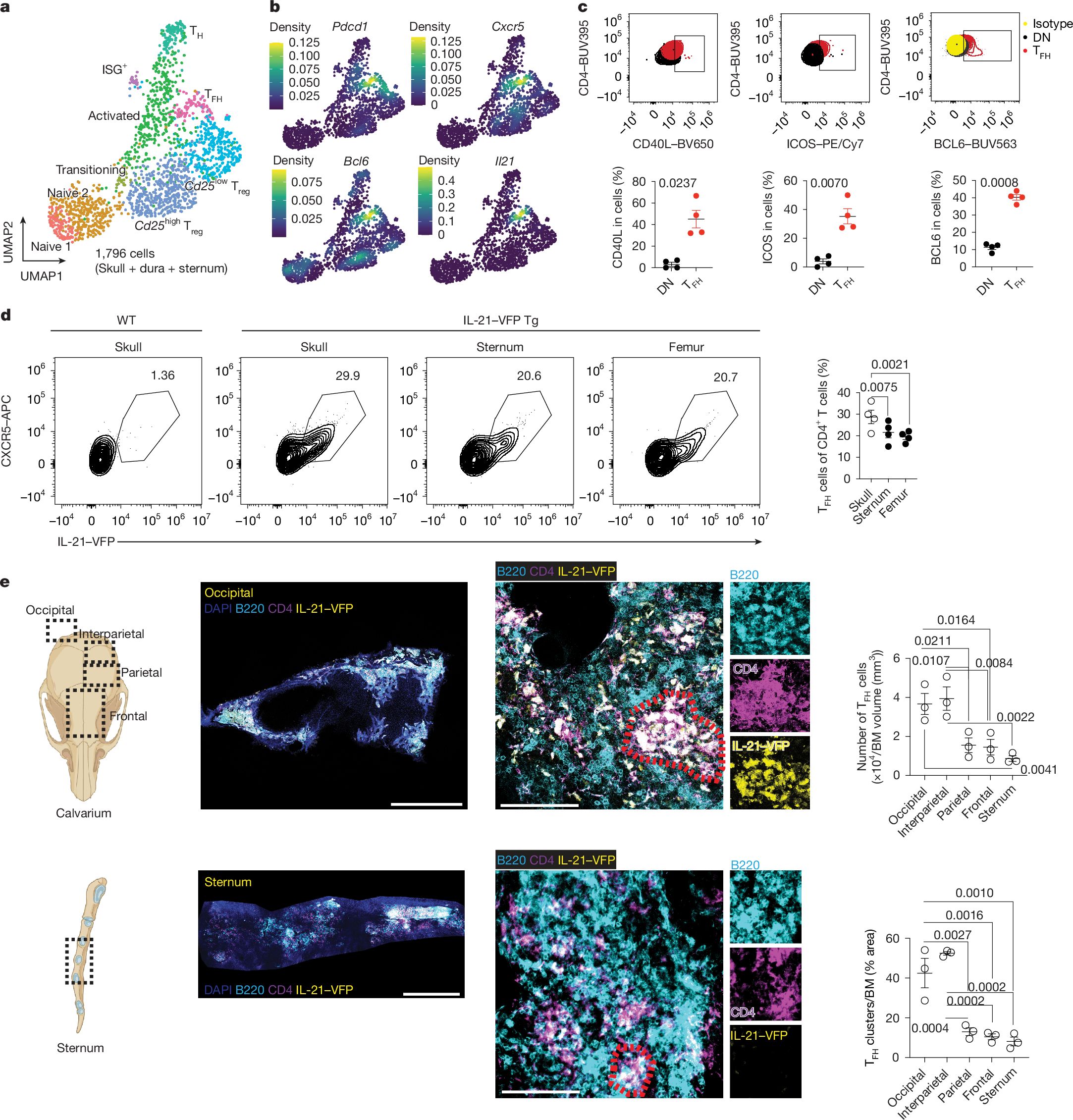
Their answer is that antigen-presenting cells, T cells and B cells form clusters with germinal-centre-like structures inside mouse skull marrow [5][6]. Within them sits a distinct population of follicular-helper-like T cells that promotes B cell activation and humoral immunity through CD40L, IL-21 and IFN-gamma signalling [1]. Single-cell RNA sequencing of T cells from mouse skull and sternum marrow turned up the expected CD4+ spread, from naive and activated through regulatory and differentiated helper subsets, plus follicular helper T cells marked by Pdcd1, Cxcr5, Bcl6 and Il21 [8]. Flow cytometry in IL-21-VFP reporter mice confirmed IL-21+CXCR5+ cells as a discrete subset, with CD4+ T cells the main source of IL-21 in marrow [9][10]. Skull marrow also carried a higher proportion of central memory T cells than other marrow sites, while overall T cell frequencies remained below those of secondary lymphoid organs [7][11].
The functional test is the part operators should care about. Modulating the presence and activity of these structures in vivo changed anti-tumour immunity in mouse brain cancer models, meaning the skull compartment is not merely correlated with the response but contributes to it [6][12]. That lines up with earlier reports of tumour-specific CD8+ T cells in the skull marrow of human glioblastoma patients and regulatory T cells in mouse tumour models [13]. If the skull is where anti-brain-tumour help gets licensed, it is a target in its own right, distinct from the tumour bed and from cervical lymph nodes.
Two cautions. Almost everything new here is mouse work; the human data point is prior literature, not this paper's own demonstration [14]. And the disease evidence presented is confined to brain cancer models, with the broader suggestion that skull marrow may influence responses across diverse neurological diseases stated as possibility rather than result [15]. Extending the mechanism to CNS autoimmunity is the obvious next hypothesis, and it is untested here.
Watch for whether calvarial marrow from human surgical samples shows the same clustered architecture, and whether blocking the named axis of CD40L, IL-21 and IFN-gamma degrades anti-tumour immunity or, in an autoimmune setting, protects [1][12].
Claim ledger
Ranked by verification strength, evidence, and original report placement.
- [1]
The authors identify lymphoid structures within skull bone marrow featuring germinal-centre-like formations and containing a distinct population of follicular-helper-like T cells that promote B cell activation and humoral immunity through CD40L, IL-21 and IFN-gamma signalling.
ReportedView cited source - [2]
Channels between the skull and the dura mater facilitate exchange of cerebrospinal fluid and immune cells between the CNS and skull bone marrow of mice under both homeostatic and disease conditions.
ReportedView cited source - [3]
Skull bone marrow is a primary lymphoid organ that supplies immune cells, including developing and immature B cells and myeloid cells, to the CNS and CNS border regions under homeostatic and neuroinflammatory or injurious conditions.
ReportedView cited source - [4]
The authors state that whether and how skull bone marrow contributes to CNS antigen recognition and immunosurveillance had not previously been elucidated.
ReportedView cited source - [5]
Adaptive immune cells within the skull bone marrow lymphoid structures surveil and respond to CNS-derived antigens.
ReportedView cited source - [6]
In mouse skull bone marrow, antigen-presenting cells, T cells and B cells form clusters with germinal centre-like structures, and these structures participate in CNS immune surveillance under homeostatic and brain cancer conditions.
ReportedView cited source
Sources & coverage · 3 publishers
The reporting this story was synthesized from, earliest first. Every link goes to the original.
- nature.comJonathan Kipnis4d agoFunctional role of skull lymphoid structures in CNS immunosurveillance
- newscientist.comCarissa Wong4d agoNewly-discovered immune hubs in our skull may keep our brain healthy
- genengnews.com