Published · 6d agoScience3 min read
The Milky Way's Oldest Known Meal: 39 Globular Clusters Push Its Merger Record Back 1.8 Billion Years
Hubble imaging and Gaia orbits separate a third population of ancient star clusters in the galaxy's inner regions, evidence of a dwarf galaxy swallowed about 11.8 billion years ago.
Written for builders.See today for builders
What happened
- New data from the NASA/ESA Hubble Space Telescope show definitive evidence of a dwarf galaxy merging with the young Milky Way galaxy in the earliest phases of its evolution.
- The results were published Monday in the journal Nature Astronomy.
- Davide Massari, of the Astrophysics and Space Science Observatory of Bologna in Italy, is the lead author of the study.
- Hubble uncovered definitive evidence of an earlier merger that occurred about 11.8 billion years ago, or just 2 billion years after the big bang.
- The finding extends knowledge of the Milky Way's history 1.8 billion years farther back in time than before.
Compiled by The ScientistSomething wrong?How this is made
Why it matters
A team led by Davide Massari of the Astrophysics and Space Science Observatory of Bologna reported in Nature Astronomy on Monday that NASA/ESA Hubble Space Telescope data show definitive evidence of a dwarf galaxy merging with the young Milky Way during the earliest phase of its evolution [s1c1][s1c2][s1c3]. The event dates to roughly 11.8 billion years ago, about 2 billion years after the Big Bang, which extends the documented record of Milky Way mergers 1.8 billion years farther back than before [s1c4][s1c5].
That number is not a coincidence of framing. The previous deepest confirmed merger was Gaia-Sausage-Enceladus, absorbed about 10 billion years ago, an event that substantially reshaped the galaxy's disk of stars [s1c6]. The newly dated merger sits 1.8 billion years earlier on the same clock [1]. The most recent massive merger, with the Sagittarius dwarf galaxy, began more than 6 billion years ago and is still in progress, with smaller mergers filling the interval between the two [s1c7][s1c8].
The method is archaeological rather than direct. The team analyzed Hubble observations of 39 globular clusters within the inner 20,000 light-years of the galaxy, the region where traces of the oldest mergers should survive [s1c9]. Globular clusters hold tens of thousands to a few million stars, include some of the oldest stars in the galaxy, and preserve stellar populations acquired from galaxies the Milky Way has eaten [s1c10]. According to co-author Chiara Zerbinati of the University of Bologna, the resolution and depth of the Hubble imaging allowed age and metal content to be measured with unprecedented precision, and combining that with Gaia measurements made it possible to isolate a cluster population distinct from the rest [s1c11].
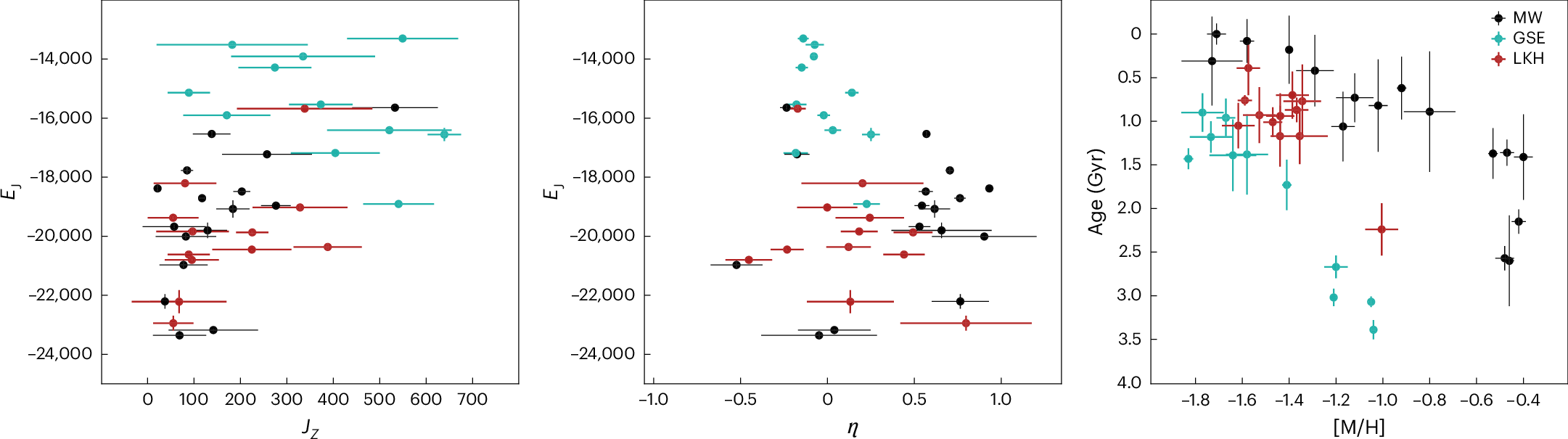
The discriminating result is an ordering, not a single measurement. Using cluster ages and metallicities, the abundance of elements heavier than helium, the team identified a third population in the inner galaxy that is older than the clusters acquired from Gaia-Sausage-Enceladus but younger than those born in the Milky Way itself, and that ordering holds regardless of metal content [s1c12]. Age-metallicity relations are the usual way to sort clusters by birthplace, so a group that refuses to fall on either existing sequence at any metallicity is hard to explain as a subset of either. The inferred progenitor held roughly 500 million solar masses in stars, which the team describes as a significant fraction of the Milky Way's mass at the time [s1c13]. They named it Low-energy-Kraken-Heracles, or LKH, after three earlier papers that argued for an early major merger [s1c14].
Massari's framing is that the paper identifies where the first significant batch of bricks in the galaxy came from [s1c15]. The caveat the researchers themselves raise is why this took so long: the young Milky Way was smaller, closer in size to the galaxies it collided with, and more chaotic, and the signatures of early mergers may have been erased over billions of years [s1c16]. Both observations and simulations had already suggested a large merger preceded the other two, but the specifics had been heavily debated [s1c17].
What to watch is whether independent spectroscopic abundances for these 39 clusters reproduce the three-population split, and whether the inferred 500-million-solar-mass progenitor is consistent with the chemistry of inner-galaxy field stars that should also have come from LKH [s1c9][s1c13].
Claim ledger
Ranked by verification strength, evidence, and original report placement.
- [s1c1]
New data from the NASA/ESA Hubble Space Telescope show definitive evidence of a dwarf galaxy merging with the young Milky Way galaxy in the earliest phases of its evolution.
ReportedView cited source - [s1c3]
Davide Massari, of the Astrophysics and Space Science Observatory of Bologna in Italy, is the lead author of the study.
ReportedView cited source - [s1c4]
Hubble uncovered definitive evidence of an earlier merger that occurred about 11.8 billion years ago, or just 2 billion years after the big bang.
ReportedView cited source - [s1c5]
The finding extends knowledge of the Milky Way's history 1.8 billion years farther back in time than before.
ReportedView cited source - [s1c6]
The Milky Way consumed the dwarf galaxy Gaia-Sausage-Enceladus 10 billion years ago, an ancient merger that greatly affected the structure of the galaxy's disk of stars.
ReportedView cited source
Sources & coverage · 3 publishers
The reporting this story was synthesized from, earliest first. Every link goes to the original.
- esa.int6d agoHubble & Gaia solve our galaxy's merger mystery