Published · 4d agoScience2 min read
Open weights, rented racks: the 1M in Qwen3.8-Max is context, not downloads
Alibaba's 2.4T-parameter open model activates 95B weights per token and accepts a million tokens of input. The licence is the cheap part; serving it still wants 72 GPUs in one NVLink domain.
Written for builders.See today for builders
What happened
- Alibaba released the open weights for Qwen3.8-2.4T-A95B (Qwen3.8-Max), its largest open-weight model, which NVIDIA says brings near-frontier capabilities to the open ecosystem.
- Qwen3.8-2.4T-A95B has 2.4T total parameters with 95B activated per token.
- The model is a fine-grained mixture-of-experts architecture with a hybrid of full and linear attention, a context window of up to one million tokens, and an output length of up to 128K.
- The model alternates full-attention layers, in which every token attends to every other token, with linear-attention layers in which the growing KV cache is replaced by a bounded recurrent state, keeping compute and memory bounded as context scales to one million tokens.
- A learned router activates only the experts needed per token, so serving costs track active parameters rather than the full 2.4T, delivering frontier-scale capacity at a fraction of the cost of a comparable dense model.
Compiled by The ScientistSomething wrong?How this is made
Why it matters
Alibaba has published open weights for Qwen3.8-2.4T-A95B, marketed as Qwen3.8-Max, which NVIDIA calls its largest open-weight model and describes as bringing near-frontier capability to the open ecosystem [1]. The million-plus figure that travels with this release is a context window, not a download counter: the model takes up to one million tokens of input and produces up to 128K of output [3]. Neither supplied source reports a download count for it [16], so an adoption number is not something this material can settle.
What the million turns on is architecture. The model alternates full-attention layers, where every token attends to every other token, with linear-attention layers that swap the growing KV cache for a bounded recurrent state, which is how compute and memory stay bounded as context scales [4]. The cost side is fine-grained mixture of experts: 2.4T total parameters, 95B activated per token [2], about 4 percent of the weights working on any given token [6]. NVIDIA's claim is that serving cost tracks active parameters rather than the full count, giving frontier-scale capacity for less than a comparable dense model [5].
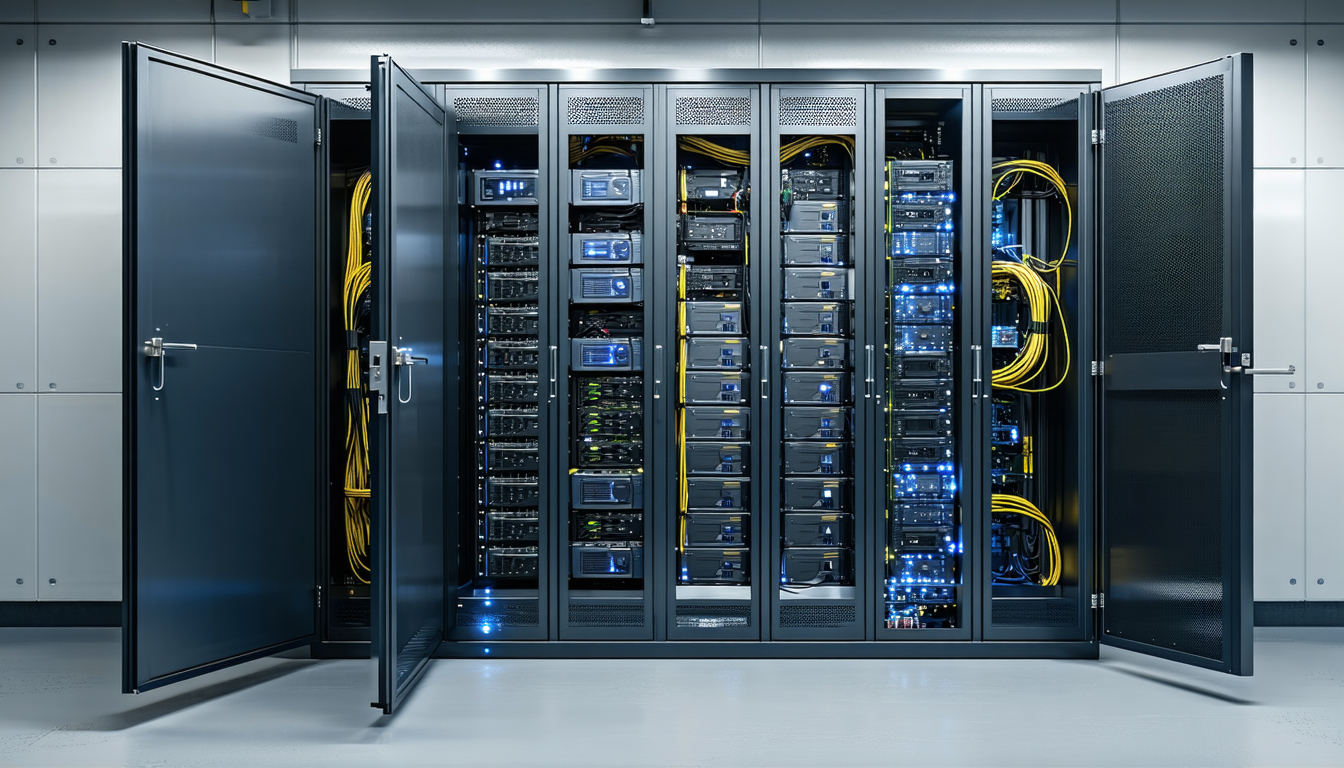
That is where the cheap tier stops being cheap. NVIDIA says deployment at this scale needs data-center-scale accelerated compute [7], and its Day 0 figures, over 4,000 tokens per second per GPU and over 350 tokens per second per user in FP8 with no extra tuning, are measured on GB300 NVL72 [8]: 72 Blackwell Ultra GPUs in a single NVLink domain with 130 TB/s all-to-all bandwidth, sized so expert traffic never crosses off-the-shelf networking [9]. Those two numbers imply roughly eleven concurrent user streams per GPU [10]. For buyers without a rack, NVIDIA points to hosted endpoints at DeepInfra, DigitalOcean, Fireworks AI, Modal and OpenRouter, with weights on Hugging Face and ModelScope [12].
Two things would move the figure. NVIDIA expects NVFP4 precision and further optimisation to raise throughput over time [18], and per-request reasoning depth controls at low, high and xhigh let operators trade compute for answer quality [11]. Whether "near-frontier" holds is a separate measurement: Artificial Analysis's Intelligence Index v4.1.1 aggregates nine evaluations weighted toward agentic tasks at 34 percent, with coding and scientific reasoning at 24 percent each [14], and claims a 95 percent confidence interval under one percent [15]. No score for this model appears in the material here [16].
Claim ledger
Ranked by verification strength, evidence, and original report placement.
- [1]
Alibaba released the open weights for Qwen3.8-2.4T-A95B (Qwen3.8-Max), its largest open-weight model, which NVIDIA says brings near-frontier capabilities to the open ecosystem.
- [2]
Qwen3.8-2.4T-A95B has 2.4T total parameters with 95B activated per token.
ReportedView cited source - [3]
The model is a fine-grained mixture-of-experts architecture with a hybrid of full and linear attention, a context window of up to one million tokens, and an output length of up to 128K.
ReportedView cited source - [4]
The model alternates full-attention layers, in which every token attends to every other token, with linear-attention layers in which the growing KV cache is replaced by a bounded recurrent state, keeping compute and memory bounded as context scales to one million tokens.
ReportedView cited source - [5]
A learned router activates only the experts needed per token, so serving costs track active parameters rather than the full 2.4T, delivering frontier-scale capacity at a fraction of the cost of a comparable dense model.
- [7]
Deploying a 2.4T parameter open-weight model requires data-center-scale accelerated compute, and inference at this scale depends on co-design across chips, system architecture and software.
Sources & coverage · 2 publishers
The reporting this story was synthesized from, earliest first. Every link goes to the original.
- artificialanalysis.ai4d agoIntelligence Benchmarking | Artificial Analysis
Additional citations
- NVIDIA Technical Blog
- Artificial Analysis