Published Science3 min read
In Chicago, the direction of tree cover tracked death rates better than the tree count
An 11-year study ties each percentage-point annual gain in canopy to roughly a 10% drop in mortality, which moves the budget question from planting counts to keeping mature trees alive.
Written for builders.See today for builders
What happened
- The study was published Aug. 5 in the journal GeoHealth.
- The study found it was not the number of trees in a neighborhood that was most strongly linked to residents' survival, but whether the overall tree canopy was shrinking or growing from one year to the next.
- Researchers combined annual satellite measurements of tree canopy for every Chicago census tract from 2011 through 2021 with mortality data, tracking canopy and deaths over 11 years.
- Each year-over-year percentage-point increase in canopy was tied to roughly a 10% drop in mortality, with the greatest reductions in cardiovascular, respiratory and mental health-related deaths.
- Neighborhoods that kept losing tree cover tended to see death rates climb, especially in the hottest parts of the city, while neighborhoods that kept gaining canopy saw death rates fall.
Compiled by The ScientistSomething wrong?How this is made
Why it matters
A study published Aug. 5 in the journal GeoHealth paired 11 years of annual satellite canopy measurements for every Chicago census tract with mortality records, and reported that what moved with death rates was whether a neighborhood's canopy was shrinking or growing from one year to the next, not how many trees it had [1][2][3]. That distinction matters because a planting count and a net canopy change are different numbers, and only the second one tracked mortality here [2].
The reported effect size is not marginal: each year-over-year percentage-point increase in canopy was tied to roughly a 10% drop in mortality, with the largest reductions in cardiovascular, respiratory and mental health-related deaths [4]. Tracts that kept losing cover tended to see death rates climb, most sharply in the hottest parts of the city, while tracts that kept gaining saw them fall [5].
The inputs were annual canopy for 2011 through 2021 plus more than 220,000 death records from state and city health departments, run through models that controlled for summer temperature, air pollution, income and residential segregation [3][6][7]. That is on the order of 20,000 deaths a year citywide, which is the sample density that makes a year-to-year panel feasible at tract level [8]. Neighborhoods were then grouped by degree of canopy cover to locate where loss and gain mattered most [9].
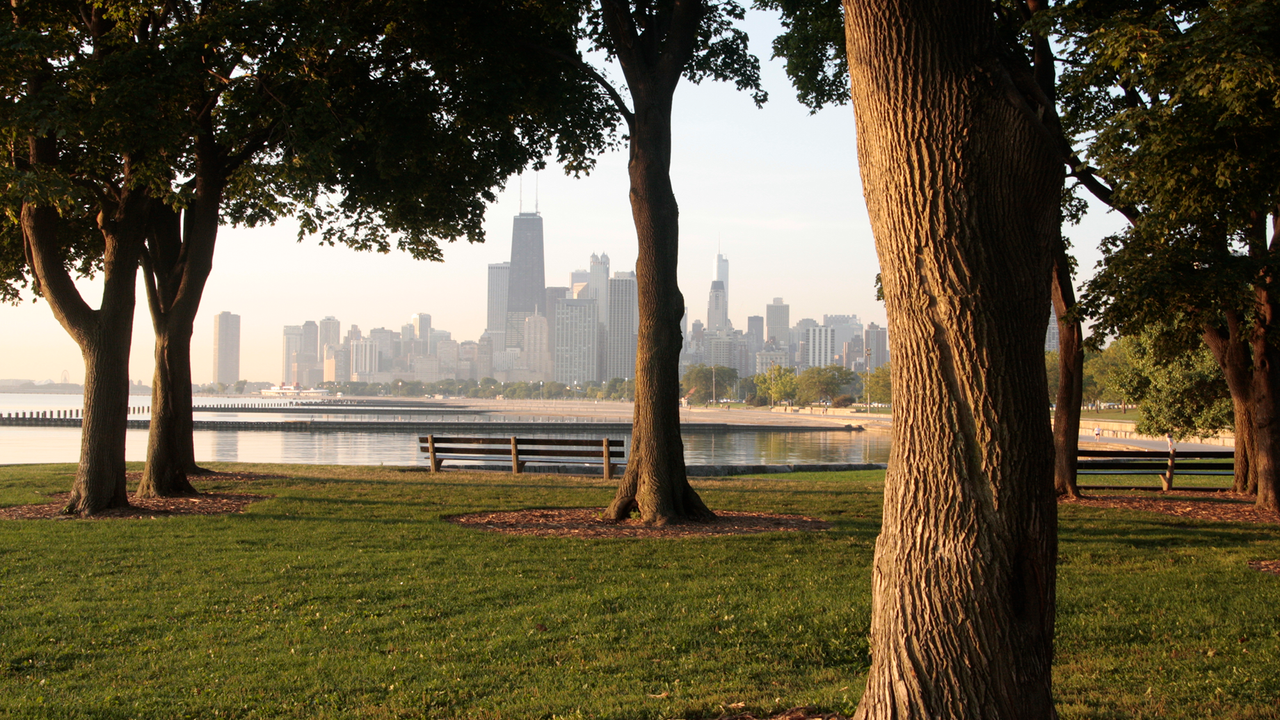
Geography followed Chicago's disinvestment map. The South Side and West Side had the steepest canopy losses, the hottest summers and the highest mortality, in some cases starting from above-average tree cover [10]. Lakefront neighborhoods stayed cooler and had lower mortality [11]. The starting-stock detail is the operational point: a tract can look well treed on a one-time inventory and still be on the losing side of the trend.
Shade does not appear to explain all of it, since canopy loss was associated with higher deaths across a range of conditions, not only heat-sensitive ones [12]. Vivek Shandas, a professor of urban studies and planning at Portland State University who was not involved in the work, told Live Science the contribution is mainly methodological, since much earlier work used a single snapshot of neighborhood greenery, including a 2022 analysis of heat-related mortality across dozens of U.S. cities [13][14]. He said the result "reinforces what we've found in other cities," noting that across 33 U.S. cities nearly three-quarters were losing greenery and the hottest neighborhoods were generally losing more [15].
The limits are real and the authors say so: this is an observational design that shows canopy change and mortality moving together, not one causing the other [16]. Shandas also noted that satellite measurements can miss newly planted trees and so understate canopy, where finer-resolution tools might catch small young crowns [17]. That caveat cuts directly at the maintenance interpretation. An instrument that cannot see a sapling will assign almost all measured change to the fate of large existing trees, which is part of why planting volume did not show up as the operative variable.
Watch whether the same annual-panel method reproduces in other cities, whether higher-resolution canopy products change the balance between planting and retention, and whether the non-heat mortality pathways get a mechanism. On the budget side, the testable consequence is unglamorous: pruning cycles, watering, storm response and removal-permit friction for mature trees are the line items this study implies are being undercounted. Co-author Harrison Garcia, a Northwestern medical student, said the project started with a walking tour of sparsely treed Chicago blocks [18].
Claim ledger
Ranked by verification strength, evidence, and original report placement.
- [1]
The study was published Aug. 5 in the journal GeoHealth.
- [2]
The study found it was not the number of trees in a neighborhood that was most strongly linked to residents' survival, but whether the overall tree canopy was shrinking or growing from one year to the next.
- [3]
Researchers combined annual satellite measurements of tree canopy for every Chicago census tract from 2011 through 2021 with mortality data, tracking canopy and deaths over 11 years.
- [4]
Each year-over-year percentage-point increase in canopy was tied to roughly a 10% drop in mortality, with the greatest reductions in cardiovascular, respiratory and mental health-related deaths.
- [5]
Neighborhoods that kept losing tree cover tended to see death rates climb, especially in the hottest parts of the city, while neighborhoods that kept gaining canopy saw death rates fall.
- [6]
The analysis used more than 220,000 death records from state and city health departments.
Sources & coverage · 1 publisher
The reporting this story was synthesized from, earliest first. Every link goes to the original.
- livescience.comOlivia MauleAug 13Saving old trees may protect people's health more than planting new ones, study of Chicago neighborhoods finds
Additional citations
- Live Science
- Live Science summary of the GeoHealth study
- Live Science, reporting the study's effect size
- Vivek Shandas, via Live Science
- Vivek Shandas, in an email to Live Science
- Live Science and Vivek Shandas
- Harrison Garcia, via Live Science