Published · 5d agoScience3 min read
A monkey's midfoot bends 46 degrees, and a tidy story about ancestral feet gets untidy
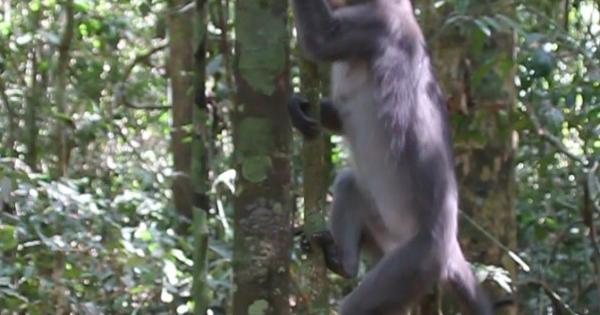
Ohio State researchers filmed wild sooty mangabeys climbing thin trunks in Ivory Coast. The measurement removes ankle anatomy as a clean way to sort what the human-chimp ancestor did in trees.
Written for builders.See today for builders
What happened
- Researchers from The Ohio State University observed wild sooty mangabey monkeys and confirmed through measurements that the monkeys display foot-bone flexibility facilitating vertical climbing up thin tree trunks.
- First author Luke Fannin recorded videos of mangabeys in the wild at the Tai Forest Monkey Project field station in Ivory Coast.
- Fannin found that the mangabey foot flexes 46 degrees at its midfoot during a vertical climb.
- Video evidence from West Africa suggests there may be no distinction between trunk climbers and full-time treetop dwellers, at least based on foot structure.
- The study makes the point that even if the last common ancestor had a more monkey-like foot morphology, it could still climb like an ape.
Compiled by The ScientistSomething wrong?How this is made
Why it matters
Researchers from The Ohio State University filmed wild sooty mangabeys climbing thin tree trunks at the Tai Forest Monkey Project field station in Ivory Coast and measured 46 degrees of flexion at the monkeys' midfoot during the ascent, in a paper published this week in the Proceedings of the National Academy of Sciences [1][2][3]. The operational consequence is that foot bones stop working as a sorting key: the last common ancestor of humans and chimpanzees can no longer be assigned to trunk climbing or full-time treetop life on the strength of ankle morphology alone [4][5].
The setup for that inference was a contrast between two joints. A chimpanzee ankle can flex upward about 45 degrees during a climb, against roughly 20 degrees for most human ankles, and that flexion is why chimps are treated as the model trunk climber [6][7]. Monkeys, by contrast, have been assumed to move through trees mainly with their arms [8], which pushed the fossil question toward a binary: was the ancestor reaching high branches from the ground, or living among them, or both [9]?
Sooty mangabeys are known to lack the versatile chimp-like ankle, yet the videos show them using foot-bone flexibility to climb vertically up thin trunks to hide, forage or sleep [2][10]. "People are making behavioral inferences from fossils, and some say a monkey can't vertically climb as well as an ape can," said first author Luke Fannin, an assistant professor of anthropology at Ohio State. "We're saying there's a functional equivalence here" [11][12].
Note what kind of equivalence that is. The 45 degrees is chimpanzee ankle flexion and the 46 degrees is mangabey midfoot flexion, so the near-identical figures describe different joints doing comparable work rather than the same anatomy [6][3]. That is the paper's point, not a weakness in it, but it means the takeaway is about function, not a ranking of feet. Senior author W. Scott McGraw, professor and chair of anthropology at Ohio State and co-director of the Tai field station, framed the video as the source of the precision: "Before, we had hunches, but in this way, it's far more precise" [13][14][15]. He also called the result clarifying and blurring at once, since competent vertical climbers that are not extinct and can be filmed undercut the idea that an advanced ape foot is required for the behavior [16][17].
The phys.org account does not report how many individual mangabeys or how many climbing bouts were measured, which matters for anyone weighing 46 degrees as a species-level number [18]. The soft-tissue caveat runs the same direction: modern hunter-gatherers and foragers who climb vertically are thought to do it through flexibility in ligaments, tendons and muscles rather than through foot bones [19]. Ligaments do not fossilize, so a skeletal foot underdetermines behavior in both directions.
Humans and chimpanzees separated 6 million to 7 million years ago [20], and identifying the ancestor is treated as central to explaining habitual bipedalism, which only humans have [21]. What to watch is whether the kinematic method travels: whether other monkey taxa filmed in the wild show the same midfoot loading, whether the underlying joint-loading data are detailed enough for other labs to reproduce, and whether reconstructions built on ape-like versus monkey-like ancestral feet [22] are restated as claims about soft tissue and behavior instead of bone shape.
Claim ledger
Ranked by verification strength, evidence, and original report placement.
- [1]
Researchers from The Ohio State University observed wild sooty mangabey monkeys and confirmed through measurements that the monkeys display foot-bone flexibility facilitating vertical climbing up thin tree trunks.
ReportedView cited source - [2]
First author Luke Fannin recorded videos of mangabeys in the wild at the Tai Forest Monkey Project field station in Ivory Coast.
ReportedView cited source - [3]
Fannin found that the mangabey foot flexes 46 degrees at its midfoot during a vertical climb.
ReportedView cited source - [4]
Video evidence from West Africa suggests there may be no distinction between trunk climbers and full-time treetop dwellers, at least based on foot structure.
ReportedView cited source - [5]
The study makes the point that even if the last common ancestor had a more monkey-like foot morphology, it could still climb like an ape.
ReportedView cited source - [6]
The chimpanzee ankle can flex upward at a 45-degree angle during a tree climb, compared with most human ankles' capacity to flex about 20 degrees.
ReportedView cited source
Sources & coverage · 2 publishers
The reporting this story was synthesized from, earliest first. Every link goes to the original.
- phys.org5d agoLast common ancestor of humans and chimpanzees could have been a vertical climber, no matter its feet
Cited in this coverage: Luke Fannin, Ohio State, quoted by phys.org
Cited in this coverage: W. Scott McGraw, quoted by phys.org
- discovermagazine.com4d agoLast Common Ancestor of Humans and Chimpanzees May Have Been a Skilled Tree Climber