Published Product3 min read
Wildfire smoke gets a unit: 106 million person-days of unhealthy air in three days
A UN University incident brief counts July's Canadian smoke as exposure rather than describing it, which is the form a continuity budget can actually use.
Not a builder's beat, but builders have a standing stake in it.See today for builders
What happened
- Smoke from Canada's July wildfires exposed people across Canada and the United States to unhealthy, very unhealthy or hazardous air for nearly 106 million person-days between July 15 and 17, per an incident brief published by the United Nations University Institute for Water, Environment and Health (UNU-INWEH) titled "The July 2026 Wildfires in Canada and Their Transboundary Smoke Problem".
- Person-days are defined as the number of people exposed multiplied by the number of days they were exposed.
- Over the peak impact period of July 13 to 18, moderate or worse air quality accounted for more than 769 million person-days.
- The unhealthy-or-worse exposure averages roughly 35 million people per day over the three-day July 15-17 window.
- The moderate-or-worse exposure averages roughly 128 million people per day over the six-day July 13-18 window.
Compiled by The Product DeskSomething wrong?How this is made
Why it matters
The United Nations University Institute for Water, Environment and Health has published an incident brief on Canada's July 2026 wildfires that counts smoke exposure instead of characterising it: nearly 106 million person-days of unhealthy, very unhealthy or hazardous air across Canada and the United States between July 15 and 17 [1]. For operators who have had to defend an air-quality policy to a finance committee, the unit is more useful than the headline number.
Person-days is people exposed multiplied by days exposed [2]. Over the wider peak window of July 13 to 18, moderate-or-worse air accounted for more than 769 million person-days [3]. Divide by the window length and the daily averages emerge: roughly 35 million people a day at unhealthy or worse [4], roughly 128 million a day at moderate or worse [5]. The moderate-or-worse total is about 7.3 times the unhealthy-or-worse total [6]. That ratio is the operationally interesting part. The population you would tell to stay indoors is a small fraction of the population whose working day you have quietly degraded, and most air-quality planning is written only for the first group.
The method is stated plainly: satellite-derived fire perimeters paired with ground-based air quality readings, overlaid on gridded population maps [7]. It is the institute's third incident brief on North American fires, after the January 2025 Los Angeles fires and the May to June 2025 Central Canada fires [8]. Three briefs on a consistent method is the beginning of a comparable series, which is what turns a number into a baseline.
The supply side moved fast. On June 28, Canada had burned more than 1.2 million hectares less than its 10-year average for the date [9]; by July 21 that deficit had become a surplus of 367,000 hectares [10], a swing of about 1.57 million hectares [11]. Nationally, 3,915 fires had burned nearly 3.04 million hectares, the third-largest total for that point in the year behind 2023 and 2025 [12]. Ontario supplied 565 fires and more than 728,000 hectares, about three and a half times its 10-year average [13], roughly 24 percent of the national area burned [14]. Southwest Ontario had taken more than two standard deviations less rain than usual over the previous two months, with temperatures more than 2C above average [15].
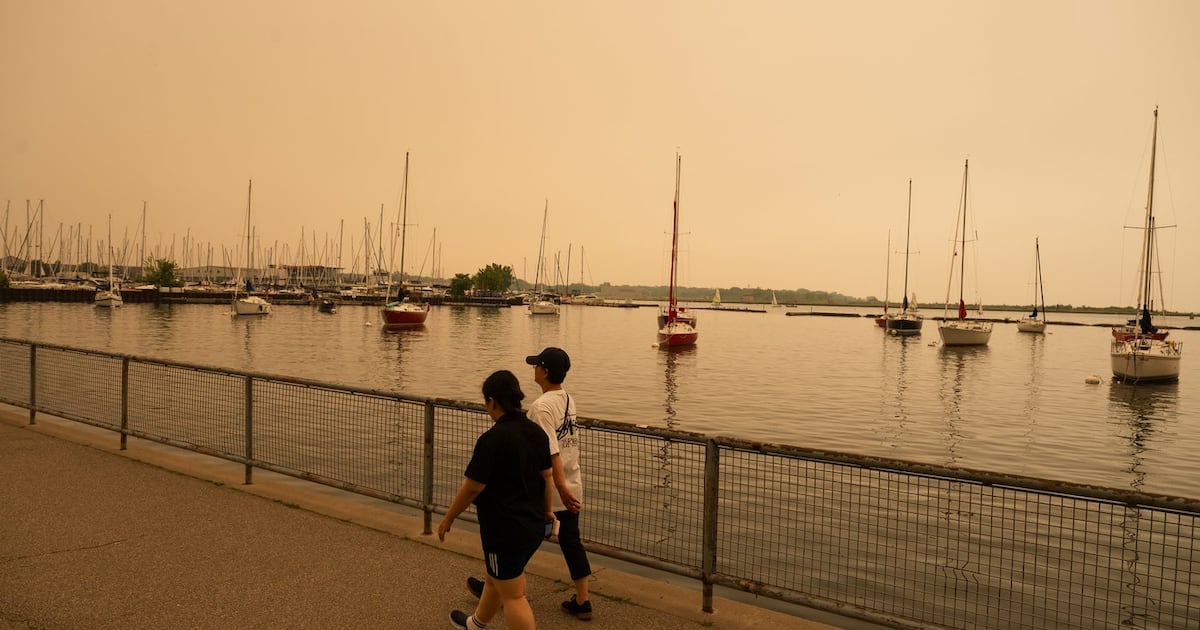
Downstream, the disruption looks like schedule risk. Toronto recorded the poorest air quality of any major city in the world for a period [16]. Smoke degraded air in Detroit, Minneapolis, Milwaukee, Chicago, New York City and Washington [17]. Officials in numerous states advised residents to stay indoors and limit outdoor exercise, with specific warnings for children, older adults and people with respiratory or cardiovascular conditions [18]. Some cities cancelled public events or moved them inside [19]. Canadian National Railway operations halted for a time [20].
Closer to the fires the cost was displacement, concentrated on Indigenous communities: more than 3,500 First Nations residents displaced nationally by mid-July [21], as many as 11 Ontario First Nations under evacuation [22], about 1,800 residents out of remote northwestern communities [23]. Ontario requested federal assistance including the Canadian Armed Forces to reach places accessible only by air or water [24]. In Namaygoosisagagun First Nation, residents escaped by boat as the fire destroyed the community [25].
Watch three things. Whether the next brief holds the same person-day definition, because the series is only worth anything if the denominator does not move. Whether the friction the brief reports between Canada and the United States over transboundary smoke [26] degrades the coordinated firefighting and cross-border health planning it argues for [27]. And whether provinces act on its call to strengthen evacuation preparedness and shelter capacity in remote communities [28].
Claim ledger
Ranked by verification strength, evidence, and original report placement.
- [1]
Smoke from Canada's July wildfires exposed people across Canada and the United States to unhealthy, very unhealthy or hazardous air for nearly 106 million person-days between July 15 and 17, per an incident brief published by the United Nations University Institute for Water, Environment and Health (UNU-INWEH) titled "The July 2026 Wildfires in Canada and Their Transboundary Smoke Problem".
- [2]
Person-days are defined as the number of people exposed multiplied by the number of days they were exposed.
ReportedView cited source - [3]
Over the peak impact period of July 13 to 18, moderate or worse air quality accounted for more than 769 million person-days.
ReportedView cited source - [7]
The analysis pairs satellite-derived fire perimeters with ground-based air quality readings, overlaid on gridded population maps.
ReportedView cited source - [8]
It is the third incident brief the institute has published on North American fires, after assessments of the January 2025 Los Angeles fires and the May to June 2025 Central Canada fires.
ReportedView cited source - [9]
By June 28, Canada had burned more than 1.2 million hectares less than its 10-year average for the date.
ReportedView cited source
Sources & coverage · 1 publisher
The reporting this story was synthesized from, earliest first. Every link goes to the original.
Cited in this coverage: UNU-INWEH incident brief, via phys.org
Additional citations
- UNU-INWEH incident brief
- Dr. Mojtaba Sadegh, UNU-INWEH