Published Product3 min read
Sixteen million lidar shots against the idea of one pantropical carbon curve
A Nature study of GEDI biomass estimates finds the Congo Basin, the Amazon and Southeast Asia respond differently to the same heat and aridity gradients. Pooled models must be wrong somewhere.
Not a builder's beat, but builders have a standing stake in it.See today for builders
What happened
- In a study published in Nature, researchers affiliated with the Smithsonian Tropical Research Institute, the University of Maryland, NASA and the Universidade Federal dos Vales do Jequitinhonha e Mucuri (Brazil) analysed 16 million 2020 NASA-GEDI satellite estimates of aboveground biomass from forests in the Amazon, the Congo Basin and Southeast Asia.
- The researchers found that the effects of temperature, aridity, soil nutrients and other environmental variables on forest biomass differ from place to place.
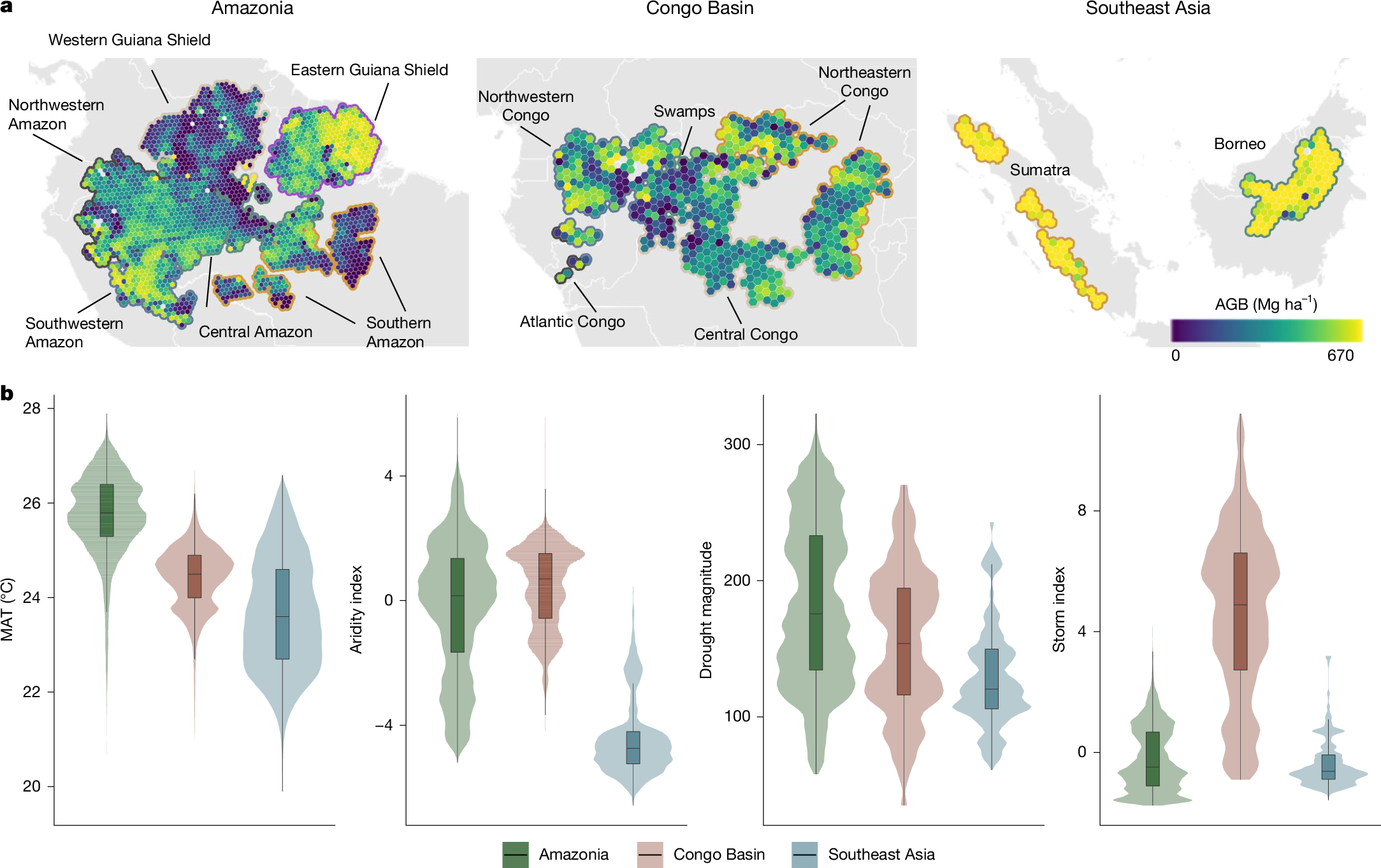
- In general, sites with higher temperatures tended to have lower biomass, with marked regional differences: forests in Africa's Congo Basin were particularly sensitive to temperature, Amazonian forests were moderately sensitive, and Southeast Asian forests were relatively insensitive.
- Water limitation was most important in Southeast Asia, where biomass decreased strongly at more arid sites, while Amazonian forests showed peak biomass at intermediate aridity and African forests were relatively insensitive to aridity.
- Across regions, the effects of different climate variables were further modified by soils and landscape features.
Compiled by The Product DeskSomething wrong?How this is made
Why it matters
Researchers affiliated with the Smithsonian Tropical Research Institute, the University of Maryland, NASA and Brazil's Universidade Federal dos Vales do Jequitinhonha e Mucuri analysed 16 million NASA-GEDI satellite estimates of aboveground biomass from 2020 across the Amazon, the Congo Basin and Southeast Asia, and reported in Nature that temperature, aridity, soil nutrients and other environmental variables act on biomass differently from place to place [1][2]. If your carbon accounting rests on one fitted relationship between climate and biomass applied across the tropics, that is a specification error rather than a footnote [1].
Take the two headline gradients. Hotter sites generally held less biomass, but the sensitivity ranking was Congo Basin (particularly sensitive), then the Amazon (moderately), then Southeast Asia (relatively insensitive) [3]. Water limitation inverted the order: it mattered most in Southeast Asia, where biomass fell sharply at more arid sites, while Amazonian forests peaked at intermediate aridity and African forests were relatively insensitive to aridity [4]. Those three aridity responses are not three settings of one curve. A monotonic decline, a hump, and a flat line cannot be reproduced by a single pantropical function, so any pooled fit is mis-specified in at least two of the three basins [1]. On temperature, a pooled coefficient is a weighted average of the regional ones, which means it necessarily overstates Southeast Asia's response and understates the Congo Basin's [2].
The modifiers make pooling worse, not better. Climate effects were themselves conditioned by soils and landscape features across all regions [5], and in the tallest forests, where trees exceed 70 metres, the authors suggest storm damage from lightning and windthrow may be the dominant drag on biomass [6]. Structure is not incidental either: lightweight-wood trees such as balsa store far less carbon than dense hardwoods like rosewood or ebony, and which of those a hectare contains depends on soil and whether the ground is flat, mountainous, dry or swampy [13].
What this settles is worth separating from what it does not. The authors argue the results resolve earlier conflicting findings on biomass patterns by showing the disagreement partly reflects real biological variation rather than methodological differences [7]. Co-author Helene Muller-Landau of STRI says the study "definitively shows that tropical forests on different continents respond differently to climate" [8], and attributes the divergence to enduring legacies of Africa's drier and Southeast Asia's wetter climatic histories [9]. STRI paleobiologist Carlos Jaramillo makes the same point on geological timescales [12]. Lead author Matheus Nunes of Maryland goes further on method, arguing global analyses are not enough and that local analysis and local experts are needed to predict climate effects [10].
Two limits operators should hold onto. The published summary reports orderings of sensitivity, not slopes, so it tells you a pooled model is biased without telling you by how much [3][4]. And this is a single year of footprints compared across sites, a spatial substitution for time rather than an observed response to warming [3].
Watch whether biomass map producers and methodology writers move to region-specific fits, and watch the plot networks that would validate them: the source flags GEO-TREES as a new network measuring forest carbon with consistent methods across sites [14]. GEDI itself is the constraint that made the comparison possible, using laser pulses to tie three-dimensional structure to climate, soils and topography [11].
Claim ledger
Ranked by verification strength, evidence, and original report placement.
- [1]
In a study published in Nature, researchers affiliated with the Smithsonian Tropical Research Institute, the University of Maryland, NASA and the Universidade Federal dos Vales do Jequitinhonha e Mucuri (Brazil) analysed 16 million 2020 NASA-GEDI satellite estimates of aboveground biomass from forests in the Amazon, the Congo Basin and Southeast Asia.
ReportedView cited source - [2]
The researchers found that the effects of temperature, aridity, soil nutrients and other environmental variables on forest biomass differ from place to place.
ReportedView cited source - [3]
In general, sites with higher temperatures tended to have lower biomass, with marked regional differences: forests in Africa's Congo Basin were particularly sensitive to temperature, Amazonian forests were moderately sensitive, and Southeast Asian forests were relatively insensitive.
ReportedView cited source - [4]
Water limitation was most important in Southeast Asia, where biomass decreased strongly at more arid sites, while Amazonian forests showed peak biomass at intermediate aridity and African forests were relatively insensitive to aridity.
ReportedView cited source - [5]
Across regions, the effects of different climate variables were further modified by soils and landscape features.
ReportedView cited source - [6]
In the tallest forests, where trees grow to more than 70 metres (about 230 feet), storms including lightning and windthrow may be the most important factors reducing forest biomass.
ReportedView cited source
Sources & coverage · 1 publisher
The reporting this story was synthesized from, earliest first. Every link goes to the original.
Additional citations
- Helene Muller-Landau, STRI
- Matheus Nunes, University of Maryland / NASA GEDI
- Carlos Jaramillo, STRI