Published Product3 min read
Nvidia wants compute to be collateral, which moves the supply constraint from fabs to credit desks
MOUs with six large asset managers aim to mobilize more than $500 billion for AI factories. Nothing is funded yet, but the underwriting model already changes who sets compute prices.
Not a builder's beat, but builders have a standing stake in it.See today for builders
What happened
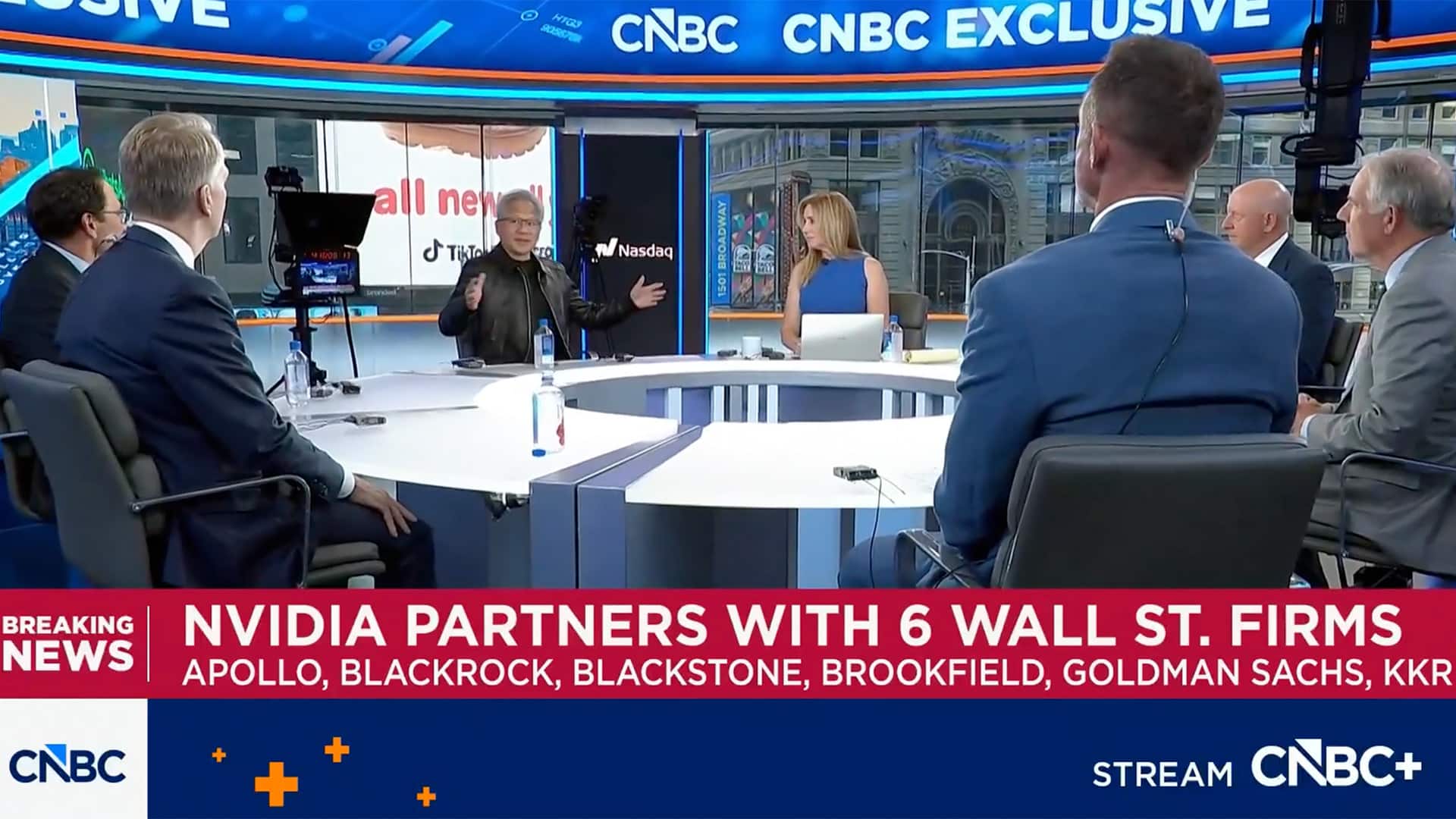
- Nvidia signed memorandums of understanding with Apollo, BlackRock, Blackstone, Brookfield, Goldman Sachs and KKR to establish independent financing platforms designed to mobilize more than $500 billion of third-party capital for AI infrastructure over time.
- The announcement is not a funded $500 billion pool today, and the final agreements still have to be completed.
- The $500 billion figure is not Nvidia revenue, not one funded pool, and not an immediate commitment to specific customers or projects.
- Today many AI factories are financed one company and one project at a time, with builders using some combination of corporate debt, customer prepayments, asset-backed loans, equity and vendor financing.
- The idea is to bring long-duration institutional capital into the market and underwrite AI factories against customer commitments, utilization, cash flow and the expected residual value of the installed compute.
Compiled by The Product DeskSomething wrong?How this is made
Why it matters
Nvidia has signed memorandums of understanding with Apollo, BlackRock, Blackstone, Brookfield, Goldman Sachs and KKR to establish independent financing platforms designed to mobilize more than $500 billion of third-party capital for AI infrastructure over time [1]. That is six of the largest pools of institutional capital in one announcement [7], and if the memorandums become definitive agreements, the binding constraint on compute supply shifts from wafer output to what a credit committee will underwrite.
Start with what was not announced. This is not a funded $500 billion pool, not Nvidia revenue, not a commitment to specific customers or projects, and the final agreements have not been completed [2][3]. What exists is a design intent, and the intent is the interesting part.
Today most AI factories are financed one company and one project at a time, using some mix of corporate debt, customer prepayments, asset-backed loans, equity and vendor financing [4]. Nvidia is trying to make that process repeatable by bringing long-duration institutional capital in and underwriting AI factories against customer commitments, utilization, cash flow and the expected residual value of the installed compute [5]. Goldman Sachs described the goal as creating "a market for credit backed by Nvidia compute" [6]. SiliconANGLE's read is blunt: the AI chip cycle is becoming a credit cycle [8].
For anyone buying capacity, the consequence is in that list of four underwriting inputs. If lenders are asked to advance against customer commitments and utilization, the customer's signature is part of the collateral. Expect the market to price shorter, more flexible contracts as more expensive than long take-or-pay style commitments, because only the latter is financeable at scale. Residual value is the other exposed assumption: SiliconANGLE flags Nvidia's residual-value support as an important tell in the announcement [9], which is another way of saying someone has to hold the depreciation curve on aging silicon, and the vendor is being asked to sit closer to that risk than a vendor normally does.
None of this removes risk. By SiliconANGLE's account it changes who holds the risk, how it is financed and how widely the exposure is spread [10]. The same demand assumptions would then connect semiconductor suppliers, neoclouds, data-center developers, utilities, private-credit funds, infrastructure investors and governments, so a failure in one part may no longer stay contained [11][12]. The publication's prior thesis is that the capital bubble pops when deployable supply grows faster than monetizable demand and financing stops bridging the gap [13]. This structure attacks the financing link, not the demand link. As the piece puts it, independent capital is not independent demand [14].
What to watch. First, conversion: whether the memorandums turn into completed agreements, with what advance rates and residual-value terms, and whether Nvidia's support is a backstop or a marketing line [2][9]. Second, contract shape: whether capacity buyers are pushed toward longer commitments because that is what makes the asset bankable [5]. Third, the operating evidence underneath the credit story, including what CoreWeave and Nebius report about demand and unit economics [15]. Compute pricing has always tracked hardware cost and availability. If this market forms, it will also track credit spreads.
Claim ledger
Ranked by verification strength, evidence, and original report placement.
- [1]
Nvidia signed memorandums of understanding with Apollo, BlackRock, Blackstone, Brookfield, Goldman Sachs and KKR to establish independent financing platforms designed to mobilize more than $500 billion of third-party capital for AI infrastructure over time.
- [2]
The announcement is not a funded $500 billion pool today, and the final agreements still have to be completed.
- [3]
The $500 billion figure is not Nvidia revenue, not one funded pool, and not an immediate commitment to specific customers or projects.
- [4]
Today many AI factories are financed one company and one project at a time, with builders using some combination of corporate debt, customer prepayments, asset-backed loans, equity and vendor financing.
- [5]
The idea is to bring long-duration institutional capital into the market and underwrite AI factories against customer commitments, utilization, cash flow and the expected residual value of the installed compute.
- [6]
Goldman Sachs described the aim as to "create a market for credit backed by Nvidia compute."
Sources & coverage · 2 publishers
The reporting this story was synthesized from, earliest first. Every link goes to the original.
- siliconangle.comDave VellanteAug 14Did Nvidia’s Jensen Huang just make the AI buildout too big to fail?
- thenextweb.comAna-Maria Stanciuc6d agoJeff Gundlach says making AI chips an asset class looks like a market top
- siliconangle.comDevony Hof6d ago