Published Product3 min read
El Nino's heat lands a year late, which makes 2027 the budget year, not 2026
Europe just logged its hottest June and July on record and the contiguous US its hottest month ever. Scientists say the El Nino now underway will hit harder next year.
Not a builder's beat, but builders have a standing stake in it.See today for builders
What happened
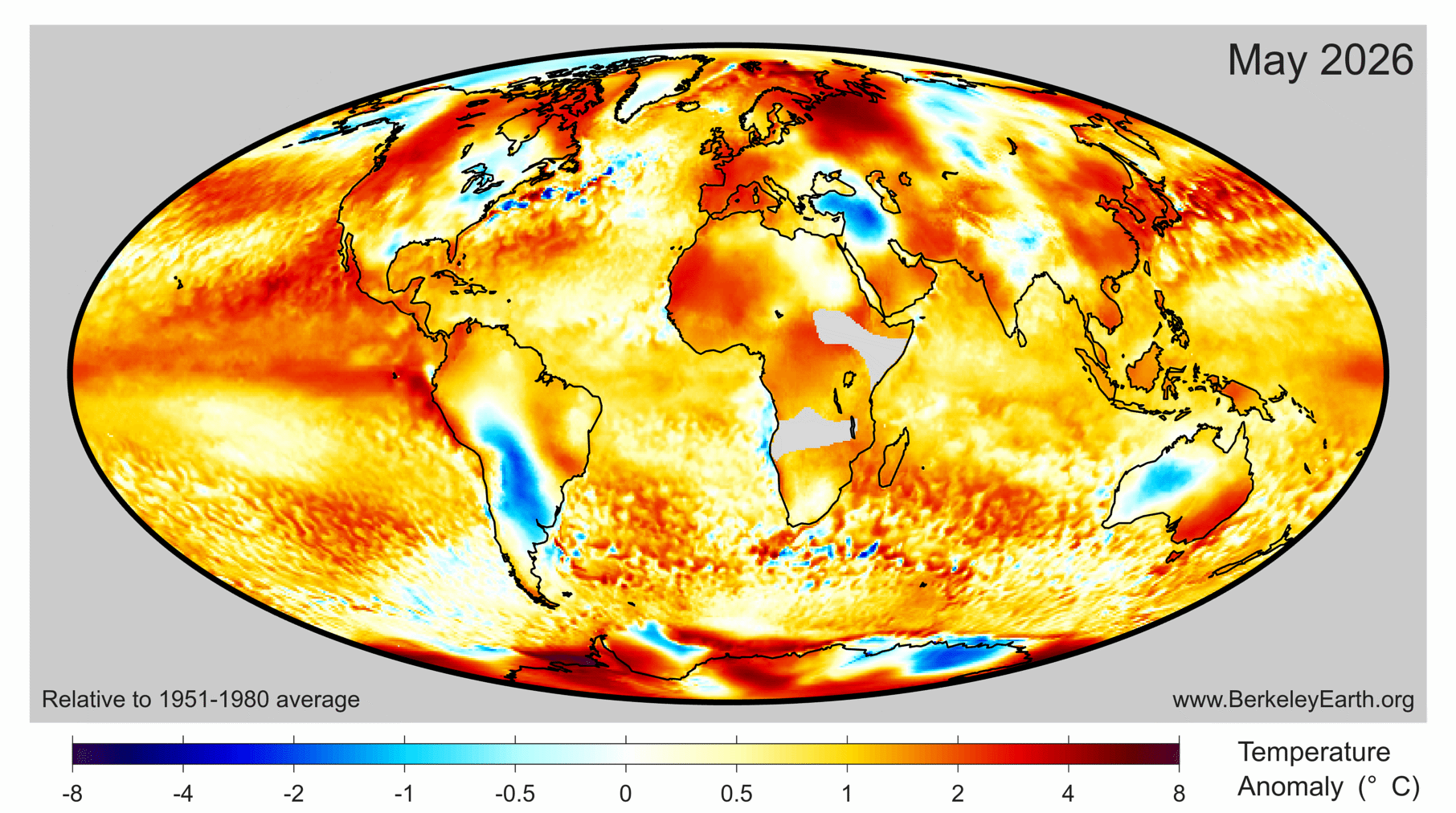
- Summer 2026 has been a scorcher for much of the Northern Hemisphere.
- June and July 2026 marked the hottest two-month stretch in Europe since record-keeping began.
- The contiguous US endured its hottest month on record in July 2026.
- South Korea saw its highest-ever recorded temperature.
- Experts say the latest El Nino event is going to affect next year's temperatures more than this year's.
Compiled by The Product DeskSomething wrong?How this is made
Why it matters
Europe has just been through its hottest June-July stretch since record-keeping began, the contiguous US endured its hottest month on record in July, and South Korea set its highest-ever recorded temperature [2][3][4]. In an August 13, 2026 explainer, MIT Technology Review reports that scientists expect the current El Nino to affect next year's temperatures more than this year's [5][22].
That is a procurement statement dressed as a weather story. The physics of the lag is unglamorous: El Nino does not add energy to the climate system, it moves heat that was already stored in the ocean into the atmosphere, and that transfer shows up in global temperatures several months behind the development of the ocean pattern itself [10][14]. The event has been declared, using NOAA's threshold of 0.5 C above normal in a defined patch of the Pacific plus the associated atmospheric shifts [9]. It is still ramping up [14].
The size matters. Some forecasts have the event peaking at more than 3.5 C above average, which would make it the strongest on record, and climate scientist Zeke Hausfather, writing for Carbon Brief, calls the onset one of the fastest in the observational record [12][13]. Hausfather also points out the pattern that should drive planning: in some recent El Nino periods the record-breaking temperatures arrived in the second calendar year of the event [15]. The last one developed in 2023 and ran into 2024, and 2024 remains the reigning hottest year on record [16]. On that arithmetic, 2024 was the second calendar year of the previous event, and 2027 is the second calendar year of this one [20][21].
Which is the awkward part of the 2026 story. Regional records have fallen all summer [2][3][4], but the global annual record still belongs to 2024 [16]. So the operating stress many teams absorbed this summer was not the peak of the current cycle, and MIT Technology Review's reporting puts a high likelihood on much of the world seeing higher temperatures next year [18].
The baselines being broken are old ones. July's contiguous US record displaced a mark set in July 1936, during the Dust Bowl, that had stood for about 90 years [6][19]. Europe is the fastest-warming continent, behind only the Arctic among world regions [7], and one study of the continent's May heat wave cited in the report found that a comparable event in 1976 would have been roughly 3.5 C (6.3 F) cooler than under today's conditions [8]. That is a shift in the floor, not a bad draw.
The operational consequence is a scheduling one. Whatever bent this summer, cooling capacity, outdoor work windows, shift rotas, backup power, heat clauses in service commitments, was bending at conditions that are expected to be exceeded [18]. Deferring the remediation by one budget cycle lands the work in the year it is most likely to be needed, and the forecast carries real uncertainty about how the rest of the event plays out [17].
Watch three things: whether the Pacific anomaly tracks toward the forecast 3.5 C peak or stalls nearer the 0.5 C threshold [9][12], whether the several-month lag holds as the event matures [14], and whether 2026 closes above or below 2024 globally [16].
Claim ledger
Ranked by verification strength, evidence, and original report placement.
- [2]
June and July 2026 marked the hottest two-month stretch in Europe since record-keeping began.
ReportedView cited source - [5]
Experts say the latest El Nino event is going to affect next year's temperatures more than this year's.
- [6]
July 2026's record for the contiguous US officially ends a record held by July 1936 for nearly a century; 1936 fell during the Dust Bowl, an environmental disaster across much of the country.
ReportedView cited source
Sources & coverage · 1 publisher
The reporting this story was synthesized from, earliest first. Every link goes to the original.
- technologyreview.comCasey CrownhartAug 13What’s behind this summer’s heat, and why 2027 could be worse
Additional citations
- Experts cited by MIT Technology Review
- study cited by MIT Technology Review
- National Oceanic and Atmospheric Administration definition, per MIT Technology Review
- forecasts cited by MIT Technology Review
- Zeke Hausfather, Carbon Brief
- Zeke Hausfather, Carbon Brief analysis
- MIT Technology Review