Published Product3 min read
Dognosis sells dog noses as a cancer prescreen. The caveats are the actual story
A Bengaluru startup reports about 90% sensitivity from dogs sniffing couriered breath samples. It also says it needs no Indian regulatory approval, because a prescreen is not a diagnostic.
Not a builder's beat, but builders have a standing stake in it.See today for builders
What happened
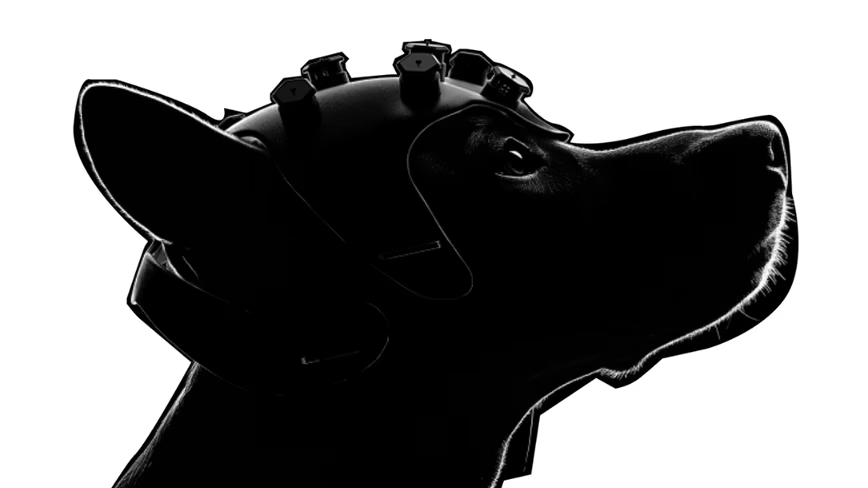
- Dognosis is a two-year-old Bengaluru startup that pairs trained sniffer dogs with sensors and artificial intelligence to flag early signs of cancer from a single breath sample.
- A patient breathes into a mask, which is couriered to Dognosis's facility, a farm outside Bengaluru, where beagles, labradors and Dutch shepherds sniff the sample.
- As the dogs sniff, sensors and AI read the animals' movements, respiration, brain activity and body language, translating them into structured data; the AI layer is meant to standardise an animal's reaction into something repeatable.
- The premise is that tumours leave a chemical signature in exhaled breath, one a dog can smell long before conventional tools can see it.
- The Dognosis process involves no imaging, no blood draw and no biopsy.
Compiled by The Product DeskSomething wrong?How this is made
Why it matters
Dognosis, a two-year-old Bengaluru company, is turning trained sniffer dogs into a data product: patients breathe into a mask, the sample is couriered to a farm outside the city, and beagles, labradors and Dutch shepherds sniff it while sensors and AI record their movements, respiration, brain activity and body language as structured data [1][2][3]. What makes this worth an operator's attention is not the dogs but the framing the company itself uses, which is that this is a prescreening tool in trials rather than a diagnostic [19][18].
The biological premise is that tumours leave a chemical signature in exhaled breath that a dog can smell earlier than conventional tools can see it [4]. The AI layer is the standardisation step, converting an animal's reaction into something repeatable, and there is no imaging, blood draw or biopsy in the workflow [3][5]. Founder Akash Kulgod says the approach targets more than 20 cancer types across seven groups, including breast, oral cavity, lung and cervical [6].
The reported numbers are the part to hold at arm's length. In Phase 2 trials published in the Journal of Clinical Oncology, Dognosis reports roughly 90% sensitivity for early-stage cancers, and says dogs trained on 10 cancer types went on to flag an 11th they had never been shown [7][8]. Those accuracy and detection figures come from the company and its researchers rather than independent confirmation [9]. A Phase 3 trial began in April across 10 hospitals, aiming for about 10,000 participants [15].
The market logic is stronger than the evidence base, and it is legitimate. India logged about 1.5 million new cancer cases and more than 900,000 deaths in 2024 [10], a deaths-to-cases ratio of roughly 60% [21]. Roughly 1.9% of women are screened for cervical cancer and fewer than 1% for breast or oral cancers, with cost, distance and the discomfort of invasive tests doing most of the work in that gap [11][12]. Dognosis raised a $1.5m pre-seed in 2024 and has closed a further undisclosed round, with Accel India and Caffeinated Capital among its backers; neither has put a figure on the latest raise [13].
Now the regulatory wrinkle. Kulgod says Dognosis needs no Indian regulatory approval because a prescreening tool is not classed as a diagnostic device [18]. That is a real launch advantage and a real exposure: the product can reach patients without clearing the bar a diagnostic would face, which puts the entire burden on communicating that a positive result is a prompt to see a doctor, not a verdict [18][19]. Anyone assessing AI health claims should read the classification as a business decision, not a technical one.
The operational plan is where the arithmetic gets tight. Kulgod plans an at-home multi-cancer prescreen in India next year at a few thousand rupees, scaling to a million tests a year on a one-week turnaround with about 30 dogs [14][16]. That implies roughly 33,000 samples per dog per year, or about 91 a day with no rest days [22]. Unsurprisingly, the stated endgame is replacing the dogs with sensors [20].
Watch the Phase 3 readout and whether anyone outside the company reproduces the sensitivity figure [15][9]. Watch the per-dog throughput as launch approaches [22]. And watch the planned US facility in late 2027 or early 2028, where the prescreen-versus-diagnostic distinction will not be the company's to define [17][18].
Claim ledger
Ranked by verification strength, evidence, and original report placement.
- [1]
Dognosis is a two-year-old Bengaluru startup that pairs trained sniffer dogs with sensors and artificial intelligence to flag early signs of cancer from a single breath sample.
- [2]
A patient breathes into a mask, which is couriered to Dognosis's facility, a farm outside Bengaluru, where beagles, labradors and Dutch shepherds sniff the sample.
- [3]
As the dogs sniff, sensors and AI read the animals' movements, respiration, brain activity and body language, translating them into structured data; the AI layer is meant to standardise an animal's reaction into something repeatable.
- [4]
The premise is that tumours leave a chemical signature in exhaled breath, one a dog can smell long before conventional tools can see it.
- [5]
The Dognosis process involves no imaging, no blood draw and no biopsy.
- [6]
Dognosis was founded by Akash Kulgod and says its approach targets more than 20 cancer types across seven groups, including breast, oral cavity, lung and cervical.
Sources & coverage · 1 publisher
The reporting this story was synthesized from, earliest first. Every link goes to the original.
- thenextweb.comAna-Maria StanciucAug 13This Bengaluru startup is training dogs and AI to sniff out cancer early
Additional citations
- The Next Web
- Dognosis, reported by The Next Web
- Akash Kulgod via The Next Web