Published Product3 min read
Blue Energy's Texas hybrid puts a gas turbine in front of every reactor
A 2.5 GW plant near Victoria will run on two 7HA.02 turbines for two years before the first BWRX-300 shows up. The build order is the honest part of the announcement.
Not a builder's beat, but builders have a standing stake in it.See today for builders
What happened
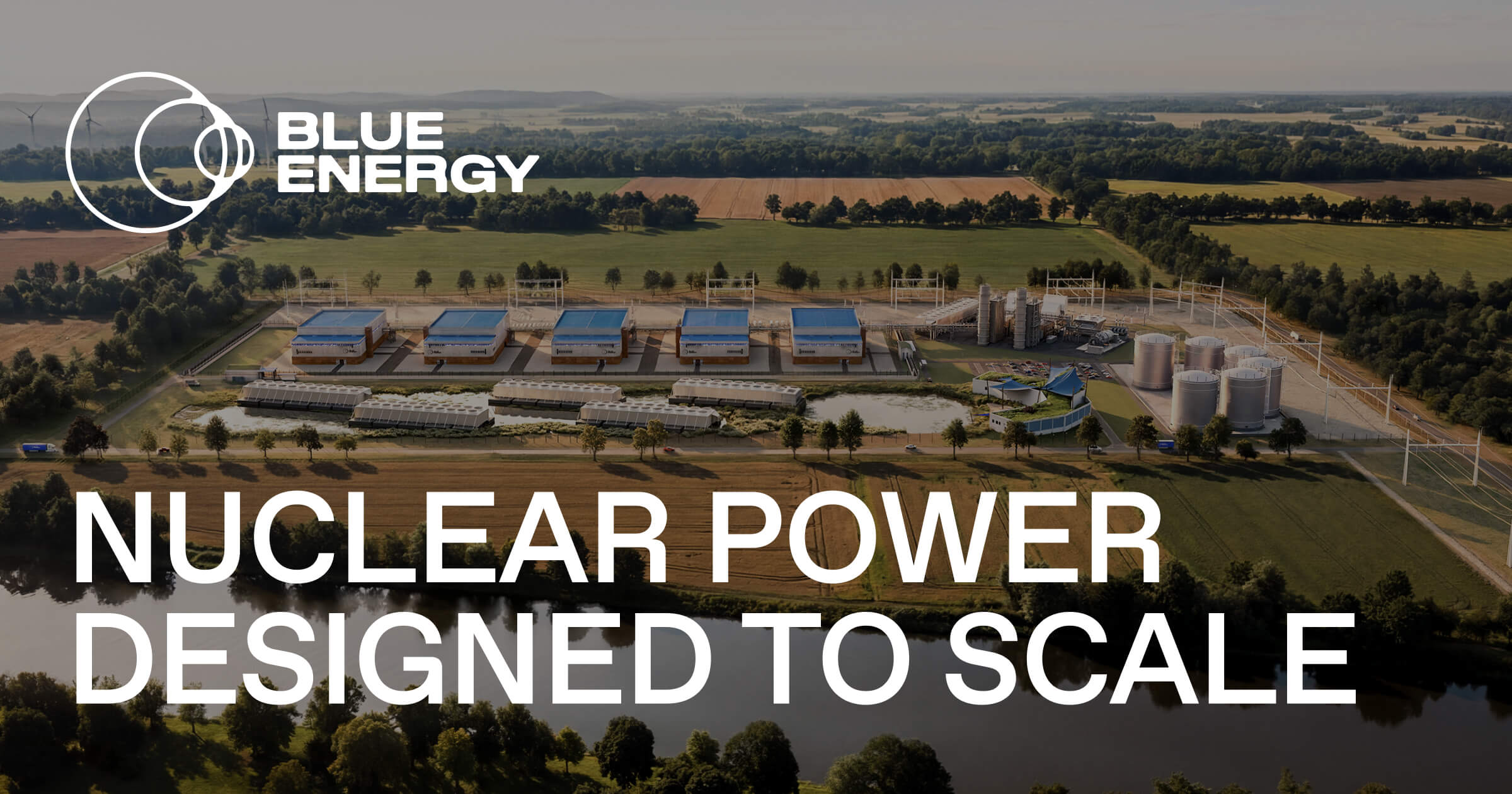
- Blue Energy and GE Vernova Hitachi Nuclear Energy signed an agreement covering further work on a planned 2.5-gigawatt facility near Victoria, Texas.
- The project will combine natural gas turbines with small modular reactors, using two different power technologies within one generation site.
- Two GE Vernova 7HA.02 turbines should supply about 1 gigawatt to a nearby data center in 2030; gas-fired generation comes online before the nuclear units.
- Nuclear generation would follow two years after the gas units, with Blue Energy planning to add as many as five BWRX-300 reactors providing another 1.5 gigawatts of capacity.
- Engineering work will advance across design, licensing and safety analysis, and the partners expect to reach a final investment decision in 2027.
Compiled by The Product DeskSomething wrong?How this is made
Why it matters
Blue Energy and GE Vernova Hitachi Nuclear Energy have signed an agreement to advance a 2.5 gigawatt plant near Victoria, Texas, combining natural gas turbines with small modular reactors on one site [1][2]. The build order is the disclosure that matters: about 1 GW of gas is scheduled to serve a nearby data center in 2030, and the reactors do not arrive until two years after that [3][4].
Do the arithmetic on the nameplate. Two GE Vernova 7HA.02 turbines account for roughly 1 GW, or 40 percent of the site's advertised capacity [3][12]. As many as five BWRX-300 units supply the remaining 1.5 GW, which works out to 300 MW apiece [4][13]. Gas is the minority of the plant and the entirety of it for the first two years of operation [15]. If the reactors slip, that share does not change on paper and rises in practice.
The company's own framing does not hide this. Blue Energy says the sequencing lets the project serve large electricity loads before the nuclear portion is operational and lets generation expand in stages [16]. The source material notes that large data centers can require enormous amounts of electricity, often faster than traditional power projects can deliver it [17]. Eric Gray, CEO of GE Vernova's Power segment, said meeting surging demand requires proven, scalable technologies, and described the work as combining HA gas turbine technology with advanced nuclear SMR technology [7]. The proven half is the half with a 2030 date and a named customer.
Note also the asymmetry in commitment language. The turbines are two units delivering to a specific nearby data center [3]. The reactors are "as many as five" [4], which is a ceiling rather than an order, and nothing is committed until a final investment decision expected in 2027 [5]. That leaves three years from decision to gas and five years from decision to nuclear [14]. Engineering work now proceeds across design, licensing and safety analysis [5].
The nuclear cost case rests on manufacturing, not on the reactor. Blue Energy calls its model the "Blue Way" and leans on factory fabrication and modular assembly, using the BWRX-300's standardized design to shift work off the construction site, with large components fabricated before they reach Texas [8][9]. CEO and co-founder Jake Jurewicz said the company is shifting from the old way of building large reactor nuclear power and that the Blue Way "slashes costs and time to power" [8]. That is a forecast about a class of project with a documented history of long schedules and significant cost overruns [10]. The only physical evidence available sits in Canada, where Ontario Power Generation is constructing the first BWRX-300 at Darlington, potentially the first grid-scale SMR operating in the Western world [11].
What to watch: whether the 2027 investment decision covers all five reactors or only the turbines plus site works [5][4]; how much of Darlington's actual cost and schedule performance is published before that decision [11]; and whether the data center offtake extends to the nuclear output or stops at the 1 GW of gas, which the announcement does not address [3].
Claim ledger
Ranked by verification strength, evidence, and original report placement.
- [1]
Blue Energy and GE Vernova Hitachi Nuclear Energy signed an agreement covering further work on a planned 2.5-gigawatt facility near Victoria, Texas.
ReportedView cited source - [2]
The project will combine natural gas turbines with small modular reactors, using two different power technologies within one generation site.
ReportedView cited source - [3]
Two GE Vernova 7HA.02 turbines should supply about 1 gigawatt to a nearby data center in 2030; gas-fired generation comes online before the nuclear units.
ReportedView cited source - [4]
Nuclear generation would follow two years after the gas units, with Blue Energy planning to add as many as five BWRX-300 reactors providing another 1.5 gigawatts of capacity.
ReportedView cited source - [5]
Engineering work will advance across design, licensing and safety analysis, and the partners expect to reach a final investment decision in 2027.
ReportedView cited source - [7]
Eric Gray, CEO of GE Vernova's Power segment, said: "Meeting surging electricity demand requires proven, scalable technologies. Our work with Blue Energy combines HA gas turbine technology with advanced nuclear SMR technology."
Sources & coverage · 1 publisher
The reporting this story was synthesized from, earliest first. Every link goes to the original.
- interestingengineering.comAamir KhollamAug 13Texas hybrid power project fuses gas turbines with five nuclear SMRs for 2.5 GW
Additional citations
- Eric Gray, CEO of GE Vernova's Power segment
- Jake Jurewicz, CEO and co-founder of Blue Energy