Published · 6d agoInvest3 min read
The Lincoln has been at sea 240 days, and that is the blockade's real clock
Centcom's chief flew to a carrier with reported food, water and mental-health problems. The endurance limit, not the diplomacy, is what energy and shipping risk should be priced against.
Context for builders, not their beat.See today for builders
What happened
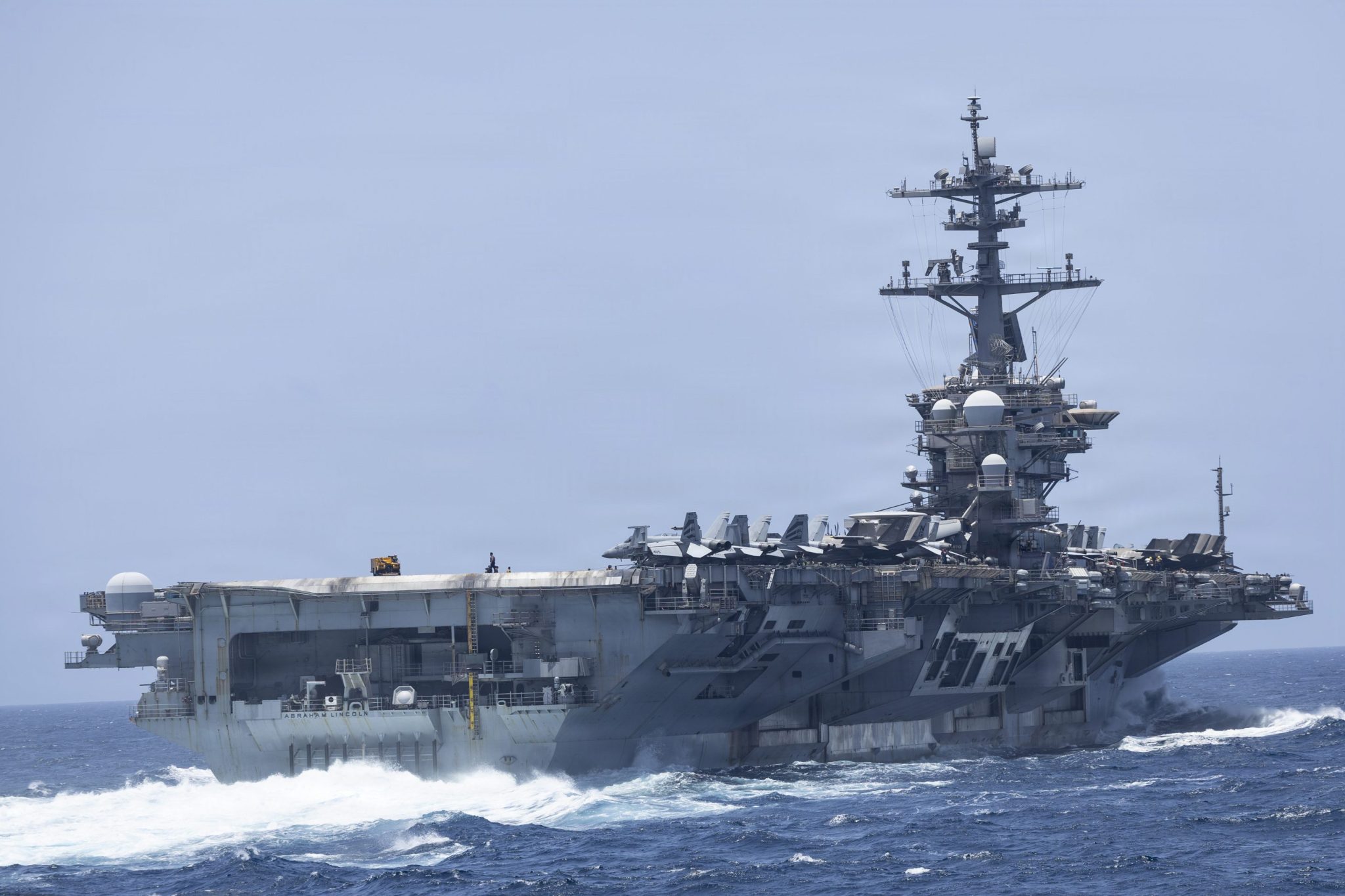
- Adm. Brad Cooper, the top U.S. military commander in the Middle East, visited the USS Lincoln in the Arabian Sea during a 10-day tour of the region that concluded on Saturday, U.S. Central Command said.
- Cooper's visit to the carrier followed outrage among family members about reports of food shortages, water contamination, mouldy showers and long shifts in wartime aboard the vessel.
- The Lincoln's deployment has included a record-setting uninterrupted time at sea of more than 240 days.
- The Lincoln arrived in the Middle East in January and has been supporting the U.S. war against Iran, including the blockade on Iranian ports.
- The U.S. Navy's blockade was in response to Iran asserting control over the Strait of Hormuz after the war started on Feb. 28 with U.S. and Israeli strikes.
Compiled by The InvestorSomething wrong?How this is made
Why it matters
Adm. Brad Cooper, the top U.S. commander in the Middle East, went aboard the USS Abraham Lincoln in the Arabian Sea during a 10-day regional tour that ended Saturday, U.S. Central Command said [1]. He did it while family members were publicly describing food shortages, water contamination, mouldy showers and long wartime shifts on a ship that Centcom itself says has been at sea, uninterrupted, for more than 240 days [2][3]. That number is the first concrete evidence that the blockade of Iranian ports has a sustainment ceiling, and that the ceiling is measured in hulls and crews rather than in communiques.
The arithmetic is the story. The Lincoln arrived in the Middle East in January and has been supporting the U.S. war against Iran, including the blockade [4]. The war began on Feb. 28 with U.S. and Israeli strikes, and the Navy's blockade was a response to Iran asserting control over the Strait of Hormuz [5]. From Feb. 28 to the mid-August reporting date is roughly 170 days, which means about 70 of the carrier's 240-plus days at sea were already on the meter before the first shots [15]. Working back from mid-August, the run began around Dec. 19, 2025 [16]. The endurance being spent on this blockade was borrowed before the conflict started.
Carriers of this type can carry more than 5,000 sailors and Marines [7], and the reported conditions are not marginal. Family members quoted by the South China Morning Post said the situation had deteriorated so badly that some sailors attempted to throw themselves overboard [10]. That account is single-sourced and comes from families, not the Navy. The same report puts the run without a port call at more than 200 days [11], against Centcom's more-than-240-days-at-sea figure [3]; the two are not reconcilable from the material supplied.
Read the official language as a signal rather than a summary. Cooper said "history will record this deployment as one of the most operationally intense and consequential of the modern era" [8], called the visit "awe-inspiring," praised the crew's "resilience," and said mental health requires attention like physical and spiritual health [9]. Cryptobriefing's read is that the visit underscores continued U.S. commitment and that the deployment has been extended beyond typical durations for such operations [13]. Both things can be true: policy holds while practice thins.
For anyone pricing energy, that distinction matters more than the headline. About one-fifth of the world's traded oil and natural gas passed through Hormuz before the war [6]. According to Cryptobriefing, market pricing has moved to a lower probability of the U.S. announcing an end to the blockade by Aug. 31, and participants expect it to persist past the end of August [12]. That is a bet on announcements. It is not a bet on enforcement density, which is what a fatigued crew and a ship overdue for maintenance actually determine.
Meanwhile the diplomatic track is thin: U.S.-Iran talks have stalled, and Iran is discussing management of the strait with Oman, a waterway previously treated as international [14].
What to watch is physical, not verbal. A first port call for the Lincoln, or a relief hull appearing in the theatre, would be the tell that the Navy is trading enforcement continuity for crew recovery, and either would arrive before any policy change is announced. Cooper also met civilian and military leaders in Bahrain, Iraq, Israel, Jordan, Saudi Arabia and the United Arab Emirates [17]; basing and logistics access along that list is what determines whether the blockade can be sustained at lower cost. Watch statements from President Trump or Cooper on the blockade's future, and the Oman channel [18].
Claim ledger
Ranked by verification strength, evidence, and original report placement.
- [1]
Adm. Brad Cooper, the top U.S. military commander in the Middle East, visited the USS Lincoln in the Arabian Sea during a 10-day tour of the region that concluded on Saturday, U.S. Central Command said.
ReportedView cited source - [2]
Cooper's visit to the carrier followed outrage among family members about reports of food shortages, water contamination, mouldy showers and long shifts in wartime aboard the vessel.
ReportedView cited source - [3]
The Lincoln's deployment has included a record-setting uninterrupted time at sea of more than 240 days.
ReportedView cited source - [4]
The Lincoln arrived in the Middle East in January and has been supporting the U.S. war against Iran, including the blockade on Iranian ports.
ReportedView cited source - [5]
The U.S. Navy's blockade was in response to Iran asserting control over the Strait of Hormuz after the war started on Feb. 28 with U.S. and Israeli strikes.
ReportedView cited source - [6]
About one-fifth of the world's traded oil and natural gas passed through the Strait of Hormuz before the war started.
ReportedView cited source
Sources & coverage · 3 publishers
The reporting this story was synthesized from, earliest first. Every link goes to the original.
- cryptobriefing.comEstefano GomezAug 16Centcom chief visits US carrier enforcing Iran blockade amid crew strain