Published · 6d agoInvest3 min read
A Nuclear-Armed Article 5 Clause Now Sits Between Riyadh, Ankara and Islamabad
The Mecca Joint Defence Agreement extends a NATO-style attack-on-one clause to a nuclear-armed signatory, and reprices Gulf escalation risk without reference to any US guarantee.
Context for builders, not their beat.See today for builders
What happened
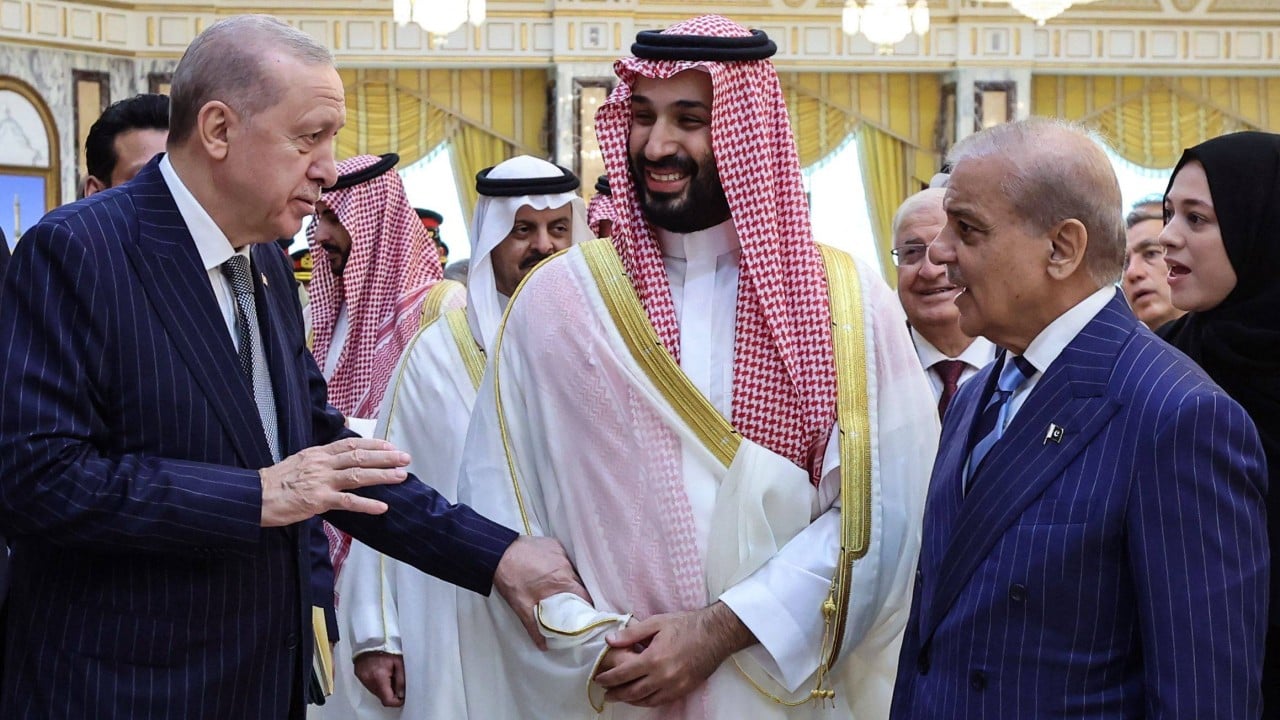
- Saudi Arabia, Turkey and Pakistan signed a mutual defense pact, the Mecca Joint Defence Agreement, on August 7 in Mecca, including a collective-defense clause modeled on NATO's Article 5.
- An armed attack on any one of the three signatories would trigger a coordinated military response from the other two.
- President Trump called the agreement a positive sign that Middle Eastern countries are "coming together and can defend themselves," framing it as a step toward regional self-sufficiency.
- The agreement was signed by Saudi Crown Prince Mohammed bin Salman, Turkish President Recep Tayyip Erdogan and Pakistani Prime Minister Shehbaz Sharif.
- All three governments described the pact as strictly defensive, non-sectarian, and not aimed at any country specifically, including Iran or Israel.
Compiled by The InvestorSomething wrong?How this is made
Why it matters
Saudi Arabia, Turkey and Pakistan signed the Mecca Joint Defence Agreement on August 7, a mutual defense pact whose collective-defense clause is modeled on NATO's Article 5: an armed attack on any one of the three triggers a coordinated military response from the other two [1][2]. The consequence for anyone pricing Gulf risk is not the ceremony but the counterparty list, because the clause now binds a nuclear-armed state to Saudi financial capacity and to a NATO member's army [10][11].
The signatories were Saudi Crown Prince Mohammed bin Salman, Turkish President Recep Tayyip Erdogan and Pakistani Prime Minister Shehbaz Sharif [4]. All three governments called the pact strictly defensive, non-sectarian and not aimed at any country, Iran and Israel included [5]. That framing is doing work: Saudi Arabia and Pakistan are Sunni-majority states and Turkey has positioned itself as a bridge between Islamic traditions, so the explicit rejection of a sectarian frame is an attempt to preempt the reading that this is a Sunni bloc against Shia Iran [20]. It is also not a standing start. Groundwork was laid in September 2025 by a bilateral Saudi-Pakistan Strategic Mutual Defence Agreement, and roughly eleven months of negotiation followed before Turkey's entry turned a two-party arrangement into something with more weight [8][9][21]. The pact emerged during the ongoing 2026 Iran war and rising threats to shipping along Gulf routes, and it declares itself open to other regional partners [6][7].
The division of labor is legible. Saudi Arabia brings money, Turkey brings NATO's second-largest army and a growing domestic defense industry, Pakistan brings nuclear capability [10]. Turkey is simultaneously a NATO member and a party to a separate collective-defense arrangement with two non-NATO states [11]. Read the two obligations together and the exposure is direct: an armed attack on Pakistan would, on the text, oblige a NATO member to join a coordinated military response [22]. President Trump welcomed the agreement as a positive sign that Middle Eastern countries are "coming together and can defend themselves" [3].
The bear case on the pact is that it is paper. Some analysts, according to the South China Morning Post, expect it to function primarily as political signalling rather than an immediate military counterforce [16]. The same commentary calls it a pragmatic response to a perceived decline in US willingness, and perhaps capacity, to police the system, and argues the Israeli and US war against Iran disrupted energy and shipping markets while undermining allied trust in Washington [18][19]. It also flags Pakistan's nuclear status as a reason an attack-on-one commitment carries global consequences [17]. Beijing, on that reading, may treat the pact as an opening to expand influence across the Middle East and South Asia, and as a template for middle powers reducing dependence on the US-led security architecture [14][15].
What to watch is definitional rather than declaratory. NATO's Article 5 has been invoked once in the alliance's history, after September 11, 2001 [12]. The tests here are how the Mecca text defines an armed attack, what the response obligation concretely requires, and whether integrated command structures follow [13]. Absent those, the clause prices as signalling. With them, every Gulf shipping incident acquires three signatures instead of one [2][6].
Claim ledger
Ranked by verification strength, evidence, and original report placement.
- [1]
Saudi Arabia, Turkey and Pakistan signed a mutual defense pact, the Mecca Joint Defence Agreement, on August 7 in Mecca, including a collective-defense clause modeled on NATO's Article 5.
ReportedView cited source - [2]
An armed attack on any one of the three signatories would trigger a coordinated military response from the other two.
ReportedView cited source - [3]
President Trump called the agreement a positive sign that Middle Eastern countries are "coming together and can defend themselves," framing it as a step toward regional self-sufficiency.
- [4]
The agreement was signed by Saudi Crown Prince Mohammed bin Salman, Turkish President Recep Tayyip Erdogan and Pakistani Prime Minister Shehbaz Sharif.
ReportedView cited source - [5]
All three governments described the pact as strictly defensive, non-sectarian, and not aimed at any country specifically, including Iran or Israel.
ReportedView cited source - [6]
The pact emerged during the ongoing 2026 Iran war and rising threats to maritime security along Gulf shipping routes.
ReportedView cited source
Sources & coverage · 3 publishers
The reporting this story was synthesized from, earliest first. Every link goes to the original.
- cryptobriefing.comEditorial Team6d agoTrump welcomes trilateral defense agreement between Saudi Arabia, Turkey, and Pakistan
Cited in this coverage: Trump, via cryptobriefing.com citing cnn.com
Cited in this coverage: cryptobriefing.com
- scmp.comSCMP Editorial6d agoSaudi Arabia-Turkey-Pakistan pact a sign of a realigning global order