Published Build3 min read
Starmind's real constraint: 250 kW of GPUs behind 160 square meters of radiator
SpaceX and NVIDIA's orbital AI satellite must shed peak waste heat at roughly 1,560 watts per square meter, by infrared alone. That number, not ambition, is the binding limit.
Written for builders.See today for builders
What happened
- SpaceX and NVIDIA are partnering on a just-announced satellite called Starmind AI1, intended to run AI data center workloads in orbit.
- The satellites will be 30 meters tall with a 75-meter solar-array wingspan.
- The satellites will contain the latest NVIDIA Vera CPUs and Rubin GPUs.
- The satellites will operate in low Earth orbit at about 600 kilometers.
- According to SpaceX, AI1 is designed around a compute payload drawing up to 250 kW at peak and 175 kW on average, and is solar-powered.
Compiled by The EngineerSomething wrong?How this is made
Why it matters
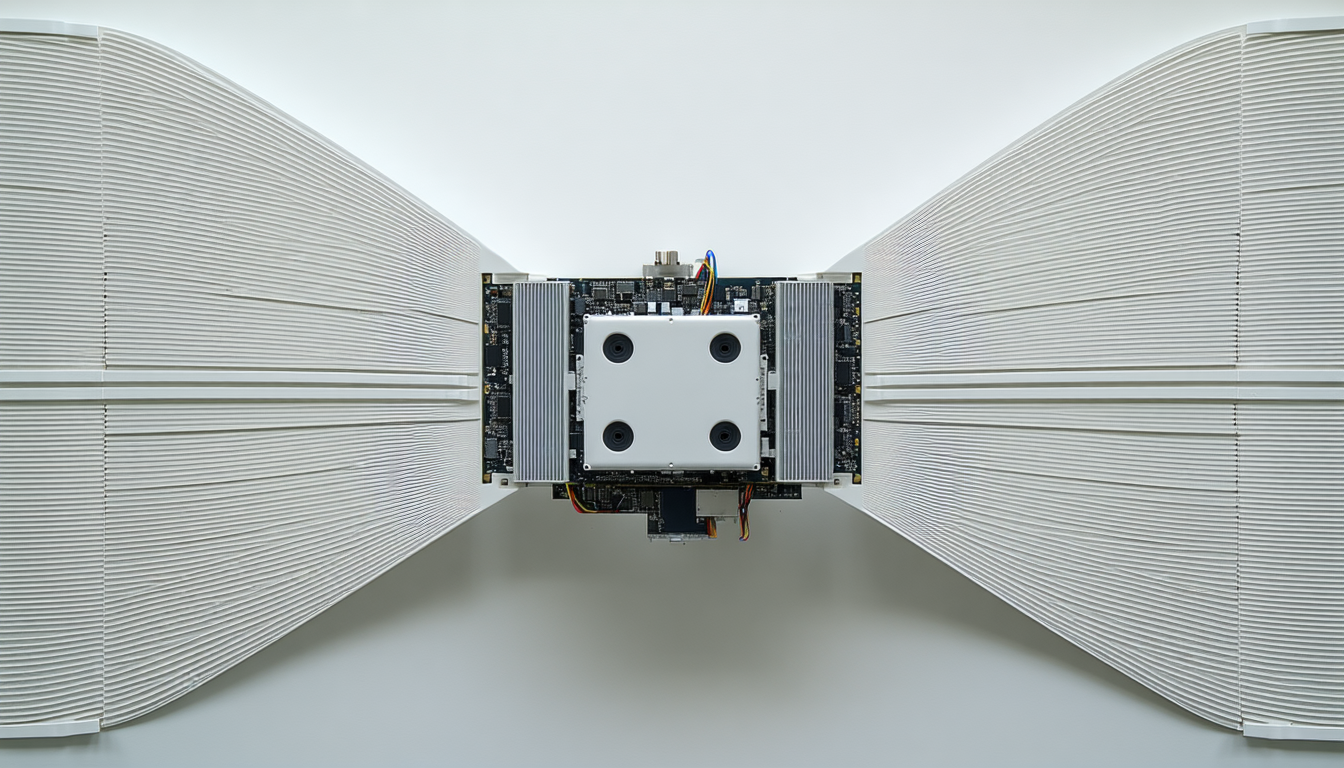
SpaceX and NVIDIA have announced Starmind AI1, a 30-meter-tall satellite with a 75-meter solar-array wingspan carrying NVIDIA Vera CPUs and Rubin GPUs into a low Earth orbit of about 600 kilometers [1][2][3][4]. SpaceX says the compute payload draws up to 250 kW at peak and 175 kW on average [5], and the entire thermal answer to that is one deployable liquid radiator of 160 square meters [6].
Divide the second figure into the first. At peak the radiator has to move about 1,560 watts per square meter of surface, and about 1,090 W/m2 at the stated average [1][2]. On the ground that heat leaves through convection, cooling towers, or evaporative cooling. In vacuum none of those are available, and the heat has to leave as infrared radiation, which The New Stack correctly describes as a very slow process [7]. Liquid cooling moves heat off the chips, but it does not reduce the radiator area you need, because nearly all electrical power into a compute payload has to be rejected as waste heat [8]. The physics sets a direct trade-off among compute power, radiator area, spacecraft mass, and operating temperature [9].
Two of those four variables have not been published. The working fluid is undisclosed; Hugh Lewis, professor of astronautics at the University of Birmingham, expects ammonia, as used on the International Space Station, according to The New Stack [10]. Whether that scales to data-center-class heat loads remains to be seen, in the source's words [11]. Radiator operating temperature is also absent, and it matters more than area, since radiative flux depends on how hot the surface runs and what it faces. NASA's figures for orbital thermal environments run from about 393 Kelvin in full sun down to roughly 3 Kelvin [12], and whether a surface is hot or cold depends entirely on whether it is pointed at the sun [13]. The same spacecraft therefore has to hold a 75-meter array in sunlight while keeping 160 square meters of radiator out of it [2][6].
All of that is packaged into an estimated 2.3 metric tons [14], roughly 109 kW of peak payload per tonne of spacecraft [3], and launched on Starship, which the source notes is still not ready for routine service [14]. SpaceX's stated goal is a million Starmind satellites of a standard design [15], built at the 11-million-square-foot Gigasat Factory in Bastrop County, Texas, still under construction [16]. At that count the fleet implies about 160 square kilometers of deployed radiator, 175 GW of average payload draw, and 2.3 million tonnes lifted to orbit [4][5][6].
The networking is the honest part of the pitch. Starlink's published specs describe mini laser terminals at up to 25 Gbps over distances as long as 4,000 kilometers, with roughly 25-millisecond latency cited for customer service [17]. The source's own read is that this suits distributing inference results, pushing model updates, connecting orbital sensors to compute, and reducing ground-station dependence [18]. That describes a specialized node, not a replacement for terrestrial capacity. SpaceX's framing is that orbit avoids competing for land, grid interconnect, and water [19]; its own list of prerequisites still includes generating power, rejecting waste heat, surviving radiation, holding laser links, and mass production, none of which the source calls easy [20].
Watch for three disclosures: radiator operating temperature and working fluid, since the trade-off cannot be evaluated without them; whether the first AI1 sustains 175 kW average rather than brief peaks [21]; and Starship cadence against Gigasat's completion [14][16].
Claim ledger
Ranked by verification strength, evidence, and original report placement.
- [1]
SpaceX and NVIDIA are partnering on a just-announced satellite called Starmind AI1, intended to run AI data center workloads in orbit.
ReportedView cited source - [2]
The satellites will be 30 meters tall with a 75-meter solar-array wingspan.
ReportedView cited source - [5]
According to SpaceX, AI1 is designed around a compute payload drawing up to 250 kW at peak and 175 kW on average, and is solar-powered.
- [6]
Each Starmind satellite will have a deployable liquid radiator system measuring 160 square meters.
ReportedView cited source
Sources & coverage · 1 publisher
The reporting this story was synthesized from, earliest first. Every link goes to the original.
- thenewstack.ioSteven J. Vaughan-NicholsAug 12Why space is actually a terrible place to cool a data center
Additional citations
- SpaceX, via The New Stack
- Hugh Lewis, University of Birmingham, via The New Stack
- The New Stack
- NASA, via The New Stack
- Starlink specifications and SpaceX, via The New Stack