Published Build3 min read
Google's AMIE now does video consultations, in a preprint, with actors
The reported expert-level result comes from simulated visits described in an unreviewed arXiv paper. What that tests, and what it leaves entirely untested, is the useful part.
Written for builders.See today for builders
What happened
- Google Research on August 11 presented AMIE (Video), a Gemini-based research system for real-time simulated clinical video consultations.
- Google reports that a randomized controlled study using simulated consultations found expert-level performance for AMIE (Video).
- The underlying study, titled "Towards Expert-level Medical AI for Real-time Video Consultations," is available as an arXiv preprint and has not been peer reviewed.
- AMIE stands for Articulate Medical Intelligence Explorer; the video version is intended to incorporate visual and auditory signals that text-only clinical interfaces cannot independently observe, including visible discomfort, breathing, gait, and other non-verbal cues.
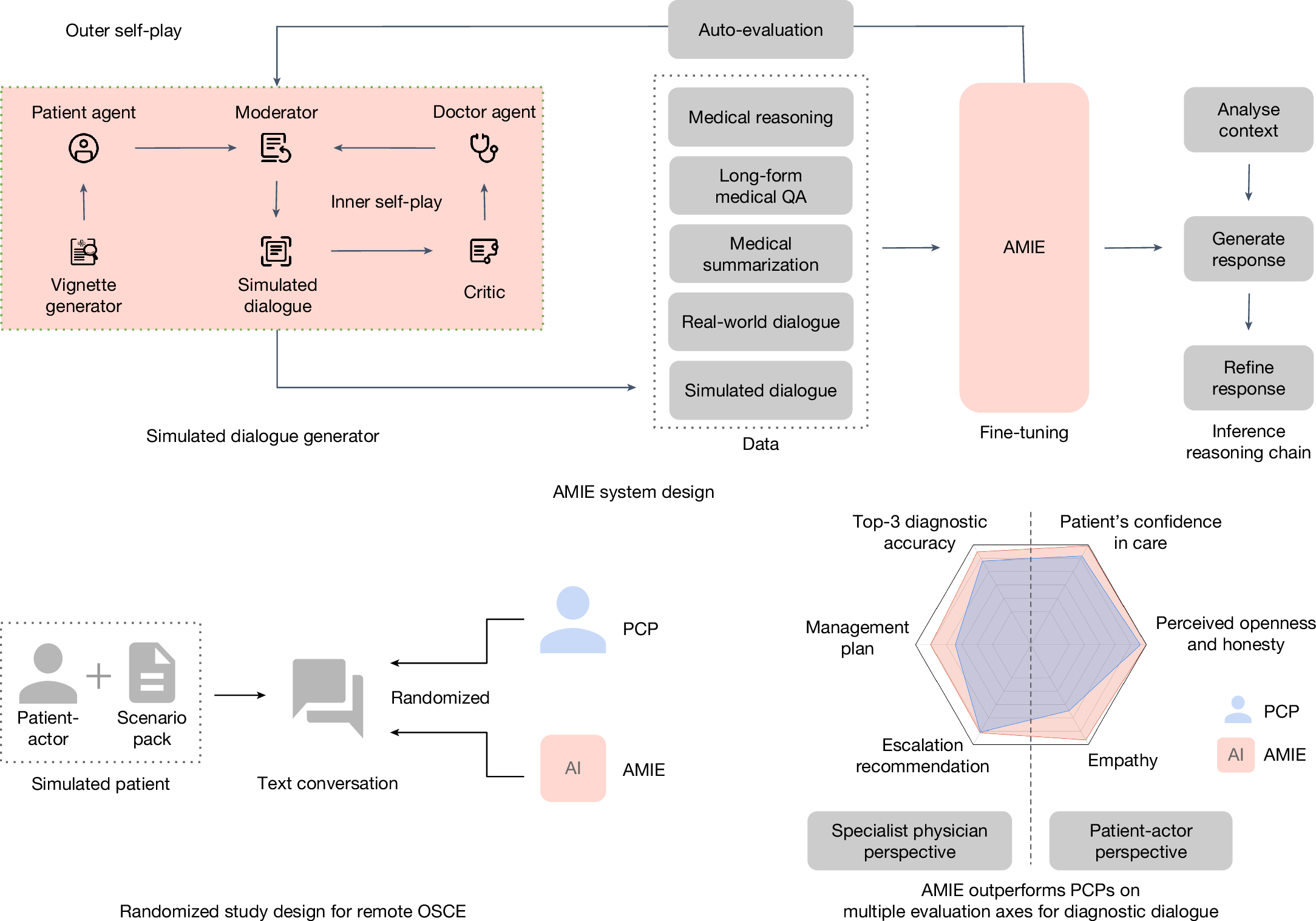
- The evaluation involved volunteers acting as patients who consulted both primary-care physicians and AMIE in video sessions.
Compiled by The EngineerSomething wrong?How this is made
Why it matters
Google Research presented AMIE (Video) on August 11, a Gemini-based configuration of its Articulate Medical Intelligence Explorer that runs real-time clinical video consultations, and reported expert-level performance in a randomized controlled study of simulated visits [1][2][4]. The evidence is an arXiv preprint titled "Towards Expert-level Medical AI for Real-time Video Consultations" that has not been peer reviewed, and the patients were volunteers acting the part, which puts the claim several steps away from anything a clinic can run [3][5][12].
The engineering is the substantive part. According to News-Medical's account of the paper, the system splits into three components: a Talker Agent for fast patient-facing dialogue, a Planner Agent to manage clinical objectives during the encounter, and a Perception Agent to interpret audio and video [8]. AIbase reports the stack is built on Gemini and Project Astra [9]. The stated purpose of the video channel is to pick up signals a text interface cannot observe on its own, including visible discomfort, breathing, gait, and other non-verbal cues [4]. In one demonstration, AMIE talked patient actors through a pronator drift test, a neurological examination maneuver [10].
That is a harder problem than scoring a model on static vignettes, because the system has to hold a conversation, decide what to ask for next, interpret what comes back, and revise its reasoning mid-call [11]. News-Medical reports that evaluators rated AMIE well on history completeness, diagnostic accuracy, treatment-plan appropriateness, and communication quality, and characterized the results as matching or exceeding physician performance on key measures [6]. Google describes the experiment as a first-of-its-kind demonstration of expert-level performance in a simulated setting [7].
Note the qualifier Google itself attaches. The findings cover simulated consultations with actors, not autonomous use with patients in routine care [12]. News-Medical states plainly that arXiv papers are preliminary and should not be treated as conclusive or as clinical guidance [13]. AIbase describes the system as still at research stage and says further validation would be required before real-world deployment [14]. The source accounts also carry no sample size, effect size, or confidence interval, so the strength of the reported advantage over physicians cannot be assessed from what has been published about the paper [18].
A standardized simulation can establish that speech, video, planning, and medical reasoning hold together in one loop. It does not establish safety across variable camera quality, examinations that get abandoned halfway, patients who communicate differently, rare presentations, workflow constraints, or the question of who is accountable when the agent is wrong [15]. For anything used in live clinical interaction, the evaluation list extends to latency, instruction-following while guiding a physical exam, robustness when perception fails, calibrated uncertainty, and the shape of clinician oversight [17]. The preprint addresses part of that; the rest is open [15][17].
Google positions AMIE (Video) alongside its earlier simulated work on text-based clinical dialogue and specialist-oriented evaluations, plus early real-world research collaborations [16]. That is the pattern to track: a research program that keeps adding modalities in simulation while real-patient validation moves separately and more slowly.
What to watch: whether the paper clears peer review with its numbers intact, whether Google publishes the sample size and per-measure margins, and whether the pronator drift style of remote exam guidance shows up in a prospective study with actual patients rather than actors [3][10][18].
Claim ledger
Ranked by verification strength, evidence, and original report placement.
- [1]
Google Research on August 11 presented AMIE (Video), a Gemini-based research system for real-time simulated clinical video consultations.
- [2]
Google reports that a randomized controlled study using simulated consultations found expert-level performance for AMIE (Video).
- [3]
The underlying study, titled "Towards Expert-level Medical AI for Real-time Video Consultations," is available as an arXiv preprint and has not been peer reviewed.
- [4]
AMIE stands for Articulate Medical Intelligence Explorer; the video version is intended to incorporate visual and auditory signals that text-only clinical interfaces cannot independently observe, including visible discomfort, breathing, gait, and other non-verbal cues.
- [5]
The evaluation involved volunteers acting as patients who consulted both primary-care physicians and AMIE in video sessions.
- [6]
Evaluators rated AMIE positively on medical-history completeness, diagnostic accuracy, treatment-plan appropriateness, and communication quality, and the results were characterized as matching or exceeding physician performance on key measures.
Sources & coverage · 1 publisher
The reporting this story was synthesized from, earliest first. Every link goes to the original.
- letsdatascience.comAug 12Google Advances AMIE for Video Clinical Consultations
Cited in this coverage: letsdatascience.com
Cited in this coverage: Google Research, via letsdatascience.com
Cited in this coverage: Google research blog, via letsdatascience.com
Cited in this coverage: Google, via letsdatascience.com
Additional citations
- News-Medical's account of the paper
- News-Medical
- AIbase