Science1 publisher3 min readPublished
Xiaomi streamed the cost and reward of a trillion-parameter RL run to a public dashboard
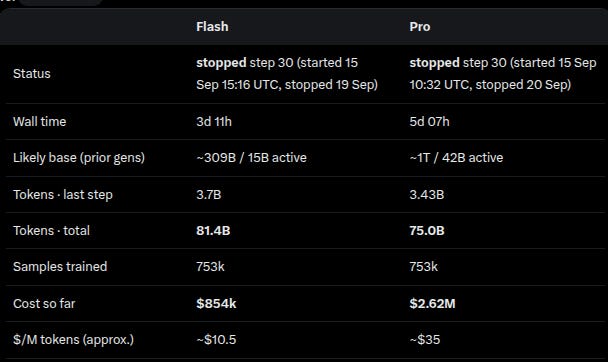
Two agentic post-training jobs, a 1.02-trillion-parameter model and a 309-billion cousin, ran with step time, reward and infrastructure error rates on the open web. Both stopped near step 30, and both models are still unreleased.
The Scientist · Science desk
What happened
- Xiaomi's MiMo team started two reinforcement-learning post-training jobs in parallel on 15 September 2026, and within two days the trainer logs were readable on the open web.
- The larger model, MiMo-V2.6-Pro, is reported at about 1.02 trillion total parameters with 42 billion active, and the cheaper MiMo-V2.6-Flash at about 309 billion total with 15 billion active.
- The public dashboard tracked cost so far, tokens, samples, live reward, step time, entropy and KL, context length, turn counts, infrastructure error rates and which datasets were filling each batch.
- Both jobs stopped near step 30, by which point the public cost ticker stood in the millions of dollars and the offline benchmark scores had moved.
- Xiaomi said the technical details will be opened in pieces, and both models were still unreleased when the account was written.
Compiled by The ScientistSomething wrong?How this is made
Why it matters
- capability A team budgeting its own agentic post-training now has outside figures for step time, infrastructure error rate and how fast cost accumulates, to compare against its own cluster.
- constraint The counters are good for cost estimation: with the reward functions, environments and dataset mix still unpublished, no reader can re-run the curve or check what it rewarded.
- decision A buyer funding an AI platform can specify which training and evaluation telemetry a supplier must expose, since one team has demonstrated that the full counter set exists and can be shown.
- precedent A visible dollar ticker makes the cost of a training run an askable question, and a lab that declines to answer is now making a choice.
A reward number means something only relative to the reward function that produced it, and Xiaomi has not published its reward design, its environment specifications or its dataset mix. A reader can watch the curve move without knowing what was being scored. The team said the technical details will be opened in pieces [6].
The offline scoring has the same shape. Two of the three benchmarks on the dashboard, DeepSWE v1.1 and AutomationBench, exist outside Xiaomi; the third is an in-house coding bench [4]. One third of the reported score surface is therefore not comparable to anything a reader can run.
The design also falls short of an ablation: two jobs ran at once, but the difference between them is size [1][2]. The pair does not isolate what scaling agentic RL changes. Fuli Luo, the team lead, framed the run after nearly six months of silence as one research question made operational, according to Parikh: how far agentic RL can scale [7].
The cost line is the part with the most reuse value, and it is also the vaguest. Parikh reports the ticker as being in the millions of dollars when both jobs stopped near step 30 [5]. Take a million dollars as the floor and divide by thirty steps: about 33,000 dollars a step [3]. That is the first outside figure most teams will have for what a step of frontier-scale agentic RL costs. He does not say whether the ticker aggregated both jobs, so treat it as an order of magnitude.
Serving cost tracks active parameters. Pro activates about 4 percent of its 1.02 trillion, Flash about 5 percent of its 309 billion [1]. On totals, Pro is roughly 3.3 times Flash; on active parameters, roughly 2.8 times [2].
Parikh's argument is about audience. He writes that the insights belong with enterprise AI leaders, decision makers, application founders and ML architects building on third-party models [9], and that while only a handful of organisations will train trillion-parameter-class models, a large number of enterprises will need to keep post-training agents on proprietary data and their own environments [10]. Before this, he writes, the public record of a frontier model was typically a parameter count, some benchmark results, an API, weights in open releases and sometimes a model report [11].
The editor's framing of a moat test only half holds. The weights are unreleased [6], and the data, environments and reward functions are the parts still pending, so nothing here would let a competitor copy the run. The operating record is on show instead: step time, how often the infrastructure fails, how fast the money goes. Parikh describes the dashboard as closer to an SRE or LLM-ops view of a training cluster than to a model release [8].
What to watch
- Whether the promised piecemeal releases include reward design, environment specs and dataset composition, the three things that would make the run reproducible.
- Whether either MiMo-V2.6 model ships with weights, and whether third-party evals land where the dashboard's offline scores did.
- Whether any other lab publishes a cost ticker or infrastructure error rate for a training run now that one has.