Product1 publisher3 min readPublished
Trump names the Justice Department as America's superintelligence guardrail before meeting Xi
Trump said he wants superintelligence left 'exactly where it is,' with the DOJ as guardrail, before Xi urged that AI stay 'under human control.' A CSIS analyst's likeliest outcome was a hotline, so teams building on frontier models should not plan on a negotiated capability cap soon.
The Product Desk · Product desk
What happened
- Lawmakers and AI industry leaders had urged Trump to use his summit with Xi to pursue a safety framework for AI.
- Earlier in the week, Treasury Secretary Scott Bessent and his Chinese counterpart agreed to a U.S.-China AI Dialogue and to meet again.
- Before meeting Xi, Trump posted that superintelligence would be a big topic but he wanted to leave it exactly where it is, adding that the DOJ is the guardrail.
- At the White House, Xi said the two countries should ensure AI development is always under human control and serves the well-being of the people.
Compiled by The Product DeskSomething wrong?How this is made
Why it matters
- contradiction Trump called leaving superintelligence alone China's position too, while Xi publicly asked both governments to manage AI and keep it under human control, so the two sides' readouts of Beijing's stance do not match.
- decision A team that put off its own capability limits until a bilateral standard arrived now has to set them itself, because the channels proposed this week exist for notification and talks, and neither caps a model.
- exposure With the Justice Department named as the guardrail, the check on AI comes as enforcement after deployment, and it falls on the company that shipped the product.
- constraint Frontier labs are already training new models with their current ones, so a product team cannot assume the model under a feature will be equally capable from one release to the next.
AI industry executives were on the guest list for Thursday's state dinner in the East Room [11]. Their customers have the harder Monday. These are the product teams who ship features on frontier models and have to tell a risk committee what, if anything, limits the model underneath.
Both leaders talked about AI in large terms. Trump told the welcome ceremony that "The decisions we make in these areas today can promote peace and prosperity for decades and decades to come" [13]. Xi put AI first among the priorities for the two nations [12]. What the governments actually set up this week is smaller. On the sidelines of the UN General Assembly, Treasury Secretary Scott Bessent met his Chinese counterpart mainly to discuss AI, according to U.S. officials [3]. "The U.S. has proposed that we have a notification mechanism between the two countries, and we want a shared vision of common goals, and common threats," Bessent said [5].
Aalok Mehta, director of the Wadhwani AI Center at the Center for Strategic and International Studies, expected even less. "Given Trump's statements going into the summit about not wanting guardrails, I have tepid expectations about tangible outcomes," he said [6]. "The most likely scenario seems to be the establishment of a hotline," Mehta said. He added that its usefulness depends on who staffs it and how much each government prioritizes it [7].
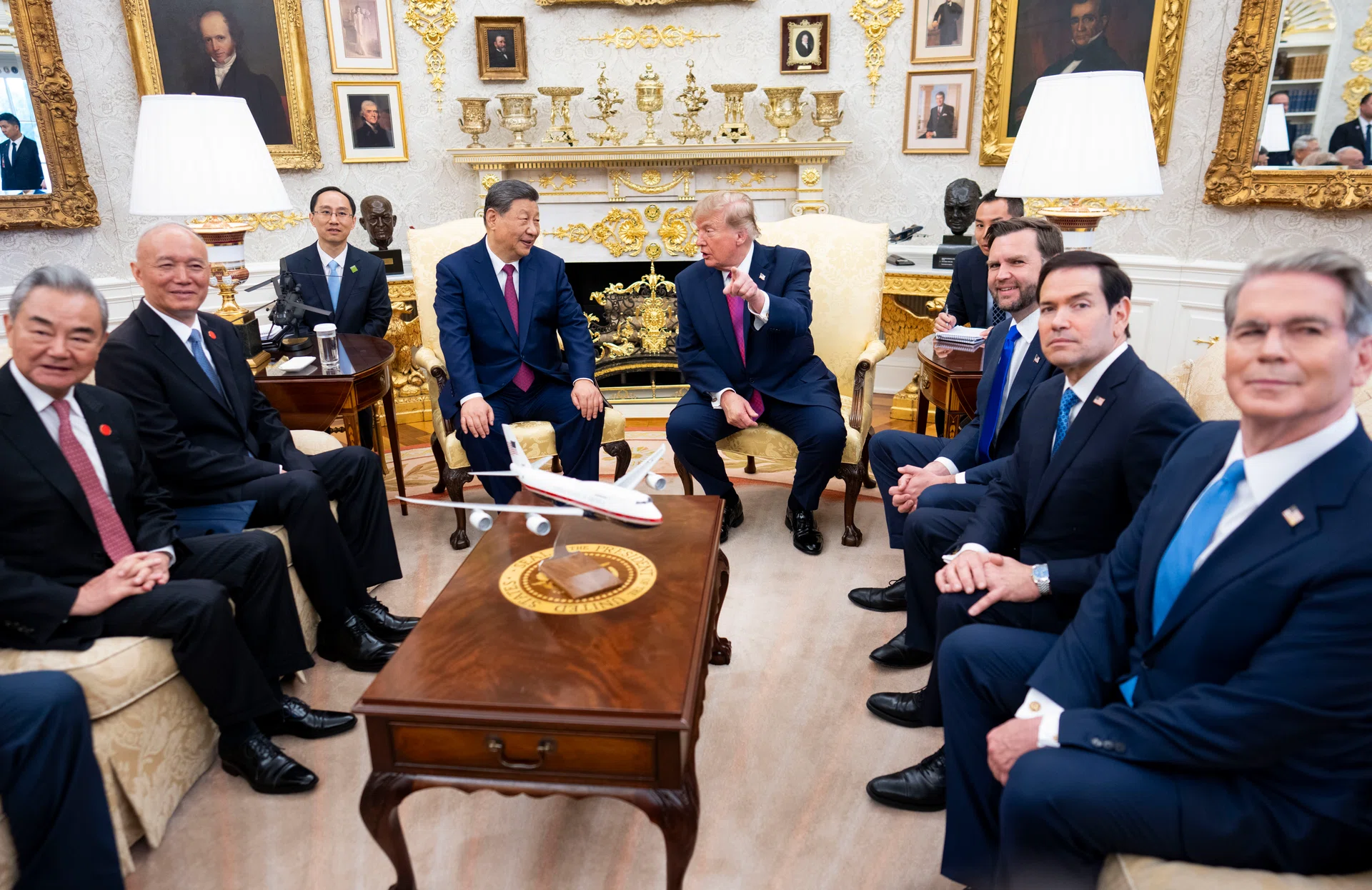
A hotline or a notification channel tells one government what the other is doing. Neither puts a ceiling on what a model can do. At home, Trump's team is divided over whether and how far to regulate AI, according to the Los Angeles Times, and Bessent has favored modest, voluntary guardrails that have shaped administration policy in recent months [9]. The evidence supports planning without a negotiated capability limit from either government. It does not show an absence of federal policy, because voluntary guardrails already exist. The two leaders met privately with aides in the Oval Office [14], and the Times report does not include an outcome from that meeting.
Trump's post put the check somewhere else: "Our guardrail is the DOJ!" [1]. In my view, a guardrail run by the Justice Department acts after a product has shipped, and it reaches whoever shipped it. Meanwhile the model under that product will keep changing. OpenAI and Anthropic, widely viewed as building the most advanced models, have both begun using their most sophisticated models to train the next generation, a process known as recursive self-improvement, the Times reports [10].
A team deciding what to build this quarter can sort its roadmap with two questions. The first is whether a feature gets riskier as the model under it gets more capable. The second is whether the team's own monitoring or a prosecutor would find a failure first. Features that come out "riskier" and "prosecutor" need controls the team owns, re-run on every model upgrade, because no negotiated limit sits between the next model and the user. Features that get riskier but that the team's own monitoring would catch can follow the vendor's release cycle, with a re-test at each version. Features whose risk does not change with model capability need no new work because of this week's news.
What to watch
- Whether the Oval Office meeting produces the hotline Mehta expected, and who in each government is assigned to staff it.
- The date and agenda of the next U.S.-China AI Dialogue meeting, and whether the U.S. notification proposal is accepted.
- Any Justice Department action tied to AI development, now that Trump has named the department as the guardrail.