Invest1 distinct publisher3 min readPublished
The only measured number in the file is one Portland intersection's average speed dropping from 39 mph to 30. Costs stay unpublished on both sides, which leaves the cheaper-than-enforcement case resting on mechanism alone.
The Investor · Invest desk

Compiled by The InvestorSomething wrong?How this is made
Portland's first test intersection on Southeast Powell Boulevard went from a 39 mph average to 30, which is the posted limit, according to Peter Koonce, who runs the city's signals and street lighting [9]; that is 23% off the baseline [1], and the square of the ratio, which is how kinetic energy scales, comes to 0.59 [2]. That second figure is arithmetic performed on two speeds rather than a crash count, and it should not be spent as though it were one.
Albuquerque's contribution to the file is a credit, not a measurement. The city attributes a dramatic drop in crashes and injuries on Lead and Coal avenues to the retrofit [2][5], its municipal development director Jennifer Turner says a driver learns quickly on that corridor that speeding means stopping [6], and a resident describes the middle-of-the-night racing and the car that ended up in a neighbour's yard as things that have stopped [7]. It is all plausible, but none of it is a before-and-after with volumes attached, and David Hurwitz, the Oregon State transportation engineering professor assessing the Portland deployment, effectively says so when he declines to draw sweeping conclusions and names more red-light running as the offset that would eat the gains [10][11].
The procurement case is thinner than the pitch. Albuquerque did not swap enforcement for signal logic; it set up three speed cameras near the rest-in-red stretch, and officials say that combination made the signal approach stronger [14]. The corridor with the crash claim attached therefore carries both lines, and no capital cost, operating cost or per-corridor figure appears anywhere in the account for either one [5]. So the cheaper-than-enforcement argument is at present an argument about mechanism, not money: signals hold red until a vehicle is detected and hand an early green to anyone at or under the limit [3][4], which means the sanction for speeding is delay, collected at the stop bar, with nothing to mail, contest or adjudicate.
The reason to watch this is that green time is an asset every city already owns and mostly gives away on a fixed schedule, and this configuration prices it: the offender pays in his own seconds, which is the only traffic penalty that never needs a collections process. Jay Beeber of the National Motorists Association takes the other side, arguing it is wishful thinking that drivers pay enough attention to learn the relationship, that they will arrive at a red and simply be frustrated without knowing why, and that an education campaign or something less intrusive would do more [12][13].
Rebecca Sanders of Fehr & Peers, who led a 2019 report at Arizona State University and Toole Design on speed management, found only Los Angeles trying rest in red among the cities surveyed, and only briefly [16]; seven years later [3] the named roster runs to five cities including that lapsed one [4], and how thin that roster still is says something about how far this idea has actually spread. What would falsify my read is narrow and checkable: if Albuquerque's crash drop does not hold once the three cameras are controlled for, the signals were the cheap sidecar to enforcement rather than a substitute for it.
Ranked by verification strength, evidence, and original report placement.
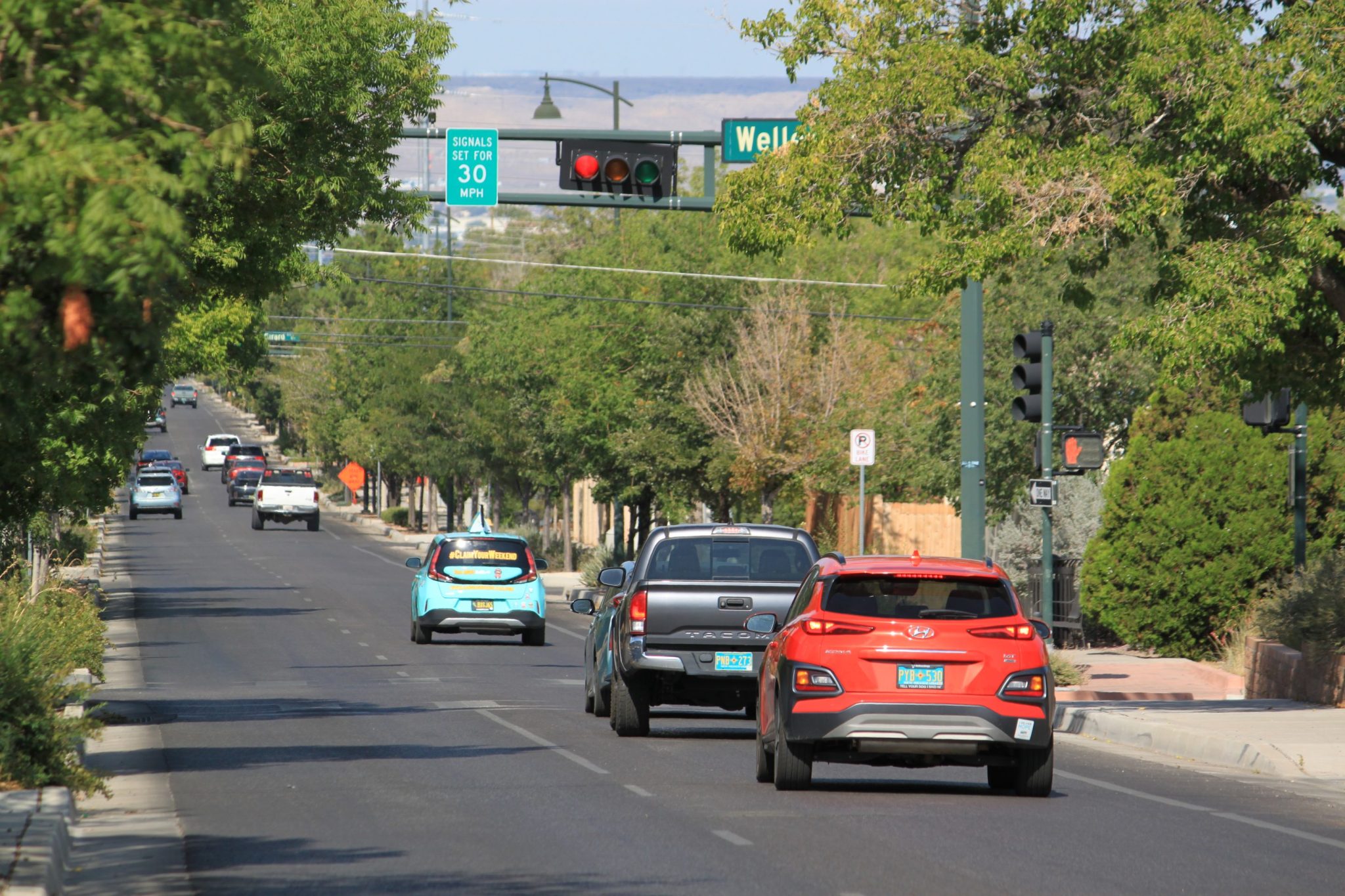
Albuquerque officials struggled for years to curb high-speed crashes along a residential corridor, and simply punishing speeding drivers did not seem to work.
The city of Albuquerque credits the approach of rewarding law-abiding drivers with fewer red lights for a dramatic drop in crashes and injuries along one busy stretch of road.
"Rest in red" is a longstanding traffic safety concept in which traffic signals default to red until a vehicle approaches.
Albuquerque and Portland, Oregon, extended rest in red by adding speed sensors that grant a much earlier green light to drivers travelling at or below the posted limit.
Albuquerque deployed the strategy on Lead and Coal avenues, parallel one-way streets.
Portland recently rolled out the concept during late-night hours on Southeast Powell Boulevard, a busy state highway with a long history of crashes, including fatal ones.
Distinct publishers with included, body-backed reporting in this cluster.
Follow any of these and your For You feed starts watching them — no settings page required.
invest
Harvard's $2.2 billion SpaceX position is half its disclosed US equity book1 distinct publisher
invest
The remedy New Mexico won at trial is the one Meta's $18 billion settlement does not contain1 distinct publisher
invest
Alaska's disappearing lakes make permafrost thaw an asset-level observable1 distinct publisher
invest
Hormuz stays shut, and Iran's reopening terms are all addressed to Washington1 distinct publisher
Evidence-backed comparisons of source perspectives and observed adoption signals. Read the methodology
Which Builder, Operator, and Investor concerns the observed source mix emphasized—not a truth score.
Evidence, demonstrated adoption, hype gap, incentives, and confidence are assessed independently, each on its own current evidence. How these are measured.
One official's stopwatch, and adjectives everywhere else
Count the quantities: 39 mph to 30 mph at a single Portland intersection, reported by the city employee who manages the signals. That is the whole measured record for the design this story is about. Albuquerque's crash-and-injury improvement is an adjective supplied by Albuquerque. The one hard crash percentage in the file, North Carolina's 43%, describes a plain default-red system with no speed sensors — a cousin, not the same thing. The Oregon State evaluation that could settle it is explicitly unfinished.
Two live corridors, five cities, one retreat
Real metal in the street, but very little of it: one Albuquerque corridor of paired one-way streets, and Portland's Powell Boulevard on late nights only. Boulder and Long Beach have small targeted versions; Los Angeles tried feedback-triggered reds and stopped. The trajectory is genuine and slow — a 2019 national survey turned up exactly one city, and seven years on the tally is a handful, with Fortune itself noting cities have been slow to embrace it.
'Dramatic' is doing a number's job
The framing runs ahead of the file in two specific places. Punishment is said not to have worked in Albuquerque — yet three speed cameras sit on the same stretch and officials credit them with strengthening the result, so the reward-beat-enforcement story is untestable as told. And 'dramatic drop in crashes and injuries' is an unquantified claim by the party being evaluated. Fortune deserves credit for carrying Hurwitz's warning about red-light running and Beeber's doubts in the same piece; the overstatement lives in the official quotes and the absent cost case, not in the reporter's handling.
Nearly every voice is grading its own corridor
Turner runs Albuquerque's municipal development and Koonce runs Portland's signals; both are describing the performance of systems they deployed. The Oregon State team helped Portland select the detection hardware and now evaluates it, which is the cleanest conflict in the story and also the one Hurwitz handles most carefully. Beeber speaks for a drivers' advocacy group with a standing position against intrusive traffic control. Sanders now works at a transportation consulting firm that sells this kind of advice, and even Romero's endorsement arrives via a home-security business that takes him through other neighbourhoods. None of this is disqualifying; all of it means the favourable readings come from interested parties.
Internally coherent, externally unchecked
We are confident about what was said and by whom: the names, roles, quotations and the two speeds are specific and consistent, and the mechanism is simple enough to reason about. We are much less confident about effects. A single publication supplies the entire record, the corridor with the boldest outcome claim also has cameras on it, and the study designed to test for offsetting harms is still running.