Invest1 publisher3 min readPublished
Seven-tenths of the decade's home price gain landed after the 2021 no-bubble call
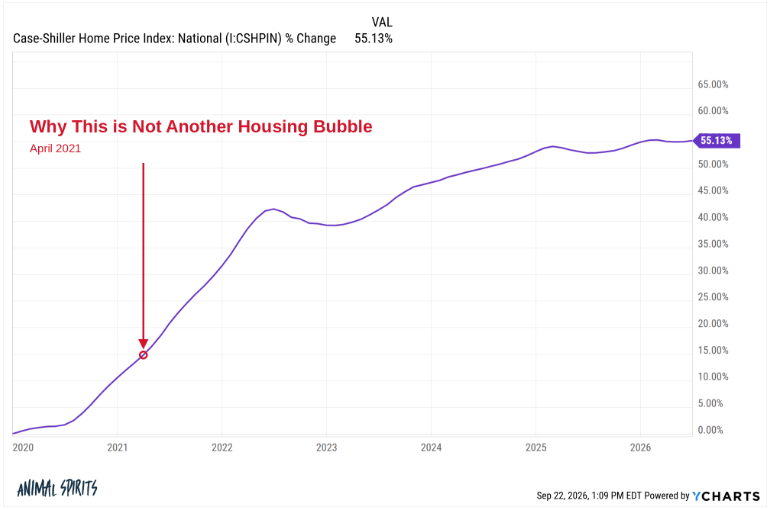
The Case Shiller national index is up more than 55% for the 2020s without a price crash, because 40% of homeowners owe nothing, most of the rest refinanced below 3%, and the adjustment came out of sales volume.
The Investor · Invest desk
What happened
- Nationwide home prices are up more than 55% for the 2020s, with 33% of that gain coming after a spring 2021 blog post argued the run-up was not another housing bubble.
- Housing starts in the 2020s never approached mid-2000s levels even with more than 40 million additional people in the United States, so no inventory glut built up behind the price move.
- Forty percent of American homeowners have no mortgage at all, and the largest age cohort in the country is now 33 to 37, in its prime homebuying years.
Compiled by The InvestorSomething wrong?How this is made
Why it matters
- constraint Housing downside has to be underwritten as a volume problem: with 40% of owners debt-free and most of the other 60% paying below 3%, there is no forced-selling channel to convert a price decline into distressed supply.
- decision Anyone allocating to commissions, origination or title is now choosing whether to price a fourth year of crash-era transaction counts, because three of them have already happened while prices rose.
- contradiction The no-bubble case rests on lending standards, supply and rate lock, with affordability left out, so the same sales data fits owners refusing to sell or buyers unable to buy.
- exposure Record home equity puts owners first in line to absorb any future price decline. The loss stays off lender collateral until that cushion is gone.
Compound the two legs and the decade comes to 54.3%: 1.16 times 1.33 is 1.5428, a shade under the more-than-55% figure the post reports [5]. Multiplying two rounded percentages does that. The date split matters more. Of those 54 points, 38 came from the second leg, because the 33% gain applied to a base already 16% higher [6]. Roughly seven-tenths of the decade's increase arrived after the spring 2021 call [6][2][3].
Now the seller side. Forty percent of American homeowners own their houses free and clear [7]. The other 60% carry a mortgage [8]. That group had well over a year to refinance at 3% or less before rates reached 6% [9][10]. Housing is the largest line item in most household budgets, and awealthofcommonsense.com says most homeowners did not want to give up those low rates [11]. Selling is optional for them.
Housing starts in the 2020s never got close to mid-2000s levels, and the country now holds more than 40 million additional people; overbuilding was one of the reasons the last cycle broke [14]. Speculation did not arrive either. The post's example is a friend who bought a rental property in 2021 and meant to keep borrowing to add more every year, then stopped at one house when rates went from 3% to 6% [18]. In 2006 and 2007, by the same account, buyers put very little money down and took teaser-rate loans [17].
Volume took the adjustment instead. Existing home sales have run for about three years at levels last seen at the depths of the mid-2000s crash [12]. "There wasn't a crash in prices but there was a crash in housing market activity," the post said [13].
The post does not put a number on affordability. Its 2021 list cited affordability being far worse in other countries [1], and it notes that the largest age cohort in America is people aged 33 to 37, sitting in prime homebuying years [16]. Two readings fit the same sales data. Either owners will not sell at 3%, or buyers cannot clear the price at 6%. The post argues the first, and rests the no-bubble verdict on lending standards, the absence of speculation and the absence of an inventory glut [19].
I would underwrite the volume recession here, not a price decline. Commissions, origination, title and the spending that travels with a move are all levered to transaction count, and count has sat at crash-era levels for three years while prices rose [12][4]. The counter-case is simple. If rate lock is what froze the market, a decline in rates releases owners and buyers at once, volume returns quickly, and affordability was a financing problem all along. What would settle it: existing sales recovering in count while prices stay flat or rise [12].
What to watch
- Housing starts: a sustained move toward mid-2000s levels would be supply finally answering a 55% price move, and would undo the no-glut half of the case.
- Forced sellers appearing among the 60% of owners who still carry a mortgage. That is the only condition under which the record equity cushion gets tested.