Product1 publisher3 min readPublished
Voyah's Passion S starts at 229,900 yuan. That figure, not the tunnel loop, is the input
The Dongfeng brand's new electric SUV pairs an 800V platform and Huawei's ADS 5.0 with a $33,800 entry price, and Stellantis has already agreed a joint venture to sell the brand in Europe.
The Product Desk · Product desk
Drafted by a language model from the sources cited here and checked against its claim ledger before publication. How we use AISend a correction
What happened
- Dongfeng's premium brand Voyah launched the Passion S electric SUV on Friday.
- The Passion S launched in three trims priced from 229,900 to 279,900 yuan, roughly $33,800 to $41,200.
- The car uses an 800V platform with an 81kWh or 98kWh battery, CLTC range of 630 to 740km, and 5C charging that takes it from 20 to 80% in ten minutes.
- The dual-motor version produces 637hp and 765Nm; Voyah quotes 0 to 62mph in 4.5 seconds and claims 93.8% drivetrain efficiency from its silicon carbide system.
- The Passion S runs Huawei's Qiankun ADS 5.0 with a dual-path 896-line lidar and five 4D millimetre-wave radars, covering assisted driving on city roads and motorways and automated parking.
Compiled by The Product DeskSomething wrong?How this is made
Why it matters
Dongfeng's premium brand Voyah launched the Passion S electric SUV on Friday in three trims, priced from 229,900 to 279,900 yuan, or roughly $33,800 to $41,200 [1][2]. The promotional stunt that got the car attention is disposable; the entry price attached to that specification is not, because Stellantis agreed in May to a European joint venture to sell Voyah's cars, and the brand already retails in the Netherlands and Norway [9].
What 229,900 yuan buys, according to Voyah's own launch figures: an 800V platform with an 81kWh or 98kWh battery, CLTC range of 630 to 740km, and 5C charging rated at 20 to 80% in ten minutes [3]. Take the larger pack and that charging claim implies an average of roughly 353kW sustained across the window, or about 292kW on the 81kWh pack [3]. The dual-motor version is quoted at 637hp and 765Nm, 0 to 62mph in 4.5 seconds, and 93.8% drivetrain efficiency from its silicon carbide system, a vendor number with no independent test behind it [4]. Driver assistance is Huawei's Qiankun ADS 5.0, with a dual-path 896-line lidar and five 4D millimetre-wave radars, covering assisted driving on city roads and motorways plus automated parking [5].
Two arithmetic points for anyone costing a competing programme. The gap between the cheapest and most expensive trim is 50,000 yuan, about 21.7% over the base [1] - a narrow ladder that leaves little room to sell range or software as an upsell. And if the base trim carries the smaller pack, which the source does not confirm, the whole vehicle retails at roughly $417 per kWh of installed battery capacity [4]. That is the number a European product plan has to survive, not the launch video.
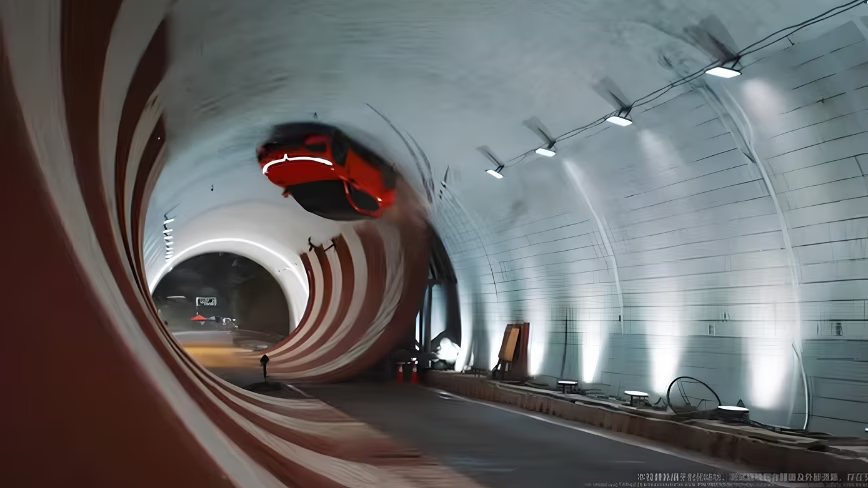
The stunt itself: the Passion S drove a full loop around the ceiling of a closed test tunnel in Wuhan, a deliberate restaging of the 2010 Mercedes SLS AMG advert [6]. Voyah says the car hit the ramp at about 130km/h with 16 degrees of steering lock and that a few kilometres per hour slower would have dropped it [7]. The company insists it used a standard production car with no effects and has released uncut footage; a leaked clip of an earlier attempt, in which the car falls from the ceiling, is the more convincing evidence that nothing was rendered [8]. TNW's reading is that with new models arriving weekly, a tunnel ceiling is a rational marketing line item [12]. That is the correct reading. The theatre is cheap; the specification is what took investment.
The context is a home price war that has pushed specification up and prices down at the same time [11], and a European market where Chinese brands have taken a record share of electrified sales [10].
Three things to watch. First, what the Stellantis joint venture actually lists the Passion S at in Europe, and how far above 229,900 yuan the converted sticker lands [2][9]. Second, whether Huawei's ADS 5.0 ships in European cars at all, or whether the software content is stripped for export [5]. Third, whether independent range and charging tests hold up the CLTC figures and the ten-minute claim [3].