Product1 publisher3 min readPublished
ANKA III flies with two SÜPER ŞİMŞEK drones, and the unit of air capability becomes a package
TUSAŞ has flown its stealth UCAV carrying two jet-powered expendable drones. The carriage arrangement has moved from an expo stand to airborne test, and the thing being bought changes with it.
The Product Desk · Product desk
Drafted by a language model from the sources cited here and checked against its claim ledger before publication. How we use AISend a correction
What happened
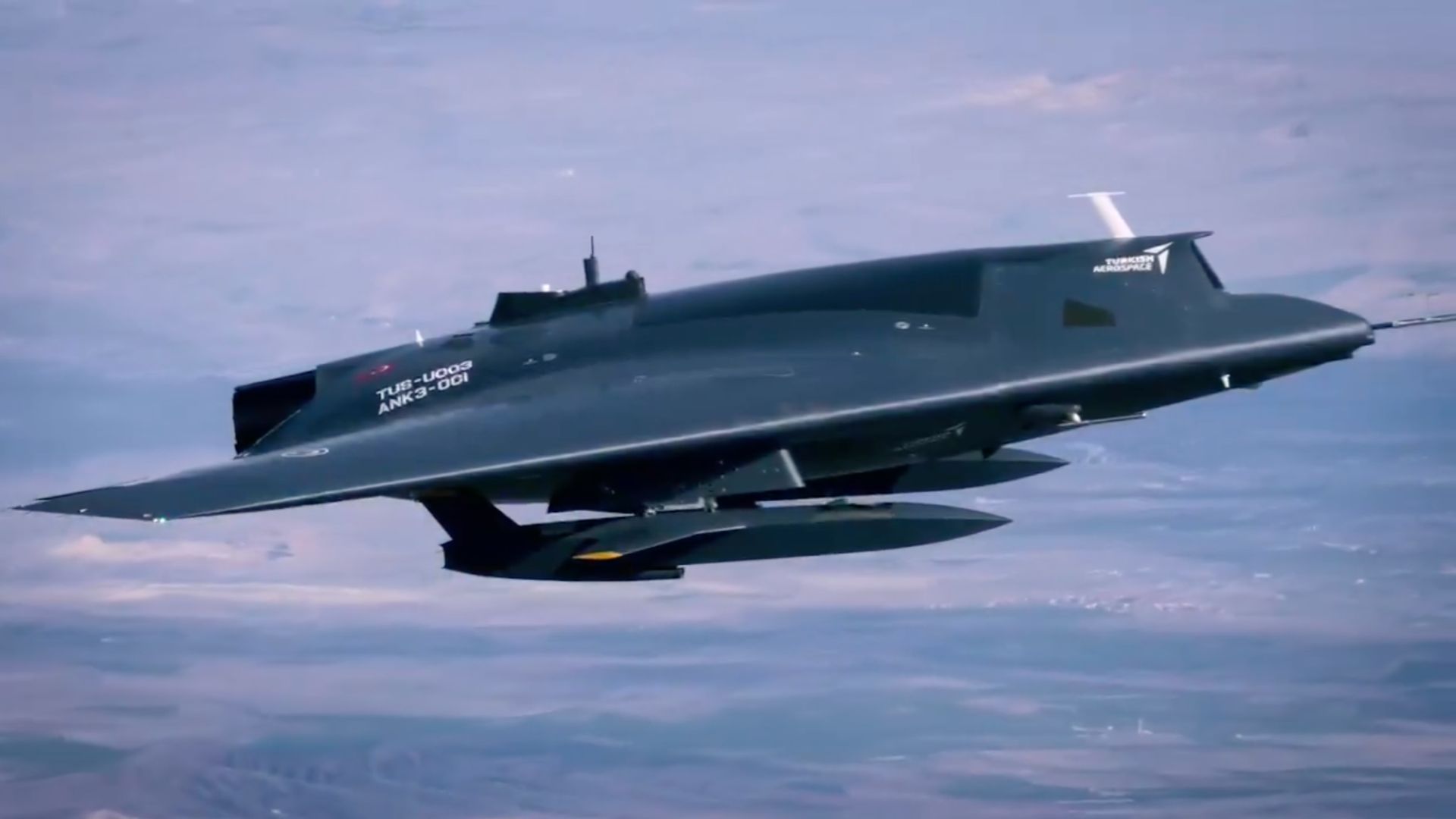
- Turkish Aerospace Industries (TUSAŞ) released flight imagery showing the ANKA III flying-wing UCAV with two jet-powered SÜPER ŞİMŞEK UAVs under its wings.
- TUSAŞ posted the video with the message "Gizli Güç!", which means "Secret Power".
- Turkish Aerospace had already shown ANKA III carrying two SÜPER ŞİMŞEK vehicles at SAHA Expo 2026.
- The August 14 demonstration shows that the two-aircraft carriage arrangement has progressed into airborne testing.
- TUSAŞ describes ANKA III as a turbofan-powered UCAV that can fly up to 40,000 feet, reach a top speed of Mach 0.7 (489 mph) at 30,000 feet, and stay airborne up to 10 hours, supporting ISR, electronic warfare, communications relay and work with manned and unmanned teams.
Compiled by The Product DeskSomething wrong?How this is made
Why it matters
Turkish Aerospace Industries has released flight imagery of its ANKA III flying-wing UCAV carrying two jet-powered SÜPER ŞİMŞEK UAVs under its wings, posted with the caption "Gizli Güç!", or "Secret Power" [1][2]. The same two-aircraft carriage arrangement had previously been shown statically at SAHA Expo 2026, and according to the report the August 14 demonstration moves it into airborne testing [3][4].
The interesting part is not the photograph but the arithmetic of what is being hung on the wings. TUSAŞ describes ANKA III as a turbofan UCAV that flies to 40,000 feet, tops out at Mach 0.7 (489 mph) at 30,000 feet, and endures up to 10 hours, with ISR, electronic warfare, communications relay and manned-unmanned teaming roles [5]. SÜPER ŞİMŞEK is a 13-foot vehicle with a 441-pound maximum takeoff weight, a 110-pound payload, a 35,000-foot ceiling and a top speed of Mach 0.85 (647 mph) [6]. So the carried drone is roughly 158 mph faster than the aircraft carrying it [7], its useful payload is about a quarter of its own gross weight [8], and the mother ship's ceiling sits 5,000 feet above the child's [9]. Two of them is up to about 882 pounds of external carriage [10]. That is a launcher, not a weapons pylon.
The separation event that has actually been demonstrated is more modest than the pairing implies. On April 8, 2025, ANKA III released a SÜPER ŞİMŞEK in flight at about 10,130 feet and 150 knots [11], which is roughly 173 mph [12] and about a quarter of ANKA III's stated ceiling [13]. Nothing in the source shows separation at altitude, at cruise speed, or with both stores on the same sortie.
What makes this a package rather than a payload is the kit list. TUSAŞ presents SÜPER ŞİMŞEK as an expendable autonomous unit whose equipment can augment radar and infrared signatures, provide electronic support, jam, deploy countermeasures or conduct attack missions, and it can fly autonomously and take mission updates in the air [14]. The report frames the concept as the larger aircraft carrying smaller autonomous systems into dangerous airspace and releasing them for surveillance, electronic warfare, deception or strike [15]. One airframe, roled by fit, is a procurement pattern operators will recognise: the buying decision moves from platform to inventory of effects.
The layer above is still a slide. At the World Defense Show 2026, Turkish Aerospace showed a concept in which a crewed KAAN fighter works with ANKA III UCAVs [16], but the report is explicit that the full three-level arrangement has not been shown in public [17]. The component that has moved fastest is the cheap end: in March 2026 Türkiye said several SÜPER ŞİMŞEK vehicles had joined the Turkish Air Force [18].
Three things to watch. First, the release envelope: whether separation is demonstrated near 30,000 feet and Mach 0.7 rather than at 10,130 feet and 150 knots [11][5]. Second, whether both stores are released on one sortie, since carriage of two is what the imagery shows [1] and single release is what has been shown [11]. Third, interoperability, which the source treats as conditional, arguing NATO options in contested airspace depend on future versions having secure communications and working with allied networks [19]. Note also that the report dates the carriage flight only as August 14, without stating a year [20].