Leadership1 publisher3 min readPublished
Late-stage marks fell four times harder than seed in Carta's year-over-year valuation data
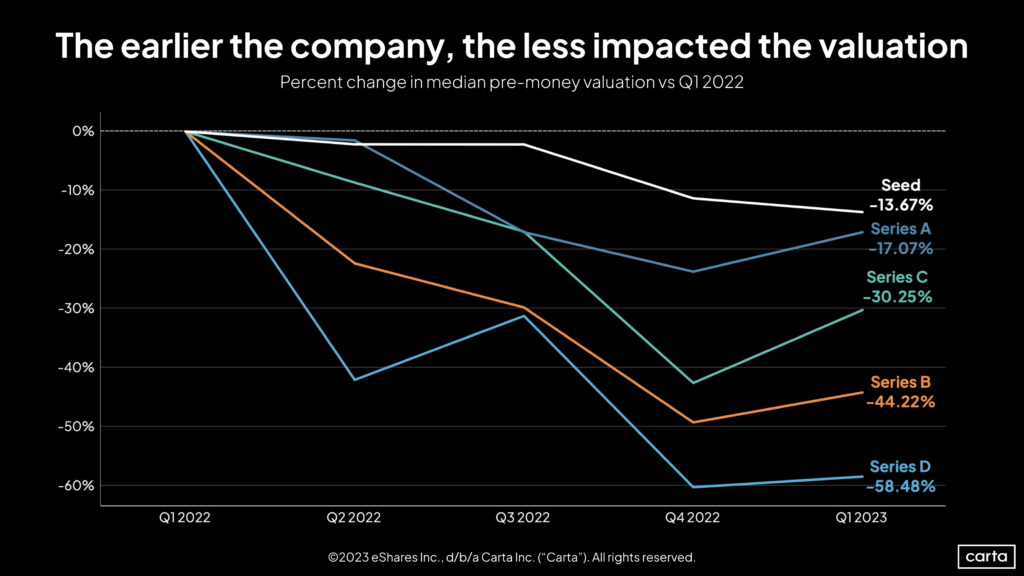
Carta's Q1 2023 medians put Series D 58% below a year earlier and seed down 14%. Portage's Stephanie Choo calls the last round's valuation close to irrelevant, and the negotiating has moved to deal terms.
The Board Room · Leadership desk
What happened
- Carta's Q1 2023 data put the median Series D valuation 58% below the same quarter of 2022, with Series B down 44% and seed, the most resilient stage, down 14%.
- Against the prior quarter rather than the prior year, valuations trended slightly up at every stage from Series A to Series D, an uptick Carta says barely dented the longer-term declines.
- Carta ties the reset to inflation, interest rates and falling public-market valuations, and Choo says most startups' own operations and finances have not changed much.
- More venture-backed companies are raising SAFEs and convertible notes instead of a new priced round, which brings in capital without setting a new valuation.
- The share of priced rounds carrying investor-friendly terms such as participating preferred shares and cumulative dividends has spiked. Carta says negotiating power is still moving.
Compiled by The Board RoomSomething wrong?How this is made
Why it matters
- constraint A board still modelling off a 2021 Series D price is modelling off a number the market would have to rise about 138% to reach again, so a flat or down round belongs in the base case, not the downside case.
- decision Choosing a SAFE keeps the price question off this quarter's table and hands it to whoever leads the next priced round, on that round's comps.
- cost Defending the headline number costs something elsewhere: the concession moves off the price and into the term sheet, where it is harder for a board to see in a single slide.
- exposure Companies whose 2021 marks were set by hedge funds, mutual funds or corporate investors are the most exposed now, because the bid that produced the mark has left the market.
The declines are easier to plan against as round trips. A median Series D valuation of 100 in Q1 2022 stood at 42 in Q1 2023 [1], and moving 42 back to 100 takes a rise of about 138% [1]. At Series B, the round trip is roughly 79% [2][2]. At seed it is roughly 16% [3][3]. In percentage points, the late-stage cut is about four times the seed cut [4].
Stephanie Choo, a partner at Portage who runs the firm's investment team in North America [5], said the reference point itself has stopped working. "It's been very tricky in this world now, where, in my opinion, the last round of valuations are kind of irrelevant," Choo said, "because the market has corrected so dramatically. How do I value a company that raised a large round in 2021? It's really hard." [6]
She has not seen a matching change inside the companies. "Have some of these companies fundamentally changed their outlook in terms of numbers? I don't really think so," Choo said [8]. Alexander Civetta, an associate at Mintz who helps startups negotiate new rounds [12], said founders have absorbed the reset: "People have always been focused on valuation, and how much money you raise relative to valuation," he said. "But everyone's expectations have been lowered on that front, and people are willing to do a little bit more on the margins to be flexible." [13]
Carta says some startups are protecting their valuation by giving ground to investors elsewhere on the term sheet [10]. "There is always a give and take," Civetta said. "There's just a little bit more give and take now than there was 18 months ago." [14]
On the demand side, Choo points to the exit of non-traditional investors such as hedge funds, mutual funds and corporations as a second reason investors hold more leverage [15]. Those buyers came in during 2020 and 2021, when rates were low and valuations high, looking for returns they could not find elsewhere [16]. "Investors now have a whole lot of other potential choices to invest their money," Choo said. "Credit and fixed income all of a sudden look a lot more attractive. Money is no longer free. So there aren't as many dollars chasing yield as there were in the previous decade." [17]
Carta's post covers valuations, fundraising instruments and deal terms; how companies re-planned runway, hiring or option pricing sits outside it [18]. So the record supports the narrower claim: the last priced round is a weak input into the next one, and the give available to a founder now sits in structure.
A stage median is a blunt instrument. The set of companies that cleared a Series D in Q1 2023 is not the set that cleared one in Q1 2022, and composition alone can move a median by a lot. That is a real limit on the number, and the reference point is broken anyway, because the investor doing the pricing has already said she cannot use it [6].
What to watch
- Whether Q2 marks extend the small quarter-over-quarter uptick Carta recorded from Series A to Series D, or the annual gap widens again.
- Whether the share of priced rounds carrying participating preferred and cumulative dividends keeps climbing once headline prices settle.
- Whether the hedge funds, mutual funds and corporations Choo says left the market come back if credit yields fall.