Product1 distinct publisher3 min readPublished
The demonstration off Virginia showed a towed connector can grab a remotely controlled T38 and hand it fuel, which is a component result rather than the persistence gain the programme is selling, and the autonomy test is still ahead.
The Product Desk · Product desk

Compiled by The Product DeskSomething wrong?How this is made
Spencer Holloway, who directs the future capabilities office for the programme behind the test, framed the problem the way an operator would: every time an unmanned vessel goes back to port for fuel, the Navy "loses persistence" and the mission is interrupted [8]. His immediate customer is hypersonic and precision long-range fires testing, where flight profiles run thousands of miles past a fixed range boundary and the data-collection assets have to be spread out to catch them [7].
Against that, look at what the demonstration measured. Four hundred gallons across roughly 100 connection cycles is about four gallons a connection [15]. The cycle count covers pier demonstrations as well as the at-sea work, which the account describes as dozens of complete exercises [5]. What got tested is how reliably a towed connector can grab a boat, push fuel through a line and let go again [3]. This is a component result. The fuel-logistics claim is a separate thing, and the two get conflated quickly once a demo has a gallon figure attached to it.
The autonomy gap sits in the same account. The T38 was remotely controlled [2], and the next milestone is to fold rendezvous, approach, capture, transfer, disconnection and return to mission into a single autonomous operation [13]. Endurance for autonomous vessels is hard to call solved in testing when the vessel had a human driving it and the autonomous run has not happened yet.
The seven-month clock is the more portable finding, and also the one with a soft edge. Interesting Engineering's account of the demonstration puts it at seven months from concept to real-world testing [6], which is not concept to something a fleet planner can task. Eight Navy organisations appear in the account of this single demonstration [16], with contracting support coming through the Littoral Combat Ship Mission Modules Program Office and the Navy's Portfolio Acquisition Executive for Robotics and Autonomous Systems [12]. Seven months is what a towable rig costs in schedule when the money can ride an office that already exists. That is a schedule worth copying if you buy accessories for uncrewed platforms. How fast anything larger moves is a separate, open question.
What does most of the work on any capability demo is the denominator. The account gives completed cycles, gallons, days and a location, and no attempt count, no failure count, no sea state, and no figure for the T38's tank or its hours on station [17]. A hundred completions out of a hundred tries is a different result from a hundred out of two hundred, and only one of those is a reliability claim. The other question is the delta in the user's unit. Gallons transferred is the rig's unit. Hours on station gained per connection belongs to the range operator, and that number is absent.
Then place the demo on a grid: does it attack the constraint that actually stops the mission, and did it run under the conditions the mission runs in. Getting the right constraint under mission conditions is what produces a capability. This test sits in a different cell: the right constraint under benign conditions, which produces a component that works and a schedule worth learning from. Attacking the wrong constraint, under any conditions, just produces a video.
Ronald Raymer of U.S. Fleet Forces Command described the payoff as pushing USVs into higher-threat areas without risking crewed vessels and personnel [9]. That payoff is downstream of the autonomous run. The 400 gallons buys the connector's credibility and stops there.
Ranked by verification strength, evidence, and original report placement.
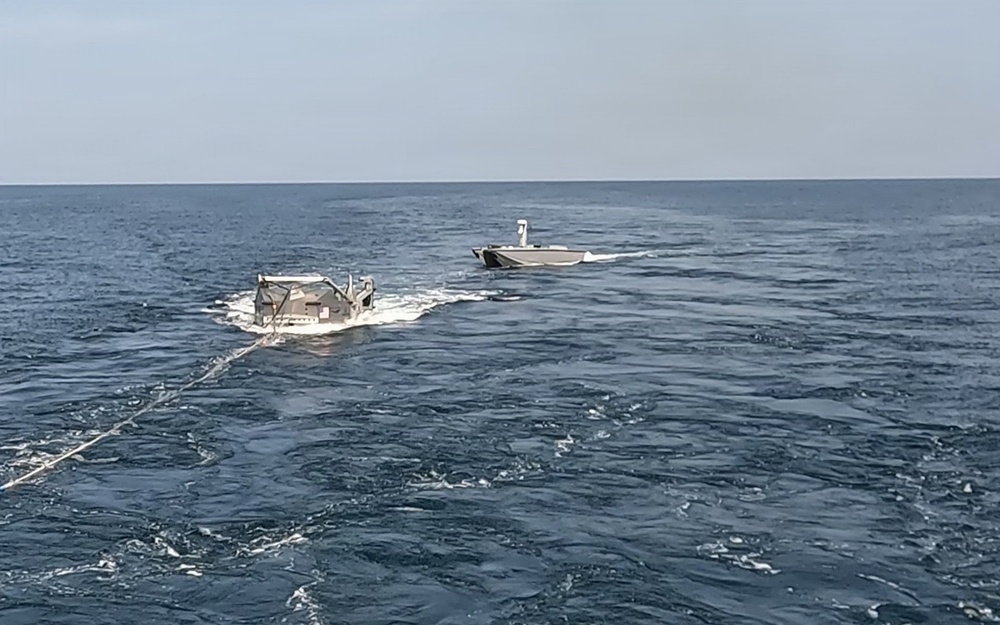
The Naval Air Warfare Center Weapons Division led the at-sea refuelling demonstration last month in waters off Joint Expeditionary Base Little Creek-Fort Story, Virginia.
A Navy-industry team used the remotely controlled T38 unmanned surface vessel and a towable capture and connection refuelling system during the exercise.
The USNS Vindicator training support vessel towed the refuelling system, and the connector repeatedly captured the T38, transferred fuel to it, and released it back into the water.
About 100 connection cycles were completed over several days leading up to and during the event, with 400 gallons of fuel transferred to the T38 in total.
The team conducted dozens of complete exercises at sea, along with demonstrations at the pier.
The system was developed from concept to real-world testing in seven months and could reduce how frequently USVs must return to port for fuel.
Distinct publishers with included, body-backed reporting in this cluster.
1 article · September 5, 2026
Follow any of these and your For You feed starts watching them — no settings page required.
product
Six months from concept to a missile off a robot boat: arming USVs is an integration job now1 distinct publisher
product
Navy moves countermeasure qualification off the jet and onto a 578-foot rail1 distinct publisher
build
A "$100M contract" that is a prize ceiling: how to read a vendor's procurement claim1 distinct publisher
invest
US strikes Iranian launchers on Larak Island days after declaring Hormuz mines cleared7 distinct publishers
Evidence-backed comparisons of source perspectives and observed adoption signals. Read the methodology
Which Builder, Operator, and Investor concerns the observed source mix emphasized—not a truth score.
Evidence, demonstrated adoption, hype gap, incentives, and confidence are assessed independently, each on its own current evidence. How these are measured.
One outlet, one service account
Interesting Engineering's piece is the entire record: two named officials, a named tow ship and base, and counts specific enough to divide (about 100 cycles, 400 gallons, several days). What it lacks is the denominator — how many captures were attempted, how many failed, in what sea state — so the numbers document activity, not reliability, and no second publisher has tested them.
A single demonstration, remotely piloted
One event, off one base, with a human driving the T38 and the connector dragged behind a training support vessel. Nothing in the reporting points to a fielded system, a second hull type, or a repeat elsewhere, and the end-to-end autonomous run is described as the milestone ahead rather than a result in hand.
Persistence promised, connector proven
The quotes reach for reliance on unmanned hulls in higher-threat water; the measurement is roughly four gallons per connection with a person still steering and a crewed ship towing the rig. Component tests do precede capability, so both can hold at once, but the persistence-and-risk argument is doing work the demonstration has not yet paid for.
Programme voices only
Every quoted person sits inside the effort, and the account names the two offices carrying its contracting immediately before announcing an autonomy milestone that will need money and range time. That is a programme making its own case for the next phase; the outlet supplies the figures and no friction, and the unnamed industry partners have the same interest in the framing.
Firm counts, projected payoff
The counts are specific and internally consistent, and a service account is unlikely to invent a tow ship or a cycle total, so we hold the mechanical result with reasonable comfort. The step from 400 gallons to mission persistence is where confidence drops: it depends on numbers nobody has published and on an autonomous test that has not happened.