Build1 publisher3 min readPublished
Europe's AI datacenter plan waits up to seven years for a grid connection
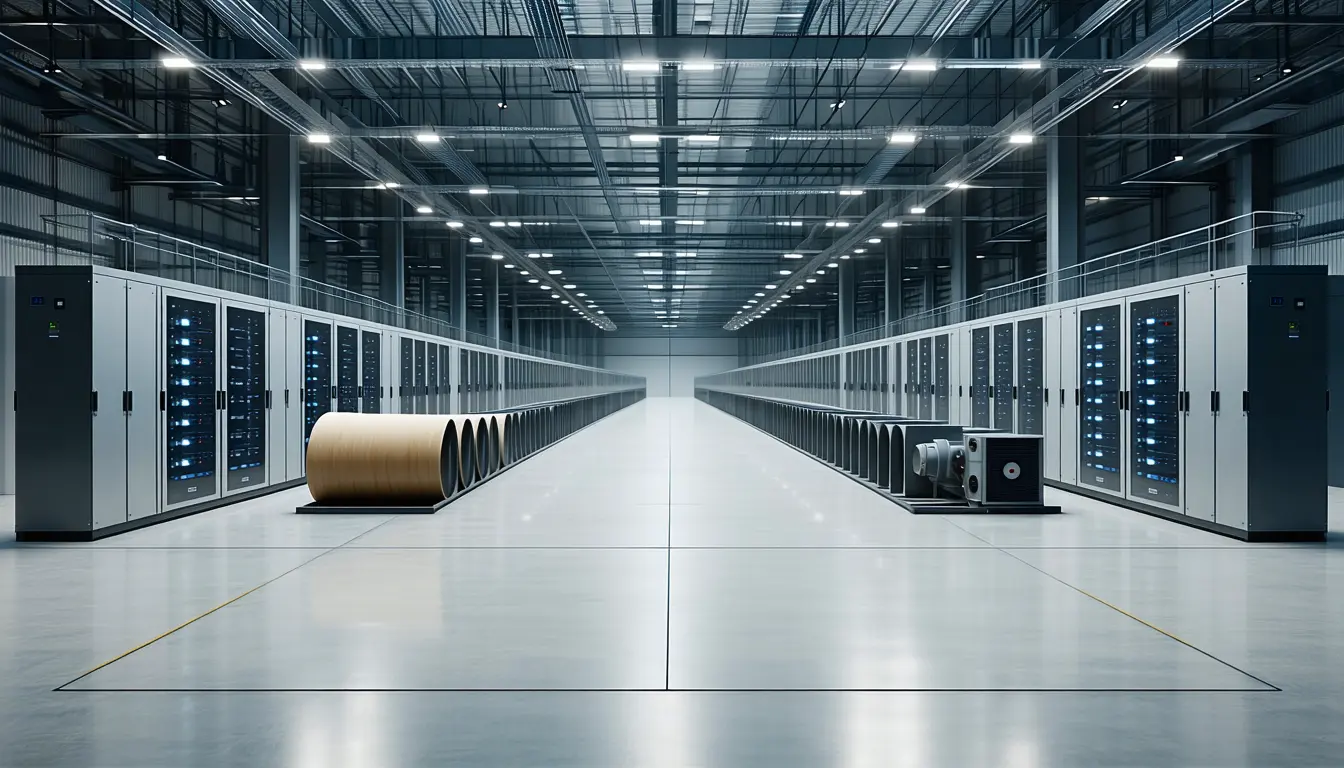
The Reuters account describes an EU where a datacenter takes about two years to build and up to seven to connect, so the seven Commission sites now being bid for depend on transmission capacity that is not there yet.
The Engineer · Build desk
What happened
- The European Commission said in July it would create seven large AI datacenters, and 18 of the 27 member states are bidding for the sites with about EUR 3bn pledged between them for future compute.
- S&P Global Ratings forecasts that the combined capital spending of six mostly American hyperscale datacenter operators could pass $1.3 trillion by 2027.
- The International Energy Agency estimates large energy-intensive industrial users in the EU paid about $107 a megawatt-hour in 2025, more than double the United States level and roughly 57% above China.
- Sixty-eight large datacenter projects have been announced in the EU since 2024, and France, Spain, Finland and Sweden account for 43 of them.
Compiled by The EngineerSomething wrong?How this is made
Why it matters
- constraint Site funding does not shorten a connection queue, so a member state that wins an award without spare transmission capacity still cannot host the load on the timetable the build implies.
- cost A European operator pays roughly twice the American price for every megawatt-hour it draws, and that difference recurs in every year of operation instead of once at construction.
- exposure New AI load joins chemical, steel, cement and aluminium plants in the same connection queues and the same tariff regimes, and output in those sectors has been falling since 2021.
- contradiction mezha.net itself flags the EUR 3bn and the $1.3 trillion as not fully comparable, so the multiple between them measures the difference in what was counted as much as the gap in capacity.
Subtract the build time from the connection time and a finished shell can stand for five years before it draws power [10][1]. The wait comes from the transmission system: it does not always move electricity from regions with surplus capacity to the places where new industrial demand appears, according to the Reuters account relayed by mezha.net [5][20]. Weak cross-border links, large differences in transmission tariffs and slow permitting divide a market that is supposed to be single, and for operators that shows up as longer connection lead times and higher running costs [6].
The price side compounds annually. Take the 100 MW datacenter that the Centre for the Study of Democracy uses to illustrate the cost difference between locations [13]. At full load that is 876,000 MWh a year [2], which at the IEA's $107 figure is about $93.7m of electricity [3]. "More than double" puts the US price at $53.50 a megawatt-hour or less, so the same load there costs under $47m, a difference of more than $46m every year the site runs [4]. The same comparison implies roughly $68 a megawatt-hour in China [5].
Set that against the money on the table. Spread over seven sites, about EUR 3bn is roughly EUR 429m each [6]. Treating a euro as a dollar, that is about four and a half years of the power bill for one 100 MW site [7]. The network needs far more: the Commission's own estimate for grid modernisation and expansion is EUR 584bn by 2030 [9], nearly 200 times the compute pledge [8], and about 40% of EU distribution grids are already more than 40 years old [8].
The reason mezha.net gives for the concentration of projects in a few countries is the pairing of affordable low-carbon electricity with reliable connection options [12].
The industrial record is the evidence that the price is binding. Total European manufacturing output in 2025 was only about 1% above 2021, and chemical production fell 19% over that period, on Eurostat data analysed by Marius Koeppen, senior analyst at the Centre for the Study of Democracy [15]. Basic metals and steel fell 16%, cement 14%, aluminium 11% [16]. The report lists other causes as well: weaker global demand, relocation of European production to the US and China, and stronger competition from Asian companies [17]. Most sectors recovered after the pandemic and the energy crisis that followed Russia's full-scale invasion of Ukraine; the energy-intensive base did not, and mezha.net reports that new energy price rises after the war between the US and Iran are making it worse [18].
The report's conclusion is that Europe falls behind in AI unless it builds a single, genuinely integrated electricity market [19]. Two years ago Mario Draghi, the former European Central Bank president, warned that Europe faced a "slow agony" without renewed investment and productivity, as mezha.net renders the phrase [14].
What to watch
- Whether the seven site awards come with firm connection dates or only with funding.
- How much of the Commission's EUR 584bn grid estimate is committed, and whether transmission tariff and permitting reform reaches a legislative text.
- Whether announced projects outside France, Spain, Finland and Sweden reach connection; that would show the queues shortening.