Product1 publisher2 min readPublished
Yunnan's underwater solar modules generated 324 mWh in two hours at 10 metres
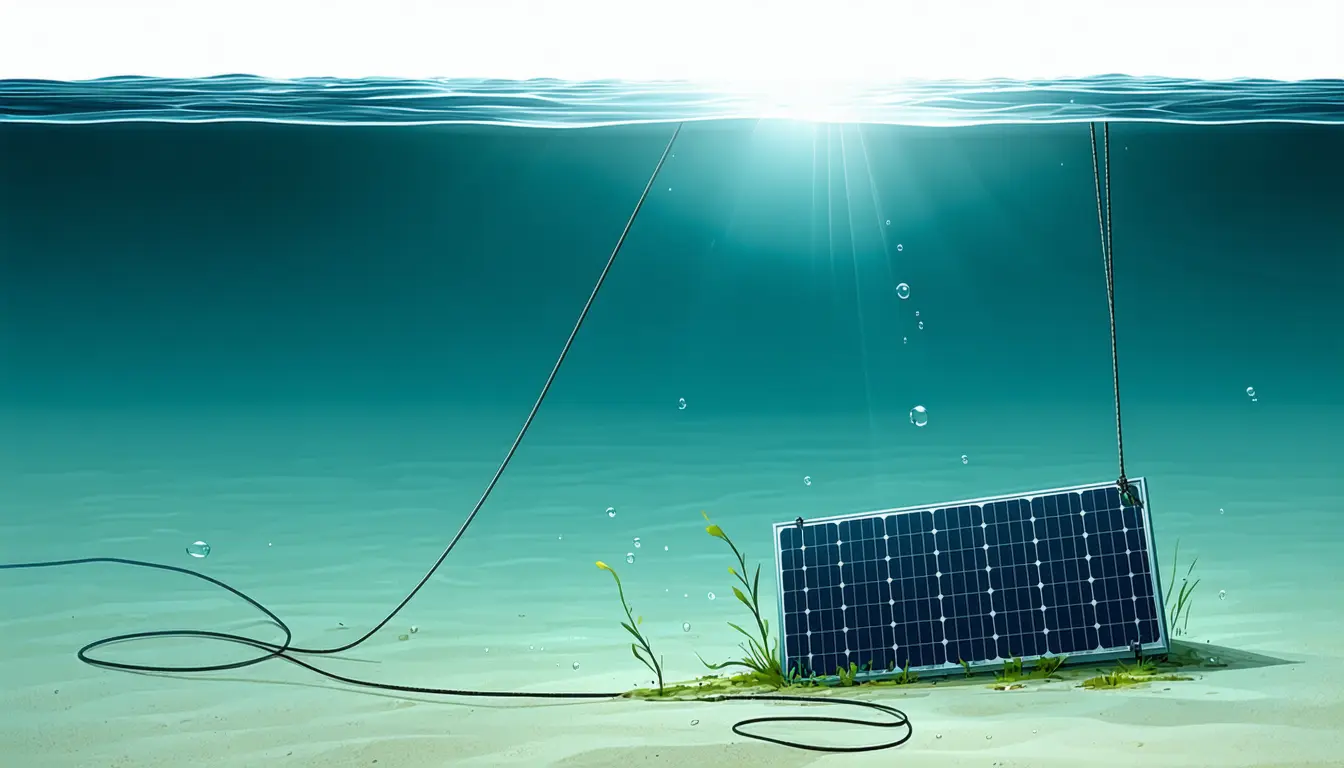
A Yunnan University group has moved submerged photovoltaics from two metres of water down to ten, and reports large-area modules working at that depth. The 5.5-year service life it projects rests on 48 days of degradation testing.
The Product Desk · Product desk
What happened
- Researchers at Yunnan University and Southwest United Graduate School operated functional solar cells at a depth of 10 metres in the South China Sea.
- Previous underwater solar work had stopped in water less than two metres deep, where light is still plentiful but few real applications sit.
- The group used wide-bandgap cells tuned to the blue-to-orange wavelengths that travel best through seawater, because standard silicon is built for red and infrared light.
- The study, published in the journal Joule, estimates a continuous operational lifespan of roughly 5.5 years.
Compiled by The Product DeskSomething wrong?How this is made
Why it matters
- capability Instruments moored 10 metres down could carry their own supply, so an offshore camera would not need a cable to shore or a technician arriving to swap cells.
- decision The lifetime projection is what decides the case for hardware that goes down once and stays; a mooring already serviced yearly for calibration just gains one less battery swap.
- constraint The result settles a depth question and leaves system sizing open, because a designer cannot work out how many panels a sensor needs without the module area.
- precedent If the group's proposed test protocols are adopted, buyers get a common basis for comparing underwater PV claims instead of each team reporting its own conditions.
Instruments moored far from shore get their power from a cable or from batteries someone has to go out and replace, and the study names both as costs submerged photovoltaics would remove [7]. What is on offer is a power source for underwater sensors, monitoring cameras and communication hardware [20].
Sunlight intensity drops quickly with depth, and that loss is what has kept submerged cells out of marine monitoring work such as aquaculture [23]. The published output works out to an average of 162 mW while the modules were generating [8]. That average covers two hours, not a full day. The study says the energy is enough to recharge standard lithium-ion batteries [9]. The account of the study in Interesting Engineering leaves out the module area, the number a power budget needs to get to watts per square metre [22].
The durability testing is much shorter than the projected life. Cells held roughly 96 percent of their efficiency after 300 days of storage [10], and prototypes showed almost no degradation across 1,160 hours at a simulated 10-metre depth off the Weizhou Islands [11]. That run is 48 days [12]. Roughly 5.5 years of continuous operation is about 48,180 hours, so the longest test covers about 2.4 percent of the projected life [13].
Wen-Hua Zhang, the study author, framed the depth as the finding. "This work presents the first functional validation of submerged solar cells practically operating at a water depth of up to about 10 meters, greatly broadening their application scope," Zhang said [14]. On scale, he said: "Moreover, we have achieved scaling from small-area laboratory cells to large-size modules." [15]
Packaging is on the team's own list of remaining problems. It names corrosive salt, high pressure and water ingress among the conditions a deployment has to survive [16], and the cover over the cell has to keep transmitting light clearly while staying durable over long durations [17].
For anyone specifying a subsea instrument, the comparison to make is with your own service interval. If a boat or an ROV already visits that mooring once a year for calibration, submerged PV takes a battery swap off the job list and the multi-year projection stays untested. If the plan is to deploy and leave it there, the design depends on the projection, and that projection has 48 days of near-zero degradation in simulation to support it [11][12]. The group says it will next test how deep the cells can go and begin work on standardized testing protocols for underwater photovoltaics [18].
What to watch
- Whether the team's deeper tests find a depth where output stops covering a sensor's own draw.
- A published module area or cost figure, the input a designer needs to size a subsea array.
- Whether the standardized test protocols the group plans get taken up by anyone outside it.