Product1 publisher3 min readPublished
Benioff says the war destroyed both of Salesforce's UAE backup data centres
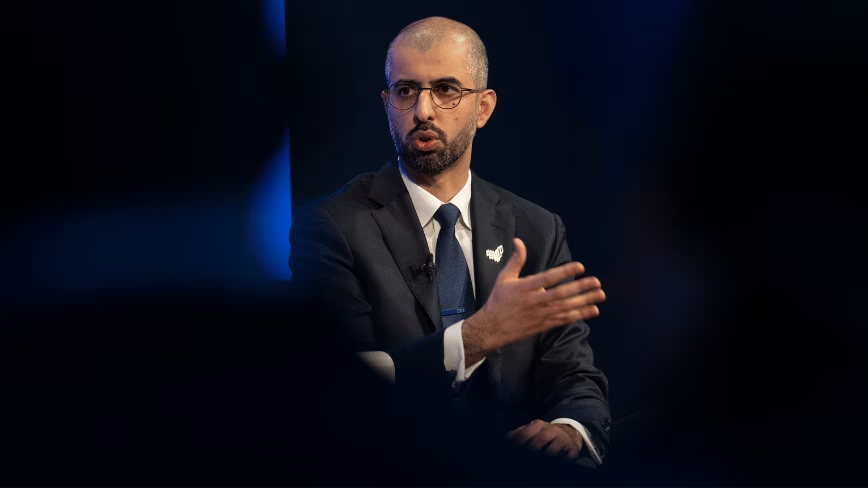
Al Olama told Dreamforce the war cost the UAE nothing in lives or business, in the same session where Marc Benioff said both of Salesforce's UAE backup sites were destroyed and AWS said Bahrain is still down.
The Product Desk · Product desk
What happened
- The UAE will change its requirements for data centres and stop promoting where they are, its AI minister Omar Sultan Al Olama said at Dreamforce in San Francisco on Tuesday.
- Salesforce recovered what it could from the destroyed sites and opened a replacement backup data centre outside the UAE.
- Al Olama said the impact of the war on human lives and on business was zero, that life in the country is now completely normal, and that the UAE intercepted more projectiles than the rest of the region and Israel combined.
Compiled by The Product DeskSomething wrong?How this is made
Why it matters
- contradiction One session carries both a minister's zero-impact assessment and a cloud region that has been unrecoverable for six months, and a buyer sizing regional risk has to decide which of the two accounts its plan is built on.
- constraint If site locations stop being published, the customer loses the only independent way to verify that two regions are far enough apart, and geographic separation turns into a vendor assurance.
- decision Anyone whose backup pair sits inside one country under one provider relationship now has a worked example of that pair failing as a unit, and a reason to move the second copy across a border.
- exposure Workloads pinned to the Bahrain region or the affected UAE zone have spent about 180 days with no site to fail back to. Most recovery commitments do not contemplate a gap that long.
A disaster recovery plan names a primary site and a secondary site. Salesforce's secondary for the UAE was a second building in the UAE, and Marc Benioff said both ran through a relationship with Amazon [4]. The company was surprised that on the first day of the war "both of those data centers were destroyed", Benioff said [5]. That was the whole in-country backup estate, gone in a day [15].
Two sites in one country share that country's air defence. In the first week the UAE faced more than a thousand projectiles and drones, and a launch from Iran takes about two minutes to arrive, according to Al Olama [12]. Amazon Web Services said this week that it cannot restore its Bahrain region or one UAE zone, six months after the strikes [7]. Anything pinned to those locations has had nowhere to fail back to for roughly 180 days [14].
Both facilities failed on the same day, and both were bought through the same provider relationship [4][5].
The disclosure change lands on buyers. Al Olama told Benioff that data centres have become critical infrastructure and a target, and put it this way: "Unfortunately they're more important than bridges. They're more important than roads. They're more important than tunnels because our whole lives are on these devices that we're using" [1][3]. On the fix, he said: "We're not going to promote the locations of data centers for anyone who wants to have any idea to do something with them" [8]. He expects most countries will need to change their rules too [9]. Published site locations are how a buyer checks that two regions are not within range of the same launches.
Al Olama also said the impact on human lives and on business was zero, and that life in the country is now completely normal [10]. He said the UAE intercepted more projectiles than the whole Middle East and Israel combined [11]. In the same period one tenant lost both of its backup sites and has waited half a year for a cloud region to come back [5][7].
The check that would have caught this is a short list, kept per pair of sites, of the single events that take both at once. A shared country belongs on it. So does a shared provider relationship, since the two UAE sites were procured that way [4]. When one item on the list is credible, the pair fails together, and the recovery copy has to sit under a different air defence, a different grid and a different government. Salesforce did that after the fact: it recovered what it could and opened a backup data centre outside the country [6].
What to watch
- Whether AWS gives a restoration date for the Bahrain region and the affected UAE zone, or moves customers to new capacity instead.
- Whether the UAE's revised data centre requirements are published, and whether site-level location detail disappears from provider documentation.
- Whether other governments follow the UAE in restricting data centre location disclosure, as Al Olama said he expects.