Product1 publisher3 min readPublished
Tutor Intelligence puts a 100-robot classroom between its foundation model and the warehouse floor
The second-generation Cassie and Sonny run on Tutor's own foundation models, and the first person to show either robot a task it has not seen is one of the company's remote tutors, staffed internationally and paid by Tutor.
The Product Desk · Product desk
What happened
- Tutor Intelligence announced second-generation versions of its Cassie and Sonny warehouse robots, both running on the company's own robot foundation models.
- Sonny, the dual-armed semi-humanoid introduced alongside Tutor's 4.5-billion-parameter Ti0 vision language action model, has gone from a research platform to a robot the company calls fully deployable.
- Cassie, the large single-arm machine that worked from a fixed position in its first generation, now moves across warehouse floors and is rated to lift 50 pounds and tug thousands of pounds.
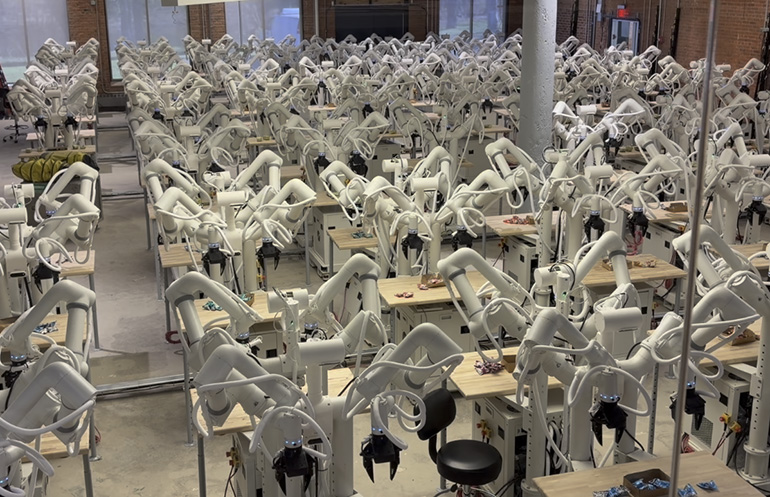
- Tutor built Data Factory 1, a 100-robot factory where Sonny robots run through post-training before the models go into the field.
- Tutor's tutors remote-control a robot to teach a task the first time, then the classroom fleet repeats it, with good runs reinforced by a thumbs up and poor ones marked with a thumbs down.
Compiled by The Product DeskSomething wrong?How this is made
Why it matters
- capability A mobile Cassie removes the fixed cell from the install. The arm travels to the pallets instead of the pallets being routed to a bolted-down station. What a site has to rebuild before day one changes with it.
- constraint The teaching loop described sits on the vendor's side. A plant that invents a task the model has not seen waits on Tutor's tutor roster and its 100-robot post-training fleet, and cannot schedule that work with its own shift leads.
- decision Buyers pick a robot by the geometry of the work: Cassie for pallet aisles and heavy material, Sonny for shelf picking between bins. Getting that wrong is a layout problem, not a software one.
- cost Gruenstein's claim of superhuman performance is checkable only at the buyer's expense. Verifying it means funding and staffing a pilot to generate the throughput numbers the launch does not supply.
Somebody has to show the robot the first time. "We have this team of tutors staffed internationally that can kind of remote control a robot and teach it how to do a new task for the first time," Gruenstein said [8]. After that, the 100 robots in Data Factory 1 go through the motions to fine-tune the behavior, and a robot that does well gets a thumbs up as a positive reward in the model while a poor run gets a thumbs down [7][9].
That placement matters on a floor that changes. A new tote size, or a seasonal SKU the model has not handled, has to be demonstrated by someone before it runs, and the SiliconANGLE account puts that first demonstration with Tutor's own tutors [18].
The split between the two robots comes down to how much each one needs to know. According to Gruenstein, Cassie's physical vocabulary is comparatively small: identify an object, grasp it, move it and place it. Sonny's is much larger, and Tutor built the Ti0 model and DF1 for that larger vocabulary [13]. "Sonny is kind of this co-design with Cassie of what is something that is human-like as a robot, but, you know, not designed just to mimic a human, but to do a class of work that humans do," Gruenstein said [12].
Cassie lifts 50 pounds and tugs thousands of pounds [4]. Take "thousands" at its floor of 2,000 and the towing rating is at least 40 times the lifting rating [17]. Those are two different machines in one frame: an arm sized for a box a person could carry, and a wheeled base sized for a loaded pallet. The first-generation Cassie worked from a fixed position; this one moves across the floor [5].
Gruenstein told SiliconANGLE that "it's really important for us not only that we build these general robots, but they're immediately practically useful" [11]. He also said, "We can get robots that recursively self-improve and are superhuman in their performance relative to people" [10]. Pricing, customers, deployment counts and any path for a site's own staff to record a new task are all absent from the report [19][18].
The $34 million Series A closed in December [6] and SiliconANGLE reported the launch on September 16, 2026 [15], about nine months later [16]. Publicly, that period has produced a room with 100 Sonnys in it, a large arm that now drives itself, and a research platform that Tutor calls fully deployable [7][5][2].
For anyone scoping a pilot, two numbers are worth writing into the contract. The first is days from delivery to the first shift the robot ran without a supervisor beside it. The second is the share of picks or pallet moves it finished with nobody stepping in. Hours powered on misses both, and so does a count of tasks in the library. The third line is commercial: how many days pass between asking Tutor for a new task and having it running on your floor, and who pays for the tutoring hours.
What to watch
- Whether Tutor ships a way for a customer's own staff to record a first demonstration, or keeps that with its internal tutor team.
- Whether Data Factory 1 grows past 100 robots, and whether any named site publishes pick rates or pallet-move throughput.
- How Cassie and Sonny are priced when terms appear: capex per robot, per hour, or per completed move.