Product1 publisher3 min readPublished
Europe's strict product liability reaches standalone software on 9 December
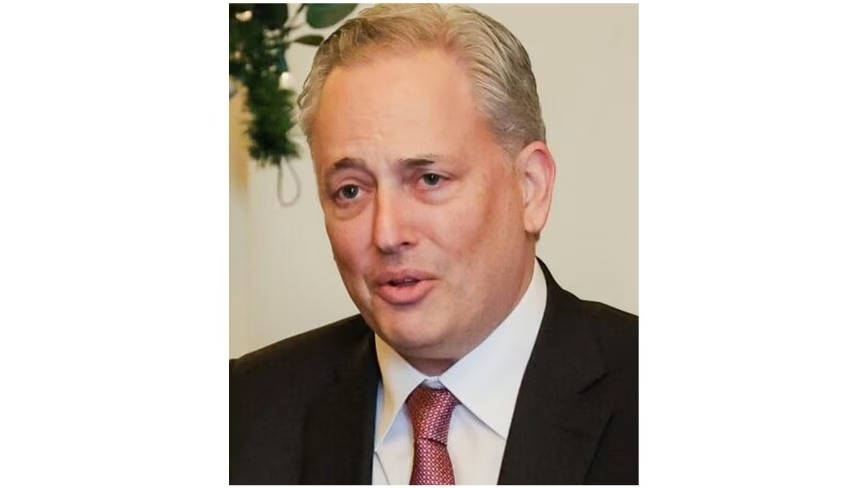
David Sacks told Anthropic and OpenAI to pace the frontier without an antitrust waiver or an approval regime, and said product liability already disciplines them. Europe will run both regimes on the same models.
The Product Desk · Product desk
What happened
- David Sacks told Anthropic and OpenAI to go ahead and slow down, and to stop asking for anything in return, according to ANI.
- From 9 December those rules treat standalone software, operating systems and AI systems as products under strict liability, and a claimant does not have to prove fault.
- The AI Act's systemic risk duties have bound frontier models since August 2025, and since 2 August the Commission can demand evaluations and fine 3% of global turnover.
Compiled by The Product DeskSomething wrong?How this is made
Why it matters
- exposure Post-release behaviour sits inside the liability question, because defectiveness now covers self-learning behaviour that turns unsafe after shipping. The team that pushed the update owns that claim.
- constraint The evaluation and monitoring record becomes the defence, since a court can order disclosure and presume a defect when the claimant cannot readily prove one.
- contradiction Sacks presents liability as the substitute for an approval regime, and Europe is applying both to the same frontier models, so the experiment he proposes never isolates the variable.
- decision Teams shipping operating systems and ordinary standalone software into the EU have to plan for December even if nothing they build is a frontier model.
Sacks, who chairs the President's Council of Advisors on Science and Technology and was the White House AI and crypto czar until March [2], offered a hypothetical that Europe has already written down. If a model enables a serious cyberattack, he argued, the company faces product liability claims, and markets already punish systems that behave unpredictably [5]. From 9 December the EU's defectiveness test takes in cybersecurity vulnerabilities and self-learning behaviour that turns unsafe after release [12].
For whoever owns the release, the change is evidentiary. A claimant does not have to prove fault [11]. Courts can order the defendant to disclose evidence, and can presume a defect where the claimant faces excessive difficulty proving one [13].
Sacks was answering two chief executives [1]. The rule covers standalone software and operating systems alongside AI systems [11]. A great many teams sit inside it who are not building a frontier model [17]. European lawyers have been working through what that means since the summer, in driver assistance as much as in chatbots [16].
What he refused was the price attached to restraint. Companies asking to pace the frontier should stop pretending antitrust law must be suspended "so you can form a cartel", he wrote, and stop demanding an approval process that supersedes product liability [4]. Demanding a regulatory framework as the price of restraint, he wrote, would look like "blackmail" [6]. He also questioned the independence of METR, the evaluator Anthropic uses, saying it is intertwined with the company's investors and staff [7].
Europe's arrangement is different from the swap he describes. The Commission withdrew its proposed AI Liability Directive in February 2025 after deciding the revised product liability rules already covered AI software [10]. But the AI Act's systemic risk duties have bound frontier models since August 2025, and since 2 August the Commission can demand evaluations and fine 3% of global turnover [14]. Both regimes will operate on the same models at once [15].
The argument is playing out alongside a resignation. A pretraining researcher left Anthropic on 8 September saying the industry was gambling with people's lives [8], and the company's alignment science lead put the odds of AI causing human extinction within a decade above 10% [9]. Sacks put the responsibility back on the labs. "The easiest way not to build superintelligence is for you to agree not to build it," he wrote [3].
What sorts the exposure for a team shipping into the EU is whether what you shipped can change its behaviour after release, and whether such a change can be explained from records that exist somewhere other than a chat thread. Where behaviour changes and the explanation is undocumented, a court can order disclosure and presume a defect [13].
What to watch
- Whether the Commission uses its power to demand evaluations of a frontier model, and whether any turnover-based fine follows.
- The first EU claim that tests the presumption of defect against a model whose behaviour changed after release.
- Whether Anthropic or OpenAI restates a pacing offer without the antitrust waiver and approval process Sacks refused.