Science1 publisher2 min readPublished
Navy divers found TNT in the mussels and sediment around a 1917 U-boat wreck
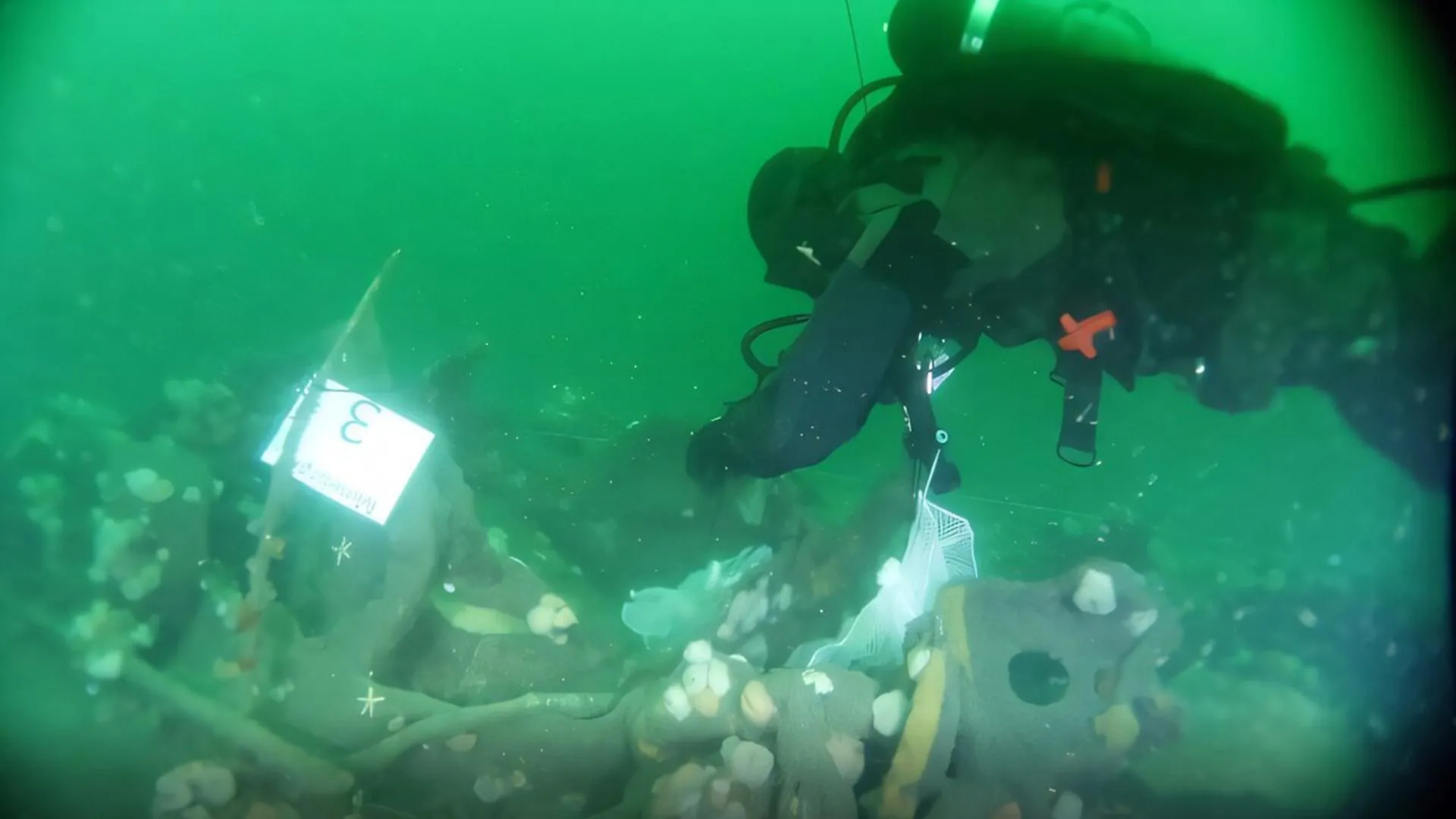
Sampling at the German submarine UC-30, sunk off Denmark in 1917 with 18 mines and six torpedoes aboard, found TNT in the water, the seabed and the animals on its hull. The professor who led it expects the leak to grow.
The Scientist · Science desk
What happened
- An Aarhus University team reported traces of TNT in the water column, the seabed and the wildlife at the wreck of the German submarine UC-30, and said pollution from the site is occurring.
- UC-30 struck a British mine off the Danish coast on 19 April 1917 and sank with all 27 crew, having turned back from a mission to Ireland because of engine problems.
- The submarine went down carrying 18 mines and six torpedoes, and the wreck stayed lost until Danish diver Gert Normann Andersen found it in 2016.
- Katrine Juul Andresen's 2024 report for the Danish Environmental Protection Agency counted 10,127 wrecks in Danish waters, around 15 percent of them from the two world war periods.
- The agency commissioned that report as part of working out how Denmark can meet the requirements of the EU Water Framework Directive.
Compiled by The ScientistSomething wrong?How this is made
Why it matters
- constraint Civilian diving on UC-30 is prohibited, so monitoring at the site runs at the pace navy dive teams can supply.
- decision Screening roughly 1,500 war-era hulls forces a triage decision, because the year a wreck sank does not tell an agency whether it was carrying munitions when it went down.
- precedent Denmark's Water Framework Directive work now has a named, sampled wreck attached to it. Agencies with their own war-wreck inventories can be asked the same question about theirs.
- cost If corrosion keeps exposing explosive inside the mines, as Andresen expects, every later survey meets a larger source than today's, and any eventual intervention is priced against that larger source.
Detection and dose are different measurements. Katrine Juul Andresen, a professor at the Department of Geoscience at Aarhus University who investigated the wreck through the NorthSeaWrecks project, said "Pollution is definitely occurring" [5][9]. The release does not report concentrations [10]. Presence in a mussel means the compound left a corroding casing and entered an animal filtering water beside it. Whether that dose harms the mussel, or anything that eats it, is a separate question [10].
Andresen said, "Civilian diving is not permitted on the wreck, so we received great assistance from navy divers. After receiving instructions, they dove down and collected sediment samples, water samples, and wildlife samples from various locations on the wreck and from the surrounding seabed" [7]. The divers also filmed the site, and Andresen said the video and photos were used "to assess the exposure of the mines and the condition of the wreck" [8]. So the chemistry sits next to a physical survey of how much explosive is already open to seawater.
On extent, Andresen hedged where the data required it. She said the wreck is "likely a relatively localized source of pollution, but it will worsen as the wreck continues to deteriorate and expose more of the explosive material inside the mines" [9]. The word "localized" rests on the contrast between stations on the hull and stations out on the surrounding seabed [7]. The team sampled once. A trend needs a second visit to the same stations [21].
The scaling claim in the Aarhus University release, published on 14 September 2026, is that thousands of similar wrecks could pose growing environmental risks as they continue to corrode [18][19]. Denmark's own inventory is where that gets tested. Fifteen percent of 10,127 wrecks works out at about 1,519 hulls from the two war periods [13]. UC-30 went down as a warship with 18 mines and six torpedoes aboard [2]; a 1943 freighter that sank empty is a different case, so the inventory tells the agency where to look. It does not count the wrecks that are leaking. Andresen's 2024 report examined those risks and possible ways to prevent or reduce the pollution [11], and it noted that authorities may eventually need to take more direct action at certain wrecks [20].
Andresen said, "I am not aware of whether the agency has taken the work further since the report was published in 2024" [15]. An estimated 190,000 mines were laid in the North Sea during the First World War [16].
What to watch
- Whether the Danish Environmental Protection Agency commissions quantified TNT concentrations, with distance from the hull, after the 2024 report.
- Whether anyone resamples the same UC-30 stations. Without a second visit, the expectation of worsening never becomes a measured trend.
- Whether the 10,127-wreck inventory is filtered for ordnance actually aboard, separating loaded warships from empty hulls.