Leadership1 publisher3 min readPublished
Highland Electric carries roughly seven dollars of raised capital for every dollar of revenue
Duncan McIntyre's school bus company has disclosed about $350 million of equity and debt against annual revenue it estimates at $45 million to $50 million across more than 100 US cities, and it buys the equipment itself.
The Board Room · Leadership desk
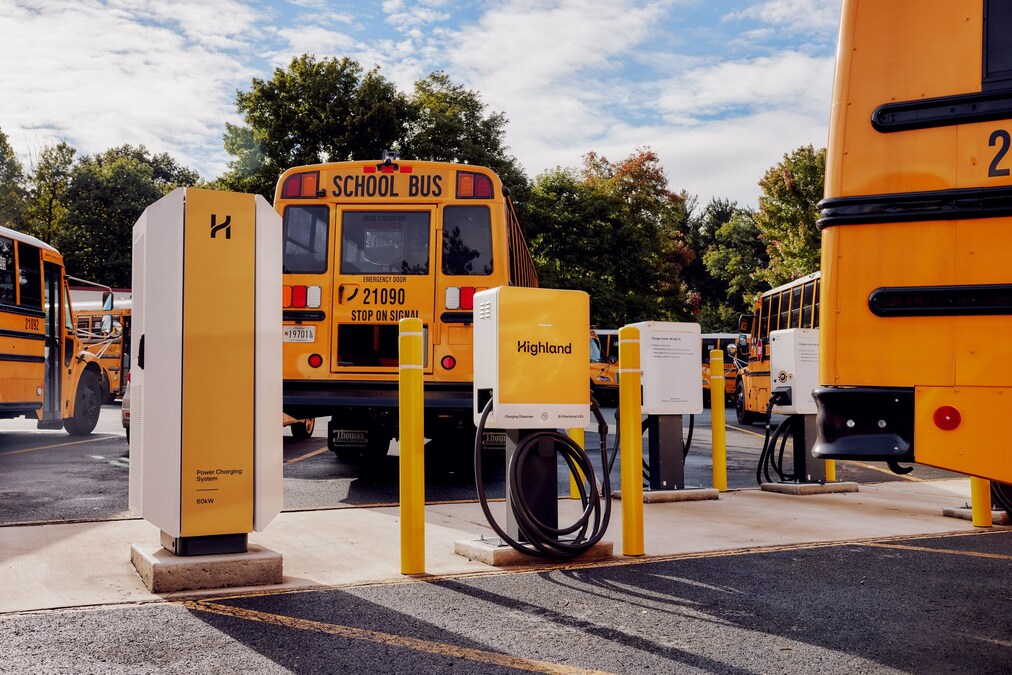
What happened
- Duncan McIntyre founded Highland Electric Fleets in Massachusetts in 2018 after noticing that the school bus tailpipe sat level with his second-grade son's face.
- It took about a year and a half to sell the first project, to the city of Beverly, Massachusetts, and McIntyre funded the company himself until that point.
- Last December the company announced a $150 million equity investment from Aiga Capital Partners to accelerate national expansion.
- Highland now runs fleets in more than 100 US cities and puts its current annual revenue at $45 million to $50 million.
- Individual fleets range from 300 buses carrying over $100 million of equipment down to ones with just two or three buses.
Compiled by The Board RoomSomething wrong?How this is made
Why it matters
- constraint Because Highland buys the equipment with project-level financing, credit terms ration its expansion, and a tighter debt market slows deliveries even where demand holds.
- decision Replacing only buses already due for retirement lets a buyer start without approving a fleet-wide conversion, so the decision arrives in small pieces a transport director can sign.
- capability The depot construction and the staff training are what let a district that could not fund the switch make it.
- exposure The revenue range and the doubling claim both come from the company, so a city committing to a multi-year service arrangement is relying on the vendor's own account of its durability.
A fleet of 300 buses carries more than $100 million of equipment, which works out to over $330,000 a bus [1]. One fleet of that size costs about twice what the whole company books in a year [7]. Divide the revenue estimate by the city count and the average city accounts for under $475,000 a year [2].
The December equity round, plus roughly $200 million in construction debt and tax-advantaged financing from long-term partners, comes to about $350 million of disclosed capital [10][3], around seven times the midpoint of the revenue range [4]. McIntyre told Entrepreneur that the business he is in is hugely capital-intensive, and that anyone who succeeds in it needs a real strategy for raising capital [14]. The project-level financing, he said, "helps us buy equipment and capitalize projects" [15].
"A lot of people think of an electric bus or an electric truck purely as that piece of hardware," McIntyre said. "You buy it from a dealership, pay for it and take it home." [16] What Highland brings with the vehicle includes workforce development that trains city staff to operate and service the fleet, and construction management that designs, permits and builds electrified depots [17].
The sale is sequenced to fit a replacement cycle. Highland does not advise a city to convert its whole diesel fleet at once; it suggests putting electric vehicles in as diesel ones come up for retirement [18]. Early projects took about a year and a half to get running and now take about six months, McIntyre said [19], roughly a third of the original time [5].
Revenue of $45 million to $50 million is thin cover for $350 million of capital, and the trajectory comes from the seller. McIntyre said "We've basically doubled year-over-year for a number of years now" [20], and that the company will "double again next year in 2027" [21]. The interview does not say what districts pay, how long the contracts run, or who owns the depot when one ends. Highland raises the capital, buys the equipment, and collects from each city in annual amounts far smaller than the equipment cost [15][1][2].
The customer list is the reason the financing carries the business. "We're in urban, we're in rural, we're in affluent, and we're in historically very underserved communities," McIntyre said [23]. The health case has not changed since he started: the World Health Organization classifies diesel exhaust as a known human carcinogen [2], children with developing lungs are particularly vulnerable according to World Resources Institute data [3], and most US school buses still burn diesel [1]. Highland is now looking at fleets in 200 cities, about double its present count [22][6].
What to watch
- Whether the 2027 doubling McIntyre predicts shows up as a disclosed revenue figure.
- Whether Highland's next raise is equity or project-level debt, and what the debt costs.
- Whether cities added toward the 200-city target sign on the same retirement-replacement sequencing as the first hundred.