Science1 publisher2 min readPublished
Seventy-three burned grass layers at Cloggs Cave record 2,800 years of the same act
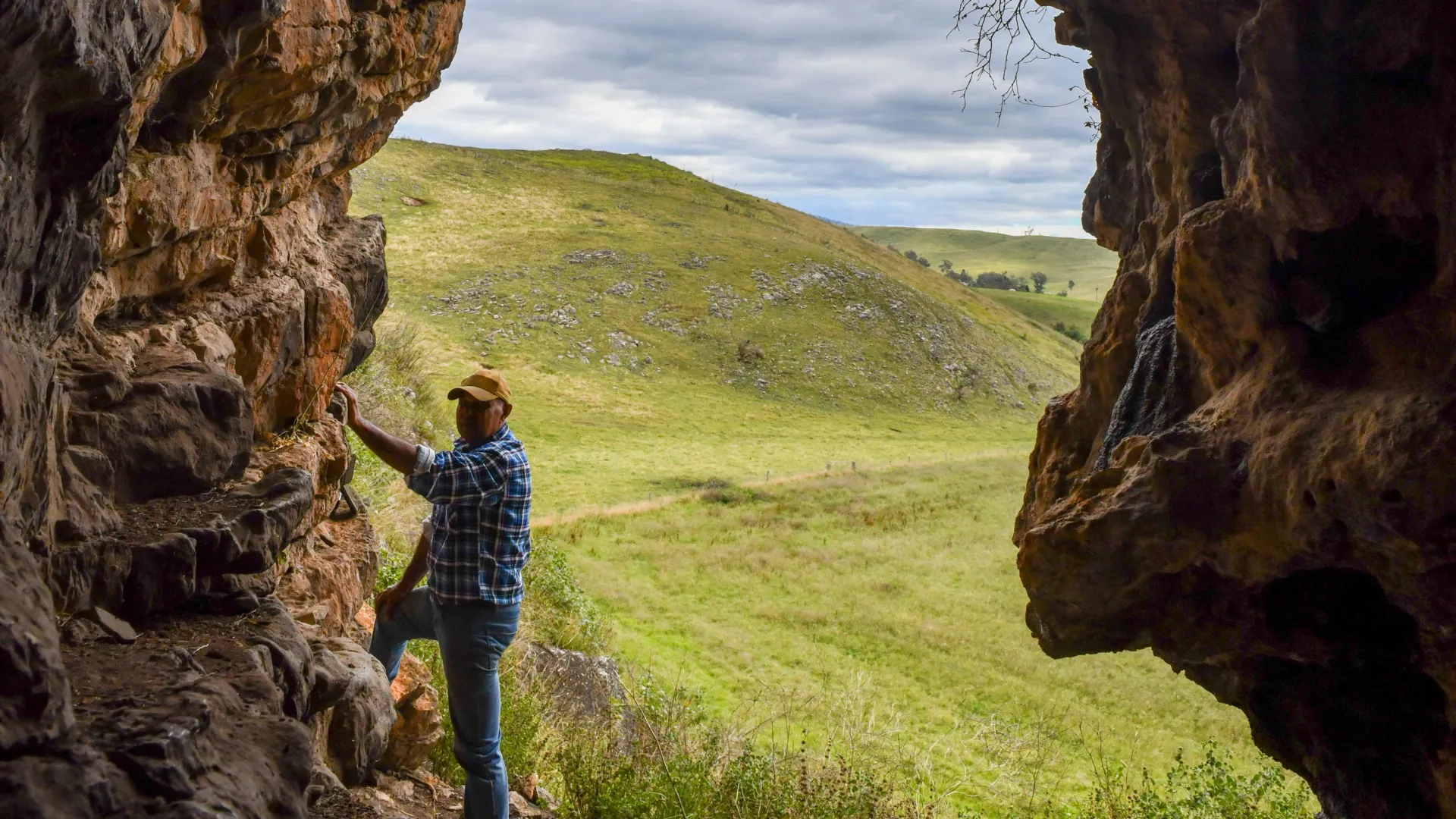
Nothing grows in the dark at Cloggs Cave, so the half-burnt silica plant microfossils in its ash layers came in with people. The dated layers show the same act being repeated for at least 2,800 years.
The Scientist · Science desk
What happened
- The 2019 and 2020 excavations at Cloggs Cave were requested by the GunaiKurnai Land and Waters Corporation, whose representatives took part in the research design, fieldwork, interpretation and communication.
- The upper sections of two excavation pits held 73 thin ash layers laid down by people between about 4,400 and 1,600 years ago, dated with optically stimulated luminescence and accelerator mass spectrometry radiocarbon.
- Grass phytoliths dominated the samples at up to 97 percent of the total, including temperate-adapted Pooideae and warmer, more humid Panicoideae, among 29 phytolith types from grasses, herbs and woody plants.
- Among the layers the team found a standing stone 28 cm high, which later analysis indicated had been placed inside the cave for ritual purposes around 2,000 years ago.
Compiled by The ScientistSomething wrong?How this is made
Why it matters
- capability Selecting only the half-burnt grains turns a plant microfossil into proof of human transport, because a possum can shed unburnt phytoliths onto a cave floor but cannot set them alight.
- constraint The microremains fix timing and repetition. Intent is another matter, and the ceremonial reading still rests on the 19th-century accounts, the oral traditions and the placed stone.
- contradiction A reader weighing how deep the continuity runs has to work with two different numbers: the release's 25,000-year span, and the span the dating it details actually covers.
- precedent A Traditional Owner corporation commissioned the questions and its representatives sat in the interpretation. That arrangement sets a working expectation for how excavation in these caves gets arranged next time.
Phytoliths are silica bodies that form inside plant tissue and stay in the sediment long after the plant itself has rotted [5]. Their value here comes from how little they travel. "Unlike pollen, which is dispersed by wind or insects, phytoliths mostly accumulate at the spot where a plant decays. No plants grow inside the cave due to a lack of light, so the phytoliths must have been carried in by people or by animals such as possums on their fur or through their scats," said Dr Elle Grono of the Australian National University, corresponding author of the study in Frontiers in Environmental Archaeology [6][2]. Burning narrowed the set further. "We focused on half-burnt phytoliths from ashy layers, which can only have been brought in by people, as unburnt ones might have arrived through either means," Grono said [7].
That design makes the microremains the primary evidence for human carriage. A charred grass phytolith sitting in an ash layer inside a lightless cave had to be brought in by someone [22].
Seventy-three layers between about 4,400 and 1,600 years ago is a span of 2,800 years [19]. Divided across the layers, that works out at one burning roughly every 38 years [20]. That average is arithmetic. The layers could be bunched or spread out, and the number of people at any one burning stays unknown.
The release from Frontiers, carried by ScienceDaily on September 15, 2026, describes ritual use of Cloggs Cave over roughly 25,000 years and says the burnt grass traces may span that period [15][1]. The dated ash sequence covers about 11 percent of that [21]. The release does not set out which deposits carry the older ages; the 73 layers come from the upper sections of pits reaching 1.5 m and 2.3 m [9][8].
Why the grass was burned comes down to two other lines of evidence: the 19th-century accounts and oral traditions describing these caves as places where powerful learned women and men known as mulla-mullung performed magic, healing and cursing [16], and the 28 cm stone the team concluded had been placed for ritual purposes about 2,000 years ago [11]. In my view the durable result is the sequence, which is a practice with 73 dated instances in it. "Here we show that the Old Ancestors selected whole grasses from the wider landscape and carried them into Cloggs Cave to spread out in thin layers and burn. Over time, sediments covered these burnt layers, preserving each layer on top of another over thousands of years," said Grono [18].
What to watch
- Published dates for the deeper sediments in the 2.3 m pit: they would test whether burnt grass layers go back 25,000 years.
- Whether the same half-burnt phytolith signature turns up in other GunaiKurnai caves named in the 19th-century accounts.
- Per-sample phytolith counts in the full paper, showing whether the 97 percent grass share is typical or the maximum.