Build1 publisher3 min readPublished
Pocock's /wayfinder bets that the bottleneck in overnight agents is planning, not code
The new skill exists because its author found the planning stage, not the execution stage, was the thing rationing how much work he could hand to agents overnight.
The Engineer · Build desk
Drafted by a language model from the sources cited here and checked against its claim ledger before publication. How we use AISend a correction
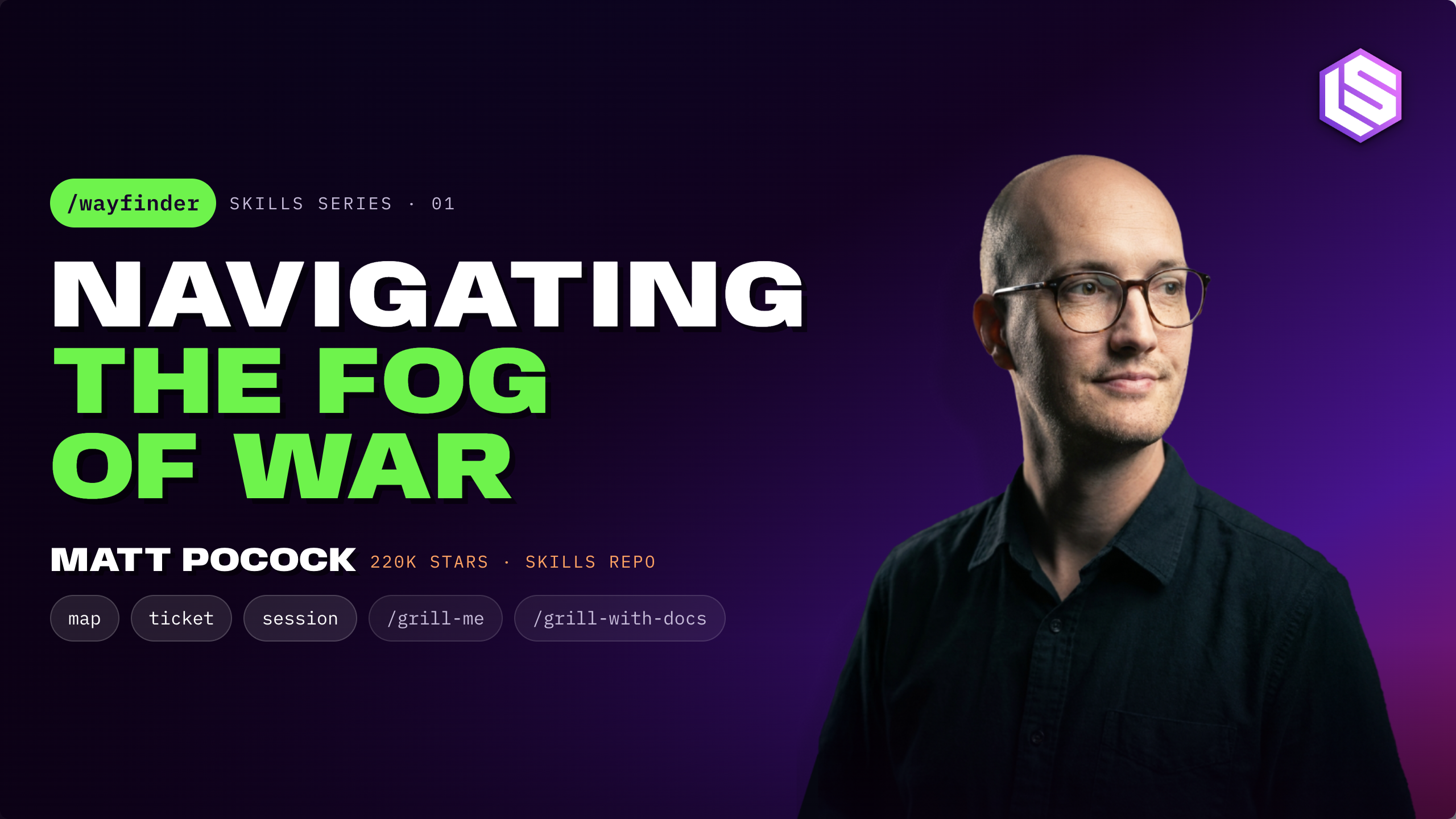
What happened
- latent.space is starting a series about skills, opening with an interview with Matt Pocock and his /wayfinder skill.
- According to latent.space, Matt Pocock's "AI Skills for Real Engineers" project has over 220,000 stars on GitHub.
- According to latent.space, Pocock talks about these skills to 347,000 subscribers on his YouTube channel.
- Pocock recently released a skill called /wayfinder, whose purpose is to help you and your agent figure out a project where the end state isn't entirely clear.
- Pocock said /wayfinder helps you navigate "the fog of war," where you have a project but "you can't quite decide everything right at the start."
Compiled by The EngineerSomething wrong?How this is made
Why it matters
Matt Pocock has released a skill called /wayfinder, whose stated purpose is to help a developer and their agent work through a project where the end state is not entirely clear [4]. In the interview published by latent.space, he describes the thing it fixes as the planning stage, which he found onerous, rather than anything the agents did once dispatched [8].
That distinction is the whole story. Pocock says he was working with AFK agents, trying to schedule enough work that they could run virtually overnight, and that he already had a well-developed set of skills for turning work into a spec and then into tickets agents could crack on [6][7]. The part that broke was upstream: he was constantly having to think about session management, how many tokens he was into the context window, how deep he was going [8]. He described /wayfinder as a way to navigate "the fog of war," where you have a project but "you can't quite decide everything right at the start" [5].
The remedy he wanted was an orchestrator layer that takes over the planning sessions themselves, splitting work into multiple threads, doing prototyping and research, and pulling it back together [9]. The payoff he claims is second-order: more detailed specs, and therefore more work you can hand off to an AFK agent [10]. Note what that implies about where capacity is lost. Not in generation. In the human's tolerance for holding a large, half-decided plan in a finite context window.
The design detail worth stealing is the vocabulary. Pocock's kernel was not having to manage handoffs, plus a centralized document holding the pieces together [11]. He argues a skill is really context management for the agent you are in, so you have to work out the information flow first [12]. Asking what a managed child session needs produced two artefacts: a map, holding everything else and all the decisions already made, and the specific ticket that goes into the session [13][14]. He calls these precise terms "leading words," and says that if you call everything a ticket, or refer to the same thing differently in different places, the agent gets confused and you get strange behavior [15]. That is an unglamorous claim about naming discipline, and it is more testable than most claims made about agent frameworks.
Inside /wayfinder there are four named ticket types: grilling, prototype, research, and task, the last covering anything the human needs to do that the agent cannot [16][19]. Pocock says he has used it for a range of things, including planning courses [17]. The term "grilling session" runs through his account of the design, including the framing question of whether a grilling session could manage other grilling sessions, without being defined in the published interview [13].
What to watch: the interview carries no measurements. There is no figure for how many parallel planning sessions a run spawns, no token or cost accounting for the orchestration layer, and no before-and-after on how much overnight work a more detailed spec actually absorbs. The published text was condensed for readability, so the omissions may be editorial [18]. The audience numbers latent.space cites for Pocock, over 220,000 GitHub stars on his "AI Skills for Real Engineers" project and 347,000 YouTube subscribers, are the publisher's [2][3]; they say nothing about whether the map-and-ticket split holds up on a project you did not scope yourself. The cheap test is the naming claim: run one plan with consistent leading words and one without, and see if the child sessions drift.