Product1 publisher3 min readPublished
The Wall Street Journal says expanded export approval for an Armenian data centre helped secure last year's preliminary deal with Azerbaijan, which puts licence-gated compute schedules on a political clock.
The Product Desk · Product desk

Compiled by The Product DeskSomething wrong?How this is made
A capacity plan's "clusters live in Q3" line usually traces back to a vendor lead time. Outside a small group of trusted countries, the lead time does not cover the step that decides everything: advanced Nvidia processors are export-controlled, and Washington's approval of the sale is discretionary [7].
Buyers file that approval as paperwork: a queue, owned by legal, tracked in a spreadsheet. In practice, per The Next Web's reading of the mechanism, it behaves differently: it can be granted, withheld, expanded or slowed without a law being passed or a dollar being spent, which makes it closer to a visa than to a subsidy [8].
The arithmetic shows how much rides on the stamp. Follow-up coverage of the Journal's paywalled report puts roughly 70,000 Nvidia processors behind a proposed $5bn Firebird project in Armenia [9]. Divide the second figure by the first and every approved processor carries about $71,400 of project capital [14]. What the approval gates is not only the chip invoice but the land, the substation, the cooling and the financing that were all committed on the assumption the hardware would clear. Treat both numbers as second-hand: The Next Web says they reached it through other outlets' coverage rather than the Journal article itself [9].
The same currency is being spent in the other direction. G42, the Abu Dhabi AI company, is exploring the sale of a majority stake to American companies to secure chip access past April 2027, according to The Next Web's Thursday reporting [11]. Armenia was offered approvals to sign something; G42 is weighing control of itself to keep approvals it already has. Firebird, meanwhile, signed a $10bn agreement with Kazakhstan in June to build what it called Data Center Valley [10]. For scale on the other side of the Armenian table, Azerbaijan's startups raised $2.6m last year [13].
What this reporting does not contain is the downside case. There is no approval timeline in it, no published conditions attached to the Armenian licence, and no instance of an approval being narrowed or withdrawn after a political outcome changed [16]. The upside is documented, including by Nvidia's own executive [12]. The revocation risk that operators would actually have to underwrite is inference rather than evidence.
So the question for a compute plan is not who the vendor is. Draw two axes. One: does the capacity need a US licence, or does it sit inside the trusted group. Two: does the project give Washington something it wants, or is it incidental to every open file. Licence-needed and useful is the Firebird quadrant, where approvals can move faster than any procurement process would explain, and where the schedule moves with someone else's negotiation. Licence-needed and incidental is the harder place to sit, because you are in the queue rather than in the deal, and nothing in the supplier contract reaches the office that sets the order. The honest version of that Q3 date names the approval it depends on, and names what the approver gets from the building being finished.
Ranked by verification strength, evidence, and original report placement.
The Wall Street Journal's Robbie Whelan reported on Friday that US negotiators used the promise of access to Nvidia's AI chips to help secure a peace deal between Armenia and Azerbaijan, sourced to people involved in the talks.
The inducement was specifically expanded approval for chip purchases for an Armenian data centre project, a detail the Journal says had not been reported before.
Armenia and Azerbaijan reached a preliminary agreement last year after decades of conflict over Nagorno-Karabakh, following White House intervention, and according to the Journal a data centre was inside the deal.
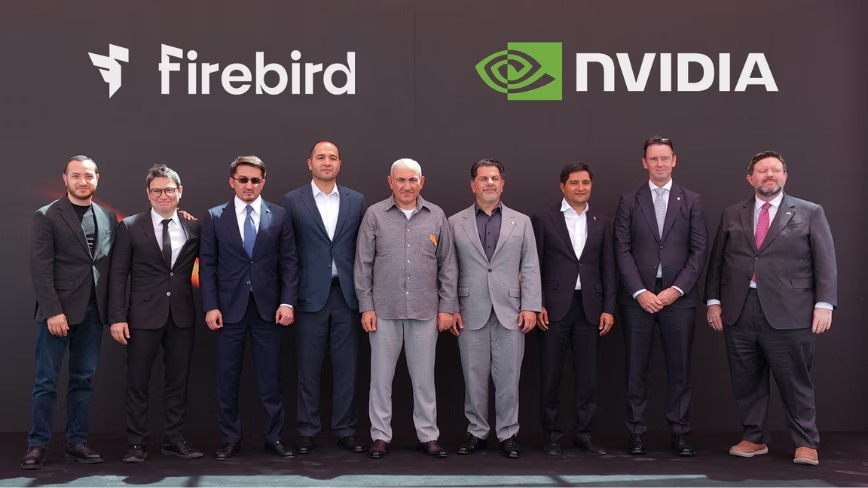
Firebird's facility in Hrazdan opened in August and was reported by thenextweb.com at the time as the largest AI factory in the region.
Prime Minister Nikol Pashinyan appeared at the Hrazdan opening flanked by technology and political leaders, in front of a banner carrying the Firebird and Nvidia logos.
Jensen Huang appeared by video at the Hrazdan ribbon cutting.
Follow any of these and your For You feed starts watching them — no settings page required.
Evidence-backed comparisons of source perspectives and observed adoption signals. Read the methodology
Which Builder, Operator, and Investor concerns the observed source mix emphasized—not a truth score.
Evidence, demonstrated adoption, hype gap, incentives, and confidence are assessed independently, each on its own current evidence. How these are measured.
One paywalled report, relayed
Everything material arrives at a remove. The Journal's reporters spoke to people involved in the talks and are not naming them; The Next Web is summarising a Journal report it has not read, behind a paywall, and says the 70,000-chip and $5bn figures came to it through other outlets' follow-ups. The exception carries real weight: Rev Lebaredian, a named Nvidia executive, told the paper on the record that his employer's presence in Armenia is a factor in creating the conditions for peace.
The building is real
The physical layer holds up better than the diplomacy: a Firebird facility in Hrazdan opened in August under an Nvidia-branded banner, Kazakhstan signed a $10bn version of the same arrangement in June, and G42 is reportedly weighing a control sale to keep buying after April 2027. Three instances of licence-gated compute changing hands or ownership add up to a pattern. What no one has produced is the licence itself.
Headline ahead of the sourcing
The headline says the US paid for a peace deal in Nvidia chips; the reporting underneath says expanded approval helped secure a preliminary agreement that also involves a Witkoff proposal for rail, pipelines and roads. Reading Firebird as an instrument of American policy is an inference drawn from two contracts. The overstatement stays modest because The Next Web itself lists what would be needed to judge the claim, including what Azerbaijan received and whether Commerce thinks a licence can be conditioned on a diplomatic outcome at all.
Nvidia's frame, in Nvidia's voice
The only named voice endorsing the chip-diplomacy reading works for the company whose hardware was the offer, and the reading flatters that company: export approvals as peace-making is a useful argument for a business whose sales depend on discretionary licences. The Journal's sources were in the room and are unnamed, which usually means they liked the outcome. And The Next Web returns three times to having used the phrase before the Journal did, a claim about the publication rather than the deal.
Direction clear, terms unknown
A single relayed report with anonymous sourcing and second-hand numbers sits against a named executive saying the substance out loud and a facility that verifiably opened. Chips were clearly on the table in the Armenian negotiation, but the licence's terms, its conditions, and what happens to it if the preliminary agreement fails all remain unknown.
product
G42 reportedly explores selling control to Americans to keep chips flowing past April 20271 publisher
build
H200s reach China at 2.5% of the order book, and Hong Kong holds the rest2 publishers
invest
Nvidia's pre-earnings re-rating is a credit story, not a chip story1 publisher
security
Influence Operations Now Target Construction Schedules, Not Just Elections1 publisher
Publishers with included, body-backed reporting in this cluster.
1 article · September 6, 2026