Invest1 distinct publisher3 min readPublished
ONEOK's $4.42 billion for Brazos values Permian gas processing near $3.68 billion per Bcf/d, resting on a Department of Energy demand curve that compounds at only about 1.3% a year out to 2050.
The Investor · Invest desk

Compiled by The InvestorSomething wrong?How this is made
The figure worth sitting with in the ONEOK transaction is the unit price, not the $4.42 billion: 1.2 Bcf/d of gas processing capacity plus 700 miles of gathering line [4] works out to roughly $3.68 billion for each billion cubic feet per day of processing [2], and that 1.2 Bcf/d equals about 1.1% of implied current national output [7]. Cheap or expensive depends on the volume curve underneath it, and the volume curve is gentler than the deal cadence suggests. The Department of Energy has US production rising 35% from here to 150 Bcf/d by 2050, against 50 Bcf/d twenty years ago [5]; back the 35% out and today sits near 111 Bcf/d [3], so the projected build is about 39 Bcf/d spread across the 24 years to 2050 [4], or near 1.3% a year compounded [5]. Three deals at a combined $11.52 billion [1] is a faster clip than that.
What the buyers are acquiring is a position along a chain rather than a commodity view. London Spivey of East Daley Analytics described ONEOK's logic to Fortune as pulling gas from the well, processing it, and putting it on its own pipe toward either a data center or an LNG terminal [9], and Pierce Norton, ONEOK's chief executive, calls the strategy touching as many molecules as possible for as long as possible [20]. Norton's other observation matters more for the arithmetic: as the Permian's oil wells mature, their output carries a higher ratio of gas, so gas volumes climb even if oil drilling stays flat [18]. That is a volume bet with less variance than a price bet, and it is the strongest part of the case.
The weaker part, or rather the more interesting version of the weak part, is that Norton has already described the exit from his own scarcity rent. Permian egress has been tight enough that regional spot prices went negative and some producers paid to have excess gas hauled off [15]; Norton says that price problem gets solved once all the long-haul lines are built [16], and ONEOK is building one of them, the 450-mile Eiger Express into the Houston area for 2028 [13], whose planned capacity went from 2.5 to more than 3.5 Bcf/d on customer interest [14], a 40% uplift [6]. A bottleneck that gets solved is one that stops paying wide spreads.
This is probably wrong, but the read here is that consolidation is a bet on throughput surviving the compression of the very basis differential that made throughput scarce, and at 1.3% compound volume growth it only pays if the acquirer holds the low-cost gathering position in its basin rather than the marginal one. It could go differently in three ways: Permian oil activity falls far enough that the gassier barrel does not offset it; the AI load stays at the stage Norton actually describes, which is continuous conversations with developers who are focused on Texas [12] rather than contracted capacity; or the private sellers stop selling, and the comp set that made $3.68 billion per Bcf/d look ordinary thins out to nothing.
Ranked by verification strength, evidence, and original report placement.
According to US Department of Energy projections, US natural gas output could rise another 35% from now until 2050, up to 150 billion cubic feet per day, versus 50 Bcf/d twenty years ago.
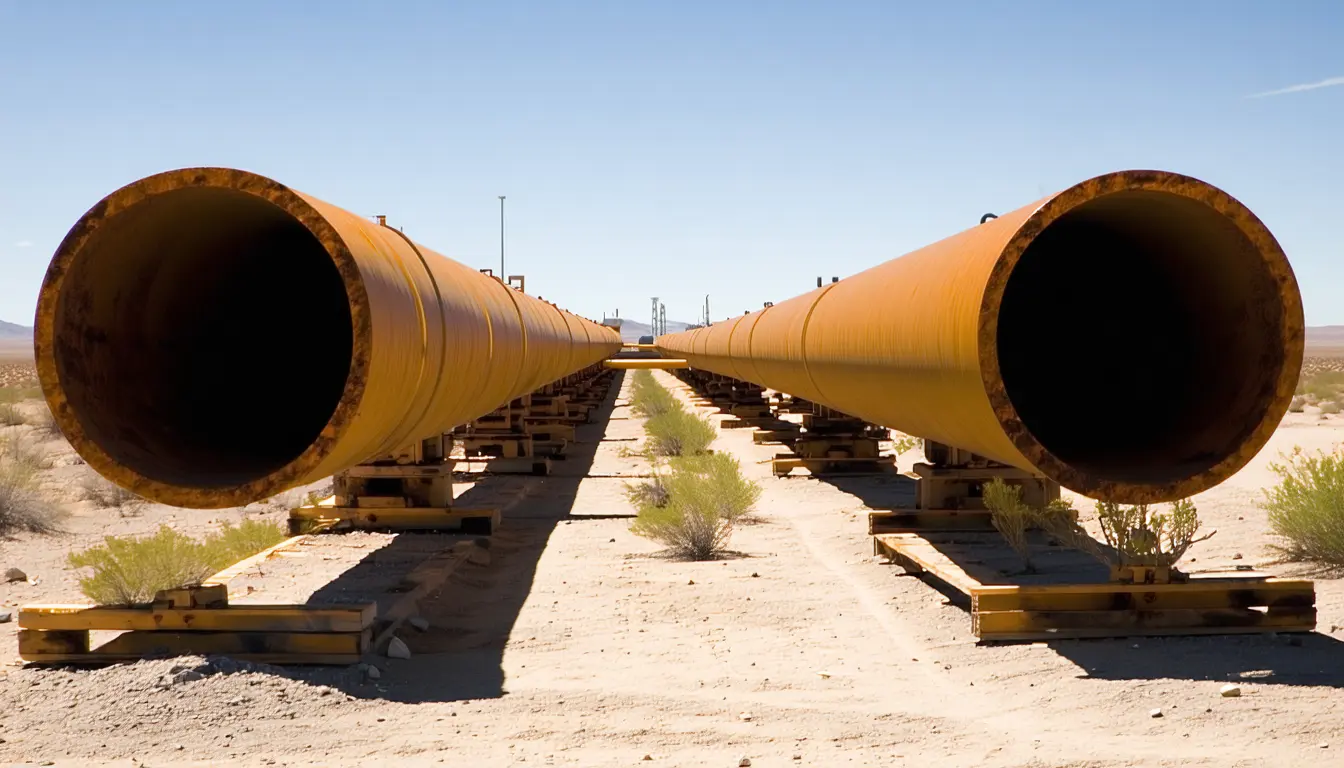
ONEOK, based in Tulsa, Oklahoma, bought West Texas-based Brazos Midstream's Permian Basin assets for $4.42 billion.
Williams acquired Momentum Midstream and its Texas and Louisiana pipeline gathering and processing facilities for $5.5 billion, shortly before the ONEOK-Brazos deal.
In May, Western Midstream paid $1.6 billion for Brazos' Delaware Basin facilities in the western lobe of the Permian.
The Brazos deal includes 700 miles of gathering lines and 1.2 Bcf/d of gas processing capacity.
In the 20 years of US shale gas boom since 2006, US natural gas production has more than doubled, following over three decades of flat output.
Distinct publishers with included, body-backed reporting in this cluster.
fortune.com
1 article · September 2, 2026
Follow any of these and your For You feed starts watching them — no settings page required.
product
TerraPower hires a builder: Hyundai E&C signed for up to eight Natrium units1 distinct publisher
invest
Texas froze 474 gigawatts of interconnection queue, and the audit is now the schedule risk1 distinct publisher
product
HTS feeders trade parallel MV runs for a cryogenic plant that never gets to stop1 distinct publisher
invest
A 180kW rack, an 18-month transformer, and a shortfall nobody has shown the math for1 distinct publisher
Evidence-backed comparisons of source perspectives and observed adoption signals. Read the methodology
Which Builder, Operator, and Investor concerns the observed source mix emphasized—not a truth score.
Evidence, demonstrated adoption, hype gap, incentives, and confidence are assessed independently, each on its own current evidence. How these are measured.
One outlet, two interested voices
Everything here comes through Fortune, and inside Fortune through the buyer's CEO and one commercial research analyst. The transaction facts are the sturdy part — prices, mileage, processing capacity, an in-service year — because they are the sort of figures a counterparty corrects publicly. The soft part is that no filing, no seller, and no second newsroom appears anywhere in this reporting, and the Department of Energy projection doing the heaviest analytical work is relayed rather than shown.
Capital already committed
This is not a plan; the money has moved. Three deals totalling $11.52 billion, a private seller split between two public buyers in a single year, a $9 billion Apollo cheque behind ONEOK's share, and a 450-mile line already redesigned upward because customers asked. Adoption falls short of the top because the demand side those assets are being bought for — data center load, LNG offtake — shows up in this reporting as a projection and a CEO's phone calls rather than a signed volume.
Growth language outruns the curve
Fortune calls US output 'projected to continue skyrocketing'. Do the division on the number cited in the same paragraph and skyrocketing means about 1.3% a year, roughly 1.6 Bcf/d added annually to 2050 — a fine business, an unremarkable slope. The AI framing stretches similarly: it justifies a $4.42 billion purchase without a single named data center, load figure or contract, and the man supplying the forecast is the man who just bought the gas. The gap is one of register, not fabrication; the deals and the pipes are concrete.
Told from the buyer's side
Read the attributions and the shape becomes clear: the CEO who just committed $4.42 billion supplies the demand outlook, the price forecast and the reassurance that Permian pricing gets fixed once his pipes are built, while a firm selling midstream analytics supplies the verdict that he paid a good price. Apollo, which needs ONEOK's scale story to work, is the funder. Nobody in this reporting profits from the deal looking expensive.
Deals firm, forecasts thin
Split the story and the confidence splits with it. What has happened — prices paid, assets acquired, capacity upsized, Apollo's money — we would stand behind. What is claimed about 2028 and 2050 rests on one interested forecast and one relayed government curve, with no second account to triangulate against. That mix, one publisher on a day-old announcement, puts us just above the midpoint.