Product1 publisher3 min readPublished
Slate's $24,950 truck carries 75 to 245 fewer miles of range than rival EV trucks
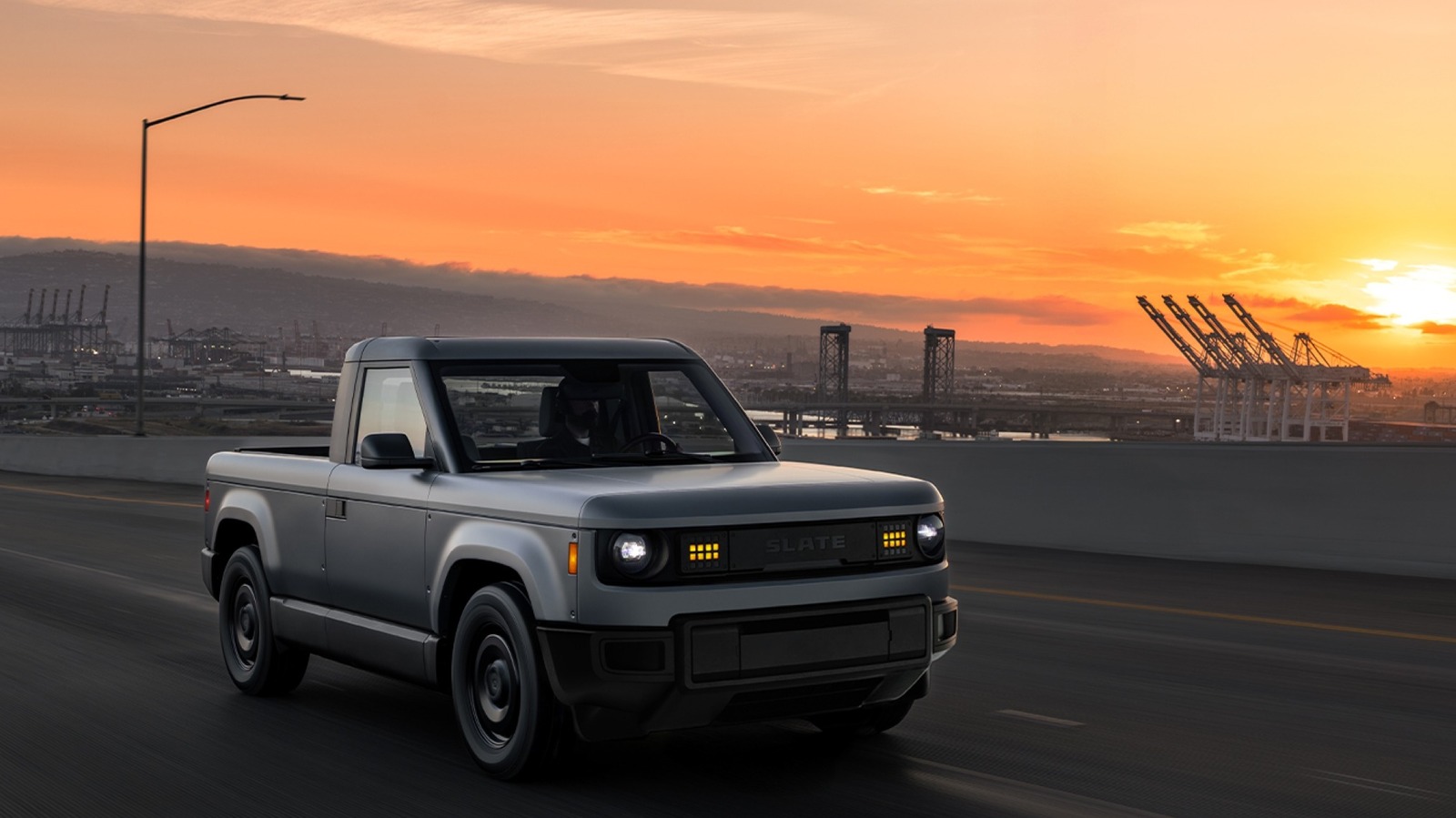
Slate Auto's base truck keeps the horsepower and tow rating of a cheap hybrid pickup while conceding range and interior equipment, and the company says the small battery is a deliberate choice about price.
The Product Desk · Product desk
What happened
- Slate Auto lists its base Blank Slate at $24,950, roughly half the average new vehicle price that Engadget puts above $50,000.
- The 135 kW rear motor makes 181 horsepower and 195 lb-ft of torque, tows 2,000 pounds, and gets the vehicle to 60 mph in eight seconds.
- A 63 kWh pack gives an estimated 205 miles, which is 75 to 245 miles below the 280 to 450 mile band Engadget gives for competing EV trucks.
- Slate says shipping starts from its Warsaw, Indiana factory later this year, with a $300 preorder holding a place in the early delivery window.
Compiled by The Product DeskSomething wrong?How this is made
Why it matters
- constraint The cheapest truck on the market is also the one whose owner has to plan around the outlet in the garage, since an overnight Level 1 top-up may or may not refill an average day's driving.
- decision Slate has pushed the spec decision onto the buyer, so its real average selling price depends on how much of the base build people pay to put back.
- exposure The deposit is about 1.2 percent of the base price. Holding a place costs a buyer almost nothing, and it tells Slate correspondingly little about who will actually take delivery.
- precedent A truck that keeps a hybrid rival's drivetrain numbers while conceding range gives other hardware teams a working figure for how much spec buyers will trade for price, once deliveries start.
A buyer with no home charger plugs a Slate into an ordinary wall outlet overnight and wakes up with 20 to 50 more miles [16]. Engadget cites a Consumer Affairs figure of 37 miles for the average driver's day [13]. At the top of that overnight window the outlet covers the day with 13 miles to spare; at the bottom it falls 17 miles short [4]. The fix is a Level 2 circuit, which fills the 63 kWh pack in five hours [15][9], and Slate has partnered with the home charging firm Treehouse to install them [18]. A Level 3 DC charger reaches 80 percent in as little as 30 minutes [14], which on a 205-mile estimate is about 164 miles [7].
205 miles from 63 kWh works out to 3.25 miles per kWh [1]. At that efficiency, the 280-mile floor of the competitive set Engadget names would need roughly 86 kWh and the 450-mile ceiling roughly 138 kWh [2]. The range Slate gives up is 23 to 75 kWh of cells it did not buy, on a truck priced at $24,950 [2][1].
The subtraction is concentrated in two places. The base build does without speakers and power windows [4]. Range is the other, and Slate says on its website that the vehicle is "focused on practical, everyday driving that balances range with affordability, efficiency, and capability" [11]; the smaller pack, it says, is "engineered to cover daily commutes, weekend adventures, and rural drives without requiring excessive charging stops" [12]. The drivetrain was left alone. Engadget's writeup says the Blank Slate "packs relatively the same punch as a 2026 Ford Maverick" [8].
The $24,950 is a default configuration, not a transaction price. Slate lists more than 200 optional accessories alongside its vinyl wraps [5], and buyers spec the vehicle in an online design tool before putting down $300 [21][20]. Engadget does not price the accessories. How much stripping buyers actually accept will show up in the average accessory spend per delivered truck.
For anyone deciding what to cut, the split that holds is between specs a customer can restore and specs welded to the platform. Speakers and window motors sit in the first column: a buyer who wants them buys them later, and their absence costs a first impression. A 63 kWh pack is a 63 kWh pack for the life of the truck, and the owner meets its limit on the trips that exceed it. Cuts in the first column are reversible at the customer's expense; cuts in the second are permanent and have to be priced that way, because no accessory catalogue sells range. Slate says shipping begins from its Warsaw, Indiana factory later this year [19].
What to watch
- Average accessory spend per delivered truck, which is where the real transaction price shows up.
- Whether Slate publishes an EPA range figure against its own 205-mile estimate.
- How many of the $300 reservations convert once Warsaw starts shipping.