Build1 publisher2 min readPublished
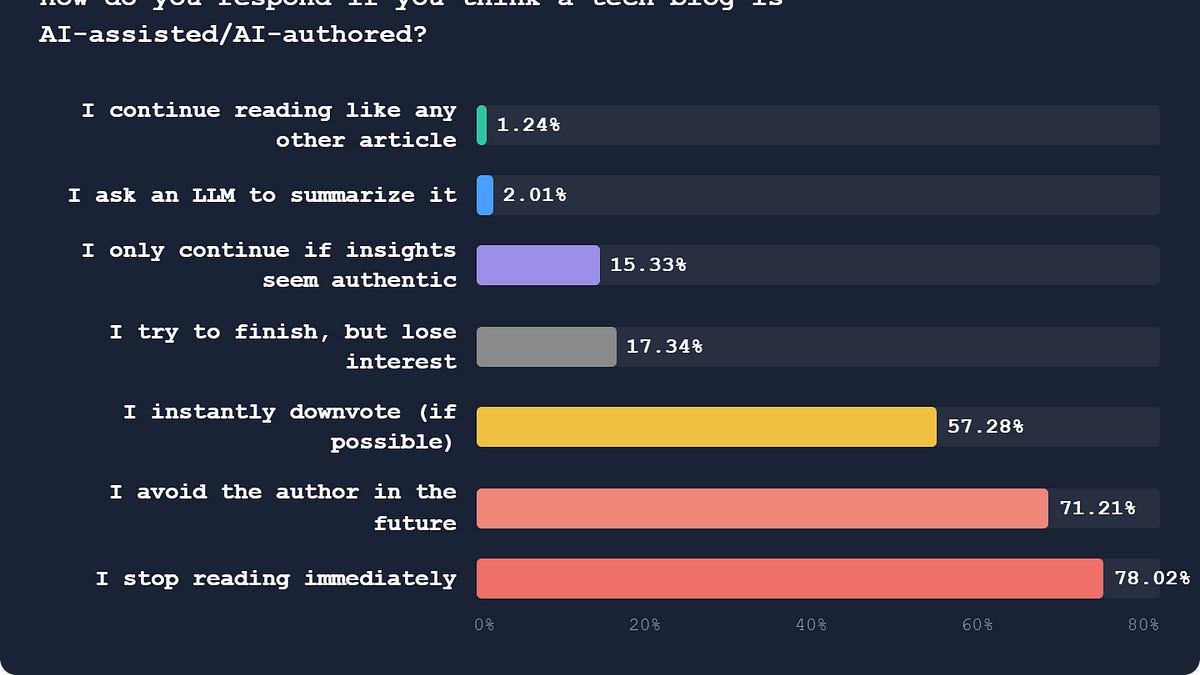
A survey of 668 developers says 71 percent avoid an author after spotting an LLM
Bryan Cantrill's case for a reader revolt runs on Cynthia Dunlop's survey of 668 developers. The survey records what readers do once they believe they have spotted a machine, and leaves open whether they are right.
The Engineer · Build desk
What happened
- Bryan Cantrill published a post arguing that readers can tell when a piece is LLM-authored, and that they care enough to abandon it mid-sentence.
- He grounds the claim in Cynthia Dunlop's survey, in which 78 percent of the 668 developers who replied said they stop reading immediately when they detect an LLM.
- Cantrill wrote in RFD 576 that using an LLM to write voids the social contract between writer and reader.
Compiled by The EngineerSomething wrong?How this is made
Why it matters
- exposure Suspicion is enough to trigger the penalty, so an author whose own cadences match the constructions readers now flag carries the loss whether or not a model touched the draft.
- decision Anyone weighing a machine-drafted public post is trading drafting time saved now against a slice of audience that, on the survey's own numbers, does not come back.
- constraint A policy on machine-drafted internal documents cannot cite these figures, because the population sampled was developers reading public writing.
- precedent On Cantrill's spam analogy, the punishment only bites once classification is reliable at scale, the way a spam label now costs a sender its domain reputation.
Dunlop's respondents were not scored against a labelled corpus. They reported what they do when they believe a piece is machine-written [2]. So the 78 percent is a penalty conditional on suspicion. Cantrill describes the signal as recognition: he wrote that to those who read broadly, "the hand of the LLM is so clear it's as if the writer's intellectual fly is open" [15]. He offers "and here's why that framing matters!" as one of the tells [8]. A writer who reaches for that construction unaided pays the same penalty.
About 521 of the 668 said they stop reading immediately [12]. About 474 said they avoid the author in the future [13]. The second number has a tail, because it describes readership lost on pieces not yet written. On the authenticity question, 98 percent said they prefer an author's own imperfectly written piece to an LLM-polished one [4]; roughly 13 respondents were on the other side [14].
For those figures to describe your readers, your readers would have to resemble Dunlop's: developers who read enough to catch the patterns and who answer a survey about them. Cantrill takes the sampling objection head on. He wrote that "active readers on social media are exactly the folks most likely to repost or otherwise promote writing they like" [7]. He is answering a question about who amplifies a piece. How common the reaction is in a general audience is a separate question.
His reason for the penalty is not aesthetic. In RFD 576 he wrote that "we readers shouldn't be expected to labor to understand a sentence that the writer themselves didn't work to create" [5]. The tells, on that reading, are evidence the author skipped the step where writing tests the idea, and readers price that. Cantrill also wrote that a public piece has one purpose, which is to serve the reader, so an author whom readers ignore has undermined himself and LLM use becomes ineffective [9]. All of that concerns public writing by developers. Internal design documents are a different case, where the audience is obliged to read.
The comparison Cantrill reaches for is spam. He wrote that filtering improved enough in the late 2000s to undermine the economics of spam, and that today being labeled as spam effectively destroys a domain name and tarnishes a brand [10]. That arc ran on classifiers working at scale. Human recognition was never what did the work. Cantrill wrote that results on identifying LLM writing had been decidedly mixed until recently, and that he had tried using LLMs themselves for LLM identification [11].
What to watch
- Publication of Dunlop's survey methodology, including whether respondents were ever tested against pieces of known authorship.
- Whether Cantrill publishes accuracy figures for the LLM-based detectors he tried, since he describes prior results as decidedly mixed.
- Whether platforms start labeling suspected LLM-authored posts the way mail providers label spam senders.