Security1 publisher2 min readPublished
Threat actor compiled its Monero miner on the victim endpoint after exploiting CVE-2025-4632
Huntress traced a September 2026 intrusion in which the actor compiled a Monero miner on the endpoint, using a MagicINFO flaw Samsung fixed 16 months earlier. The build step is loud in telemetry, but it ran only after Defender had been disabled.
The Watch · Security desk
What happened
- Huntress says a managed endpoint alerted early in September 2026 on activity originating from its Samsung MagicINFO Premium installation, reportedly tied to CVE-2025-4632, an arbitrary file write as system authority.
- The actor needed three tries to pull AnyDesk from 194.87.89[.]30, after Microsoft Defender removed a certutil download command and then a PowerShell Invoke-WebRequest command.
- The actor then compiled the Monero miner on the endpoint itself, running Silent XMR Miner Builder.exe, a Windows builder linked to the open-source SilentXMRMiner project.
- Huntress reported the first intrusion and advised remediation; eight days later the same endpoint came back with different post-compromise activity through the same access vector.
Compiled by The WatchSomething wrong?How this is made
Why it matters
- capability Building on the host hands the actor a miner fitted to that machine, including its CPU architecture, so each victim can end up with a different binary to match against.
- constraint The compile step is only detectable where telemetry keeps recording after Defender is turned off, and in this chain Defender was disabled before the builder ran.
- decision Fixing the file-write bug does not evict this actor: responders have to remove the rogue AnyDesk and the oldadministrator account, which share a password.
- exposure Any unpatched MagicINFO Premium server is reachable this way through its embedded Tomcat, and the resulting commands run under tomcat9.exe rather than a user shell.
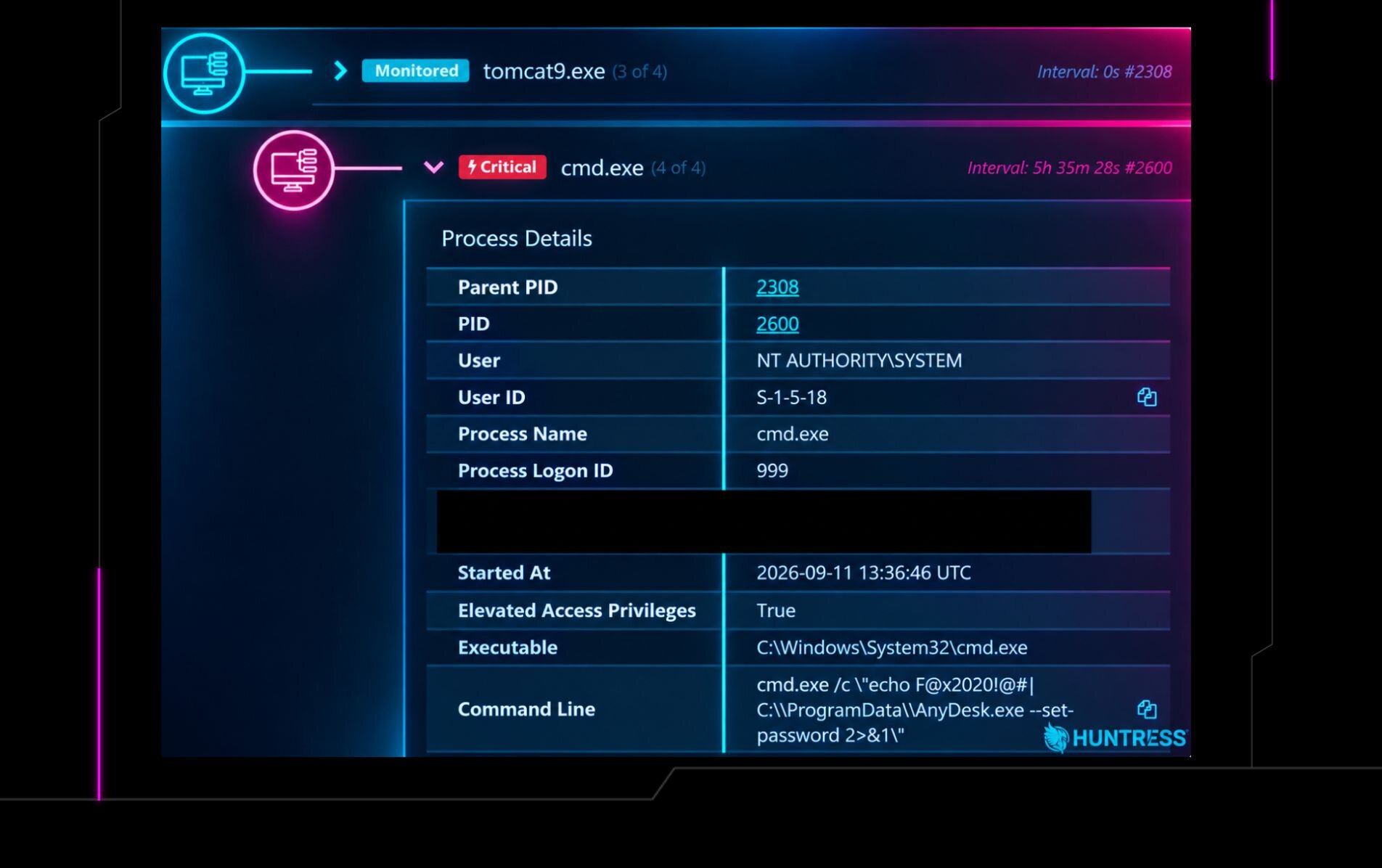
The process tree did the identification. The successful AnyDesk download ran with tomcat9.exe as its grandparent process, and the command that set the AnyDesk password had tomcat9.exe as its parent, which is what sent Huntress SOC analysts back to the MagicINFO flaw [14][17]. MagicINFO is a Java web application deployed on an embedded Apache Tomcat server, so anything driven through the bug executes out of that service [15]. CVE-2025-4632 writes an arbitrary file as system authority [7].
Samsung fixed CVE-2025-4632 in May 2025, after the fix for an earlier flaw, CVE-2024-7399, was found to be incomplete [8]. The alert on this endpoint came early in September 2026, about 16 months later [6][21]. Huntress has published post-exploitation detail on MagicINFO vulnerabilities before [16].
Defender worked until it was switched off. It removed the certutil download, then removed the PowerShell Invoke-WebRequest download [11][12]. The third attempt succeeded, and Huntress illustrates it with an EDR detection; the write-up does not include the command line for that one [13]. Silent XMR Miner Builder.exe only ran after SystemSettingsAdminFlows.exe had been used to disable Defender [19][20].
That ordering decides who sees the miner build. Huntress wrote that the compile processes "resulted in a significant spike in activity" and were "quite noisy from an EDR telemetry perspective" [5]. The noise is several .NET Framework utilities and an array of C compilers running under a builder associated with the open-source SilentXMRMiner project [3][2]. What the actor buys with it is a binary tuned to the host, including for CPU architecture [4].
For a shop whose only endpoint telemetry is Defender, that whole stage is missing from the record, because by then Defender is off [19]. The catchable stages were the quiet ones at the front, and Defender caught two of the three download attempts there [22]. The recorded indicators are narrow: the AnyDesk payload served from port 8899 on 194.87.89[.]30, and a local account named oldadministrator holding the same password as the rogue AnyDesk install [10][11][18].
What to watch
- Whether Huntress publishes the method behind the third, successful AnyDesk download, which its write-up shows only as a detection.
- Whether other MagicINFO intrusions show on-host compilation, which would move local builds from one actor's habit to a campaign pattern.
- Whether the same endpoint is reported a third time once the rogue AnyDesk install and the oldadministrator account are removed.