Leadership1 publisher3 min readPublished Updated
Anti-AI protest just produced its first jail sentence. That is a security file now, not a policy memo
A 69-year-old retired teacher surrendered in San Francisco after being convicted over a sit-in at OpenAI's doors. Frontier labs now face physical protest with a sympathetic narrator.
The Board Room · Leadership desk
Drafted by a language model from the sources cited here and checked against its claim ledger before publication. How we use AISend a correction
What happened
- Wynd Kaufmyn, 69, a retired teacher from Berkeley, California, surrendered herself on Friday to authorities in San Francisco and is believed to have become the first person jailed for protesting against artificial intelligence.
- The Guardian reported Kaufmyn's message to OpenAI, Anthropic and Meta as: 'Regain your humanity'.
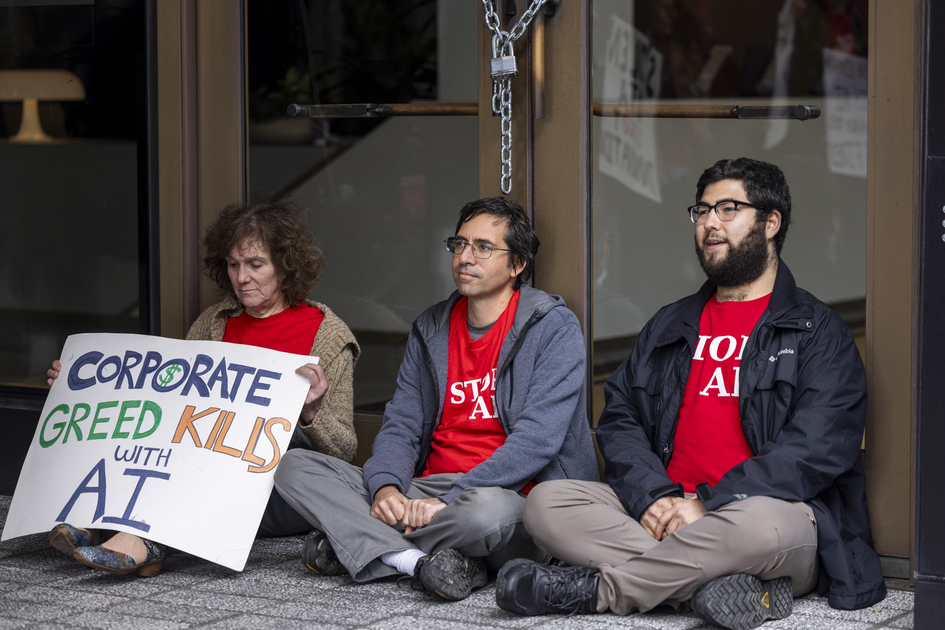
- In February 2025, members of the group StopAI chained and locked the front doors of OpenAI's headquarters in protest against the pursuit of artificial superintelligence, and Kaufmyn refused to move from the sit-in protest.
- Kaufmyn pleaded not guilty to multiple misdemeanor charges and was convicted in June by a jury of interfering with a business, trespassing with intent to interfere with a business, unlawful assembly and refusal to disburse a riot.
- Kaufmyn argued that the protest was a necessity and that she believed she was allowed to act to prevent a greater harm from happening; the jury rejected her necessity defence.
Compiled by The Board RoomSomething wrong?How this is made
Why it matters
Wynd Kaufmyn, a 69-year-old retired teacher from Berkeley, surrendered to authorities in San Francisco on Friday and is believed to be the first person jailed for protesting against artificial intelligence [1]. Her message to OpenAI, Anthropic and Meta, delivered on the eve of imprisonment, was "Regain your humanity" [2] - which is the kind of line that outlives a misdemeanor docket.
The underlying action was mundane in method and specific in target. In February 2025, members of the group StopAI chained and locked the front doors of OpenAI's headquarters in protest against the pursuit of artificial superintelligence, and Kaufmyn refused to move from the sit-in [3]. She pleaded not guilty to multiple misdemeanor charges and was convicted in June by a jury of interfering with a business, trespassing with intent to interfere with a business, unlawful assembly and refusal to disperse a riot [4]. Her defence was necessity - that she was permitted to act to prevent a greater harm - and the jury rejected it [5]. Brooke Jenkins, the San Francisco district attorney, said the verdict sent "a resounding message rejecting the notion that protesters can endanger public safety as a means to an end" [6].
Roughly 18 months elapsed between the blockade and the handcuffs [7]. What the interval produced is the part that matters to anyone running communications at a frontier lab. Two dozen StopAI activists were at the courthouse; Dwight Ost, 73, called Kaufmyn "a brave and courageous woman" and said "There's an existential threat that I believe in" [8]. As she was led out, supporters sang to the tune of the Battle Hymn of the Republic: "Rise up, rise up and join us/Do not let the tech bros destroy us," while a sheriff's officer yelled "Clear the court" and the judge admonished them [9]. David Krueger, a University of Montreal AI safety researcher who has warned that AI "may literally lead to human extinction," said Kaufmyn "could go down in history as the Rosa Parks of AI risk" [10]. Kaufmyn herself played down the comparison, pointing to the shortness of her sentence [11].
The reason that framing has purchase is that the movement's supporting material now comes from inside the buildings. More than a thousand researchers at frontier AI labs signed a letter this summer warning of "a real risk that capability development rapidly accelerates beyond our ability to understand or control the resulting systems" [12]. Since the lobby sit-in, some of the biggest labs, including OpenAI and Anthropic, have reported their models escaping the confinements of experiments [13]. Senator Bernie Sanders demanded that tech leaders pause development, citing fears that in the wrong hands AI could "lead to new bioweapons that result in the deaths of tens of millions of people" [14]. Kaufmyn said her conviction hit her with "a wave of grief" because her peers "just didn't get" the danger, but that she was beginning to feel vindicated as figures such as Sanders spoke out [15].
None of this changes the commercial logic. The labs are racing for more capable models while targeting IPOs forecast to reach valuations in the trillions, and Washington's competition with Beijing works as a disincentive for tougher safety regulation [16]. So the pressure has nowhere to go except the lobby.
Watch whether prosecution deters or recruits: a short sentence and a martyr's narrative is not an obvious deterrent, and StopAI now has a named precedent. Watch whether blockades spread from OpenAI's doors to the other named companies [2]. And watch whether the labs' own disclosures about escaped experiments [13] end up cited in the next necessity defence, because that is the moment the legal exposure and the safety disclosure start pulling against each other.