Product1 publisherNot yet confirmed elsewhere3 min readPublished
LG's North America boss says large solid-state cells are the problem, and Europe just poured concrete
Robert Lee puts solid-state in phones about ten years before cars. A 12 GWh plant at Dunkirk and Chinese pilot lines due in 2027 are built on the opposite reading.
The Product Desk · Product desk
Drafted by a language model from the sources cited here and checked against its claim ledger before publication. How we use AISend a correction
What happened
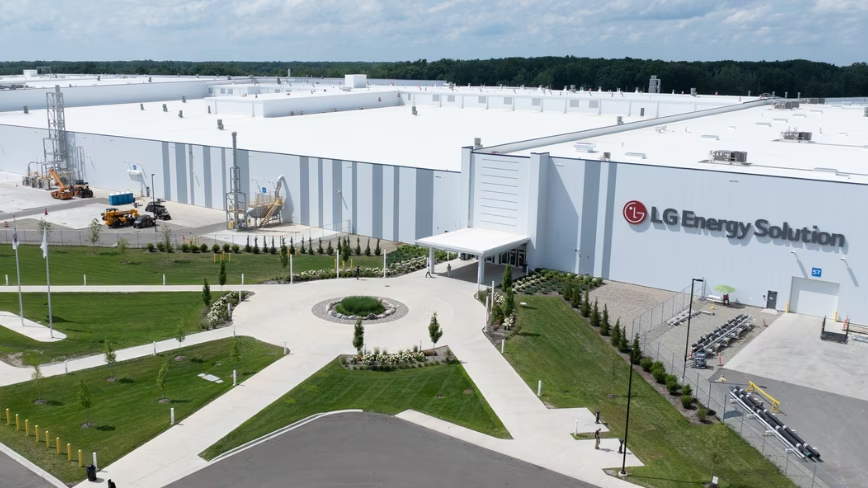
- At a roundtable inside LG Energy Solution's new Lansing plant, North America president Robert Lee said the problem with solid state is large-scale production.
- He put solid-state in smartphones about a decade before EVs, with specialised applications arriving before either cars or grid storage.
- ProLogium broke ground in February on a 12 GWh solid-state plant at Dunkirk, billed as Europe's first.
- BYD, CATL, Geely and others are aiming at solid-state pilot production in 2027 and wider deployment by the end of the decade.
Compiled by The Product DeskSomething wrong?How this is made
Why it matters
- contradiction Lee's ten-year horizon and the Dunkirk construction schedule cannot both be correctly timed; one set of capital has been committed against the wrong calendar, and the plant is the side that has...
- exposure European subsidy is now underwriting the manufacturing learning curve of Taiwanese, Korean and Chinese owners, so a slipped solid-state date leaves the continent carrying the risk without the...
- decision Carmakers specifying late-decade platforms have to choose between a nickel-light lithium-ion chemistry with a date attached and holding capacity open for a large-format cell nobody has yet built...
- constraint If Lee is right, Europe's fallback depends on incremental lithium-ion output it does not have, which turns the solid-state leapfrog from a strategic choice into the only route left.
Lee's claim is narrower than general scepticism, which makes it harder to wave away. He grants that small cells already reach good energy density; the difficulty scales with the format, and at the very large sizes he says most companies are struggling [4]. Nothing in that requires the chemistry to fail. It requires the factory step to stay unsolved, which is a different proposition from the one being funded.
The carmaker demonstrations look like counter-evidence until you read the labels. Mercedes ran a prototype EQS almost 750 miles on Factorial Energy cells, BMW has put a Solid Power pack into an i7, and Stellantis is testing a pack in a Dodge Charger Daytona [6]. Two of the three are semi-solid rather than fully solid, and TNW's reading puts that distinction at the centre of Lee's argument, running through most of the launch dates in the field [7]. A semi-solid pack in a running car says nothing about whether a fully solid large-format line can be built.
Then the range figure nobody sets side by side. That near-750-mile prototype run [6] is roughly 1.9 times the range LG says it will get from the lithium manganese rich cells it is developing with General Motors [12], cells that use far less nickel and cobalt and are meant to cost about what a cheaper lithium iron phosphate pack costs [8]. One of those numbers is a single demonstration drive. The other is a cost-per-mile claim about volume output. Buyers are choosing between them, not admiring both.
The interest is worth naming. LG sells lithium-ion and has just opened a plant in Lansing making it [2], so its president talking down a competing architecture is testimony with a position behind it. The hedging cuts the other way, though: the company is preparing 46-series cylindrical cells in Arizona and running a sodium-ion pilot for storage, in a market where CATL commercialised sodium first [9]. A firm spreading bets across that many chemistries is hedging its own forecast as much as anyone else's.
Europe has less room to hedge. Northvolt's collapse left the continent's new plants in Taiwanese, Korean and Chinese ownership [10], and TNW's conclusion is the awkward one: if large-format solid-state really is ten years out, the route back runs through incremental lithium-ion improvements Europe does not currently manufacture at scale [11]. The ground broken at Dunkirk in February [5] assumes the leap arrives sooner than that, and a plant sized for automotive cells that has to sell into phones and specialist formats is a different business than the one that was financed.
One pair of dates is worth holding onto. Chinese pilot lines are targeted for 2027 and LG's incremental cell is promised for 2028, a year apart [13]. Both theories of the decade get their first serious test inside the same twelve months.
What to watch
- Whether ProLogium's Dunkirk output goes into automotive-format cells or is redirected to consumer and specialist applications.
- Whether the Chinese 2027 pilot lines produce fully solid large-format cells or semi-solid ones under the same label.
- Whether the GM lithium manganese rich programme holds both its 2028 date and its claimed parity with lithium iron phosphate cost.