Product1 distinct publisher3 min readUpdated
The pack figure is 500 Wh/kg, the brands are named, and four battery makers are aiming at the same year. What a pilot actually proves is the open question.
The Product Desk · Product desk
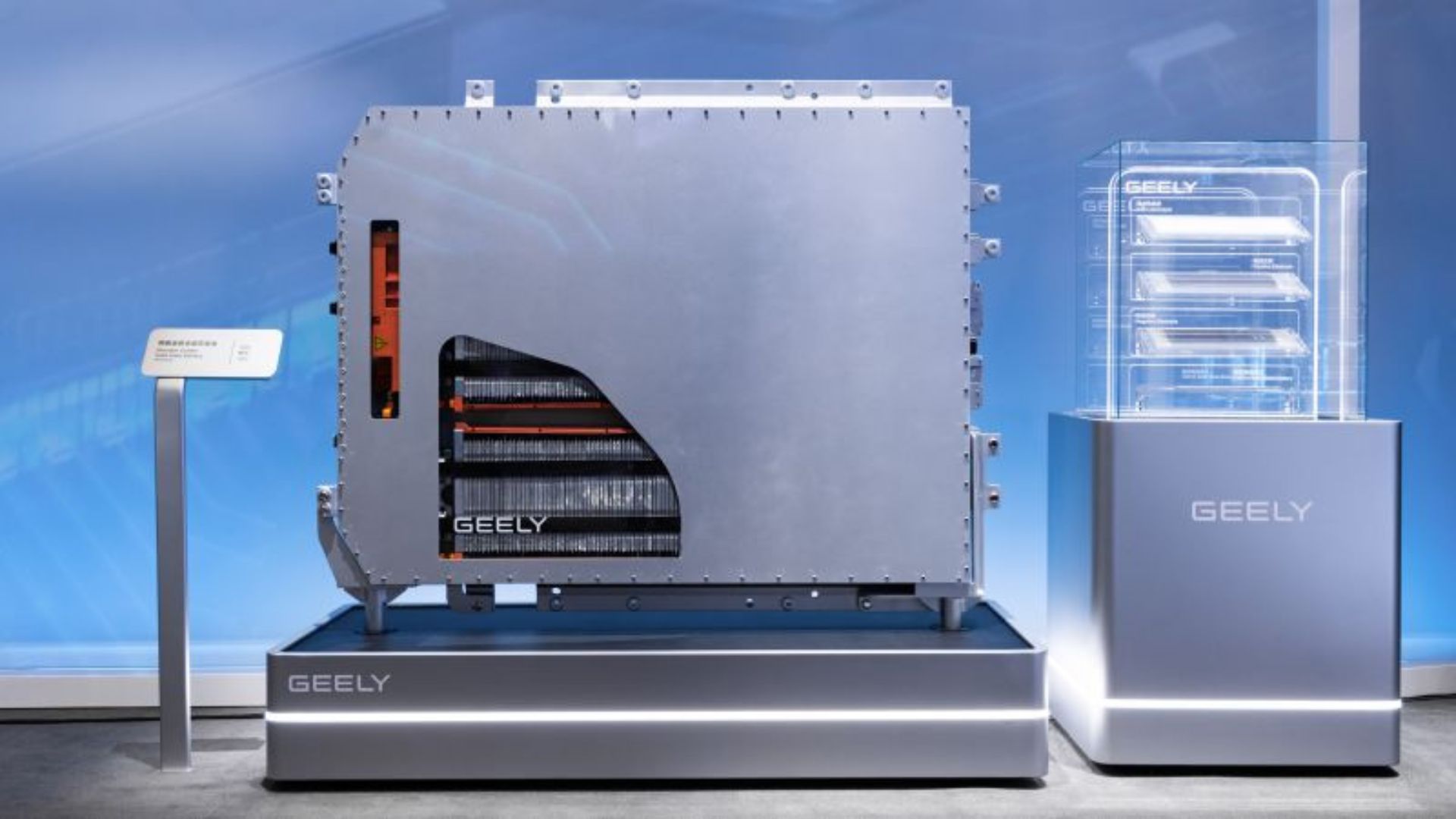
Compiled by The Product DeskSomething wrong?How this is made
"Pilot deployment" is the load-bearing phrase in Geely's announcement, and it is doing a lot of work. A pilot is not a production line, and the company has not said how many cars, at what price, or at what yield [1]. The report itself lists production yields and cost among the variables that will decide whether any of this matters beyond the headline number [16]. What Geely has supplied is a figure attached to a year, and once you count the other firms pointing at the same year, five organisations now have 2027 on the record for early solid-state hardware [10].
The number deserves a closer read than it is getting. Geely describes 500 Wh/kg as a battery pack figure, and compares it to the 250 Wh/kg of its current liquid-electrolyte Golden Brick cells [2][3]. Those are different denominators. A pack figure carries housing, cooling and structure that a cell figure excludes, so the two numbers do not sit on one basis, and the "doubling" framing either understates the cell chemistry required or the 500 is really a cell number and the pack has not been described at all [11]. That matters because the 1,000 km range claim [4] and the company's line about "range comparable to diesel, and charging measured in minutes" [15] depend on the pack, not the cell.
Set that against the most cautious voice in the story. CATL chairman Robin Zeng has put solid-state at roughly level 4 on the nine-point technology readiness scale, the stage of partial-scale prototypes [9]. Five levels remain between that assessment and mass production [12]. A pilot fleet on public roads is plausibly what the middle of that ladder looks like, so both statements can hold at once. But they came out of the same industry in the same news cycle, and CATL is itself one of the four battery makers with a 2027 trial-production target [8].
The most informative detail is the least promoted one. Dow's key account technical leader Bo Tong says the company developed a solid-state cell adhesive for Geely's programme [5] that holds from -40C to 120C [6]. Adhesive is an assembly problem rather than a chemistry problem: solid electrolytes need sustained physical contact at the interfaces through thermal cycling and fast charging, and a stack that delaminates loses capacity no matter how good the material is. A named supplier doing specific work on stack integrity tells you more about where a programme sits than any energy density slide.
One figure in the coverage has no owner. The million-kilometre service life, about 621,000 miles, is attributed to unnamed reports rather than to Geely or Dow [13]. That is the number most likely to end up in a warranty document, and the only one here that nobody has put their name against.
Follow any of these and your For You feed starts watching them — no settings page required.
Ranked by verification strength, evidence, and original report placement.
Geely's announcement coincides with identical 2027 trial production targets from BYD, CATL, Gotion High-Tech and CALB.
CATL chairman Robin Zeng cautioned that solid-state development still sits around Level 4 on the 9-point Technology Readiness Level scale, meaning partial-scale prototypes before mass production.
Geely Holding officially announced plans to launch pilot deployments of solid-state batteries across its lineup of vehicle brands by 2027.
Geely revealed a materials partnership with Dow Chemical; Dow key account technical leader Bo Tong confirmed the company developed a specialised solid-state cell adhesive.
The Dow adhesive remains solid in temperatures ranging from -40C to 120C (-40F to 248F), preserving structural integrity through freezes and fast-charging cycles.
The technology is slated to reach Volvo, Zeekr, Polestar, Lotus, Lynk & Co and Smart.
Evidence-backed comparisons of source perspectives and observed adoption signals. Read the methodology
Which Builder, Operator, and Investor concerns the observed source mix emphasized—not a truth score.
Evidence, demonstrated adoption, hype gap, incentives, and confidence are assessed independently, each on its own current evidence. How these are measured.
One outlet relaying vendor claims
All material rests on a single trade publication that sources its headline numbers from Geely's own LinkedIn post. There is no test data, measurement protocol, third-party validation or primary document for the 500 Wh/kg pack figure, the 1,000 km range projection or the 1 million km lifespan. Two items carry named attribution and lift the score off the floor: Dow's Bo Tong on the adhesive temperature window, and CATL's Robin Zeng on TRL 4 of 9. The pack-versus-cell basis mismatch is visible in the source's own wording and further weakens the central comparison.
Announced target, nothing deployed
Nothing is in customers' hands. The observable events are a stated 2027 pilot target across six brands, one named supplier disclosure from Dow, and a reported cluster of matching 2027 targets at four battery makers. The article's mention that 'real-world validation testing is already underway' carries no scope, volume or location, and a pilot by definition precedes series production. The non-zero score reflects a concrete date and a named component supplier rather than any shipped or deployed hardware.
Headline numbers outrun readiness
The framing — 'coming soon', energy density doubled, diesel-rivalling range, charging in minutes, a million-kilometre lifespan, 'the days of diesel dominance may finally be numbered' — sits well ahead of what the same article can support. The doubling rests on comparing a pack figure to a cell figure; the lifespan figure has no named source; and the leading supplier's chairman puts the technology five levels short of the top of a nine-point readiness scale. The gap is not maximal because the source does date the milestone, name the recipient brands and explicitly flag cold weather, charging speed, yields and cost as unresolved.
Vendor and supplier promotion, unmediated
Every performance number originates with a party that benefits from it. Geely is marketing its own roadmap through a LinkedIn post that the article quotes as its primary evidence; Dow is a materials supplier promoting a component it developed for the programme; CATL's chairman, whose caution is the sole counterweight, is himself a competing incumbent with reason to temper rivals' timelines. The publisher adds a traffic-oriented range headline and no adversarial sourcing, leaving the promotional chain intact.
Confident on framing, not on physics
Confidence in the assessment is moderate: the cluster is a single publisher, so corroboration is impossible, but the decisive weaknesses are legible inside the source itself — the pack-versus-cell mismatch appears in its own wording, the TRL 4 caution is quoted from a named executive, and the unresolved cost, yield, charging and cold-weather variables are conceded in the closing paragraph. That makes the low evidence and near-zero adoption readings dependable, while any judgement about whether 500 Wh/kg is achievable by 2027 remains out of reach.
invest
A dealer says Polestar's US "ban" was a choice, and wants $25 million for it1 distinct publisher
product
Waymo opens the trunk: a 5nm ASIC, a quadrillion ops, and a supplier list rivals can price3 distinct publishers
product
BYD's Denza N8 fits 130 kWh of LFP in an SUV and claims 1,003 km1 distinct publisher
product
Anthro's Kentucky bet says the solid-state bottleneck is electrolyte supply, not chemistry1 distinct publisher
Distinct publishers with included, body-backed reporting in this cluster.
1 article · August 21, 2026