Science1 publisher3 min readPublished
NTNU researchers turn scattered bird-disturbance findings into data a drone pilot could fly by
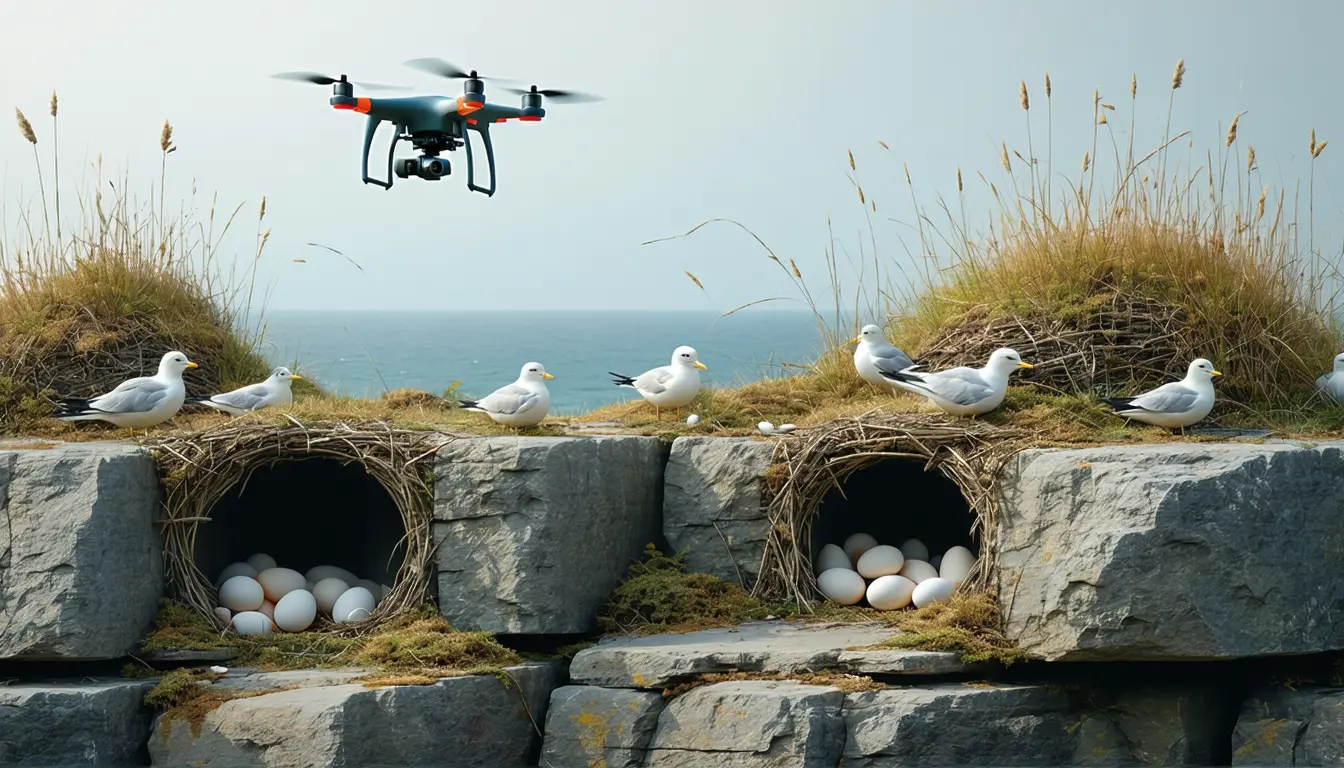
A paper in Drones synthesises what is known about how species react to drone size, noise and approach angle. Eider ducks ignore a pass at 30 metres; king penguins at that height show a rise in heart rate.
The Scientist · Science desk
What happened
- Norwegian rules ban drone flying in many protected areas, and outside them ask pilots to ensure their flying does not disturb birds or wildlife without specifying how that is to be done.
- Published findings have eider ducks unbothered by a drone passing at 30 metres while king penguins' heart rates rise at the same height, so a single altitude rule does not fit both species.
- About 457,000 Norwegians own at least one drone, which is the population any ecological guidance would have to reach.
Compiled by The ScientistSomething wrong?How this is made
Why it matters
- constraint A safety zone can only be written in metres. Metres do not separate a species that ignores a 30-metre pass from one whose heart rate climbs at it. Species-specific limits would need thresholds, and for most birds the published work has not measured them.
- contradiction Hellerud treats drones as a disturbance source while NINA reports less disturbance than earlier survey methods. Both readings can hold, and the difference sits in operator knowledge. Neither account has tested that against an unbriefed control.
- capability Once approach angle, noise and frequency are expressed as engineering parameters, a pre-flight tool could tell a pilot which approach a capercaillie tolerates. The synthesis exists. The tool does not yet.
A rulebook can put a number on altitude. That is also the variable the evidence handles worst. Studies cited by Ken Hellerud have eider ducks showing no significant reaction to a drone passing at 30 metres, while king penguins at that height show a significant increase in heart rate [10][11]. A zone drawn in metres alone cannot be set correctly for both [20].
Geometry is the other variable. "How the drone moves in relation to an animal makes a big difference. Does it approach from below, from above or at the same height? The capercaillie, which spends a lot of time on the ground, will react very differently to a certain flight pattern than smaller migratory birds and birds of prey," said Hellerud, a head engineer and doctoral student at the Norwegian University of Science and Technology in Gjovik [12][1]. He also points to the drone's size, how much noise it makes, and the frequency range it operates in [13].
His objection to the existing literature is that it studies those factors one at a time [14]. Little is published on how drone type, flight style, an individual animal's response and the long-term ecological consequences of drone traffic connect to each other [15]. The framework, described in the journal Drones, gathers what exists and converts it into technical data engineers can use when building algorithms and simulation software [18].
"In order to simulate something, you first need to know what to simulate. The framework we've developed allows us to synthesize existing knowledge and in many ways answers that question," said Lizhen Huang, a professor in NTNU's Department of Manufacturing and Civil Engineering who supervises Hellerud's doctoral work toward a simulation tool for pilots [17][16].
A heart-rate increase in a king penguin is a physiological measurement taken on an individual [11], not a count of abandoned nests or a season of breeding success. Nest abandonment is separately documented: drones can drive nesting birds off their nests [3]. Hellerud says he often sees the other direction of the problem too, with animals reacting to the aircraft: "There have been reports of numerous examples of birds of prey that attack drones when they feel threatened. When we are out collecting data, we often observe that the drones quickly attract a lot of attention from the birdlife in the surrounding area" [2].
Against that, the Norwegian Institute for Nature Research says drones let its scientists survey seabirds with far less disturbance than before, and credits pilots who know the wildlife in the areas they fly and the behaviour of the species there [4]. It is a report from the institute doing the flying. In the source material, nobody has flown the same colonies with briefed and unbriefed pilots to measure the difference.
That matters for where the money goes. If the controlling variables are what the pilot knows and how the aircraft approaches, the spending goes into briefing, species training and permit conditions instead of a quieter airframe. Hellerud's ambition is to move the knowledge into the flight itself: "We will be able to create tools with our framework that give drone pilots a lot of this knowledge in real time" [5]. The literature has not yet produced the species data such a tool would need at usable resolution [15].
What to watch
- Whether the Drones synthesis yields per-species, per-approach thresholds specific enough for a regulator to write into rules.
- Whether Norwegian authorities replace static safety zones with guidance keyed to species and flight pattern.
- Whether anyone flies the same seabird colonies with briefed and unbriefed pilots and measures the disturbance difference.