Science1 publisher3 min readPublished
A premolar fragment closes the Pilbara gap in the Tasmanian devil's mainland record
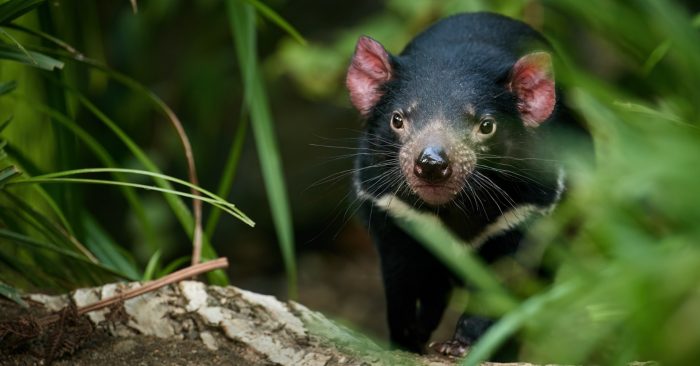
Two fossils and a set of chewed bones from the Juukan 2 rockshelter place Tasmanian devils in Western Australia's Pilbara from about 45,000 years ago into the mid-Holocene, on the same bones people carried in and butchered.
The Scientist · Science desk
What happened
- A study in Archaeology in Oceania reports the first unequivocal Tasmanian devil remains from the Pilbara, recovered from the Juukan 2 rockshelter on Puutu Kunti Kurrama and Pinikura Country.
- The older find is a fragment of a lower premolar from sediment dated 42,500 to 47,100 years old, and the younger is part of a lower jaw with two molars from sediment dated 6,900 to 7,300 years old.
- Of 55 gnawed bones whose tooth pits were measured, at least 10 matched devil dimensions most closely, with marked bones occurring before the Last Glacial Maximum, after it, and in the Holocene.
- The team also logged 263 digested bone fragments too large to have passed through the region's smaller carnivores, such as quolls and mulgaras.
- Juukan 2 was extensively damaged by mining blasting in 2020, and research and rehabilitation there have continued under the direction of Traditional Owners.
Compiled by The ScientistSomething wrong?How this is made
Why it matters
- constraint Both ages belong to sediment layers, not to the teeth. Tying the animals to about 45,000 years depends on the stratigraphy holding, and a direct date on either specimen could move it.
- capability Measured tooth pits and the size of digested bone let researchers register a large scavenger in deposits that hold none of its skeleton, so sites with no devil bones can still be screened for devil feeding.
- precedent If devils fed at a hot arid-zone shelter through the glacial maximum, other Pilbara deposits should carry the same chew marks, and one that carries none becomes a result someone has to explain.
Two specimens would be a thin basis for extending a species range, and the paper does not rest on them alone. The team has cataloged more than 8,000 animal bones from the shelter so far, and more than 1,000 of those carry chewing or gnawing marks, mostly from rodents but also quolls, devils and possibly monitor lizards [9]. That is roughly one cataloged bone in eight [2]. Tooth pits were then measured on 55 specimens, and at least 10 came closest to devil dimensions [10], about 18 percent of the measured set [1].
What that share does not measure is abundance. Ten matches show that devils chewed bones at Juukan. They do not show how many devils, or how often, and the 55 measured specimens are about 5 percent of the gnawed material logged so far [5].
Wild devils are now confined to Tasmania [2]. Their mainland fossil record already ran from southern Australia to the tropical north, across the Nullarbor, central Australia, Queensland, the Northern Territory and parts of southern Western Australia, with the Pilbara the one large blank [3].
Neither fossil was dated on its own material. The ages come from the sediment each was found in [7][8], and the midpoint of the older range is about 44,800 years [4]. A sediment date is an age for a layer, so reading it onto a bone assumes the bone belongs to that layer, which is the ordinary assumption in a stratified deposit.
People used Juukan 2 from at least 47,000 years ago and kept using it through the Last Glacial Maximum, roughly 29,000 to 19,000 years ago [4]. The premolar's sediment falls inside that occupation. Juukan 2 is also the only known mainland northern Australian Pleistocene-aged archaeological site where animal bones occur in unequivocal association with stone tools [5].
The pattern inside the deposit is more specific than shared space. Medium and large animals were carried in and butchered by people, while smaller animals mostly arrived in owl pellets, and the devil-like chewing sits on the larger, human-associated material [13]. The authors offer camp scavenging as a possibility, with human camps giving devils predictable feeding for tens of thousands of years [14]. The deposit cannot show a devil and a person in the shelter in the same season.
The two fossils are separated by at least 35,200 years [3], and the chewed bones are what connect them across the sequence [11]. Devil-like images appear in rock art at Nganjarli in Murujuga, within the Dampier Archipelago National Heritage Place, and no comparable images are currently known from around Juukan itself [15]. Marine shell beads from the shelter show that people or objects moved between inland and coastal areas during the Holocene [16].
What to watch
- Direct dates on the jaw fragment or the premolar, which would separate the specimens' ages from the sediment ages.
- Whether other Pilbara rockshelters yield devil-sized tooth pits and digested bone, or come up empty.
- What further faunal material the Traditional Owner-directed work recovers from the damaged Juukan deposits.