Product1 publisher3 min readPublished
Talkdesk's CX survey puts end-to-end AI resolution at 15% of companies
Talkdesk's survey of 252 customer-experience leaders found 98% use AI, yet 15% let agents resolve an issue end to end across systems. That gap points the next support budget at integration work and the compliance reviews it brings.
The Product Desk · Product desk
What happened
- Only 19% of organizations in the survey have scaled AI beyond a single use case, and nearly 80% run fewer than 10 AI automations in production.
- Some 64% run specialized AI agents for tasks such as identity verification or billing, but 35% have AI that keeps customer context and acts across systems.
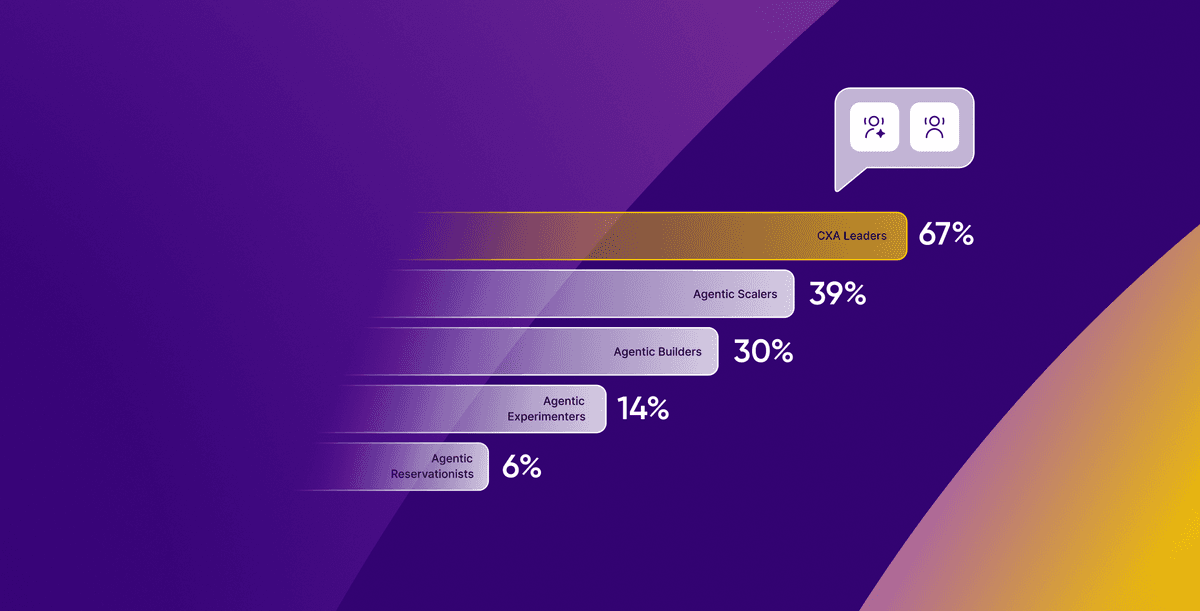
- Companies in Talkdesk's top tier are about four times as likely as the next tier to report major CSAT or NPS gains, 22% against 5%.
Compiled by The Product DeskSomething wrong?How this is made
Why it matters
- decision Pilot counts stop working as a progress report for CX leads, because the survey separates its tiers by the share of issues AI resolves without a human, and teams can now be benchmarked on that share.
- constraint Wiring agents into billing and claims systems gives them write access, so an integration budget has to fund security and compliance review before any connector ships.
- cost Until journeys resolve end to end, companies pay for the AI tools and also for the staff who finish the requests those tools leave open.
A driver calls an insurer after a crash. That one event needs a tow truck, a claim, a repair shop and a rental car, handled by several departments on several systems [7]. Pedro Andrade, Talkdesk's vice president of AI, used that call in an analyst briefing on the survey to show where most companies' AI stops [7]. "Routing work is not the same as resolving it," Andrade said [8].
Teams tell themselves they have agents, and by one count in the survey, 81% of organizations are piloting or deploying them [4]. By another count in the same survey, 24% use agentic AI, defined as systems that take a goal, reason through it and act across systems [3]. Both figures describe the same 252 respondents [1]. A team that benchmarks itself against either one has to decide which definition of "agent" it means before it counts. For the driver, an agent that checks identity and then hands off without the case history means the context gets rebuilt at the next stop [6].
The outcome figures that matter in the survey measure resolution. Talkdesk sorts respondents into tiers: 56% sit below the point where AI acts at all, and 29% are "Agentic Scalers" with one of the two capabilities it measures, while "CXA Leaders" have both [12]. Among Leaders, 38% resolve more than 40% of customer issues without a human; 60% of Scalers resolve fewer than 20% [13]. Leaders are also about twice as likely to run churn prediction (51% against 28%) and personalized recommendations (44% against 19%) [14].
Disconnected systems also cost staff time. Human agents in the least mature organizations lose about 35% of their time to switching systems, re-entering data and searching for context, against roughly 25% in the most mature [18]. The gap is about 10 percentage points of staff capacity [1]. It is measured between different companies, not within one company before and after it connected anything. Tiago Paiva, Talkdesk's founder and chief executive, said the result is "a false sense of progress," with widespread deployment masking how few organizations can quantify AI's impact [10].
I think the next dollar belongs on connecting the systems behind the highest-volume journey, ahead of another pilot. The cost of that choice is permission. Asked what limits automation, respondents put compliance (50%) and security (48%) above disconnected systems (45%) and legacy infrastructure (44%) [16]. None of the top barriers came from the AI models [16]. The evidence has limits of its own. The benchmark is Talkdesk's, and the satisfaction gains are what respondents reported about themselves, compared across tiers [1] [15].
The test starts with the three contact reasons that carry the most volume. Each journey gets two yes-or-no scores: whether the AI keeps the customer's context when the case crosses systems, and whether it can take the final action in the system of record. A journey that fails both is a router. One that keeps context but cannot act hands a better-briefed case to a person, and one that acts without context works only when the request lives in a single system. Journeys that pass both are the only place another pilot makes sense. Everywhere else the money goes to the failing score, and when that score is action, the first line item is the security and compliance review.
What to watch
- Whether Talkdesk and NewtonX publish the full methodology, including how respondents defined an AI agent and how CSAT or NPS gains were measured.
- Whether a repeat of the benchmark shows Agentic Scalers moving into the Leader tier, which would test whether the resolution gap closes when systems are connected.
- Whether compliance and security teams publish approval paths for agents that write to systems of record, since those were the two most-cited barriers.