Science1 distinct publisher3 min readPublished
LB 1's hip bones group statistically with Pleistocene Homo and away from the australopiths. That retires the convenient reading that the hobbit's odd skeleton is simply primitive. Its ancestry stays as open as before.
The Scientist · Science desk

Compiled by The ScientistSomething wrong?How this is made
Iliac flare is a shape measurement with a biomechanical claim attached: how far the blades of the pelvis splay outward from the center of the trunk, with wide flare linked to australopith anatomy and, functionally, to bipedal walking less efficient than ours [8]. The obstacle lay in the instrument, not in the fossil itself. Different published methods for quantifying flare in human relatives had been returning contradictory results [9], so Lewton and colleagues built a quantifiable version of the variable and combined it with other pelvic measurements before comparing anything [4].
The comparison set is what makes the result readable. Chimpanzees and gorillas were included alongside australopiths and both living and extinct human species [3], which gives the metric something to fail on: if the measurement were noise, apes and australopiths would not separate cleanly from Homo. They do, and LB 1 falls with Pleistocene Homo, Homo erectus among them [5]. That placement describes where LB 1 sits among other hominins; it does not measure walking speed. The authors write that H. floresiensis likely used a form of bipedal walking markedly similar to ours [18], and in the same breath that it is not identical to ours [19]: their reading is of an animal not covering long distances or moving fast, possibly still doing some climbing [7]. Lewton put the same limit on the inference in plainer terms, saying the species was not a particularly fast biped [6].
What this does not tell you is where the hobbits came from. Locomotor shape tracks movement, not lineage, and the skeleton sends mixed signals depending on body part: the hand bones look australopith-like while the shoulders and upper arms look human-like [10]. A Homo-like pelvis removes the option of describing the whole animal as a primitive holdover, which is the tidy explanation the mosaic used to enjoy. It does not choose between the two leading origin hypotheses, and the authors say their results are consistent with both [11]. Caley Orr of the University of Colorado Denver, who was not on the study, told Live Science it matches the smaller pelvic comparison his own team published last year, in which LB 1 also came out mostly human-like [12], and that what it means for hobbit origins remains ambiguous [13].
The denominator deserves a mention. This is one adult female, about a meter tall, dated to somewhere between 100,000 and 60,000 years ago [1] - a window 40,000 years wide [17]. Variability within H. floresiensis cannot be measured from a single pelvis, which matters given Orr's point that early human skeletons vary considerably in size and shape [13]. So the flare result sharpens the picture of how LB 1 walked without moving the candidate ancestors. What would change that picture is a second hip bone; this one has already been read as clearly as the data allow.
Ranked by verification strength, evidence, and original report placement.
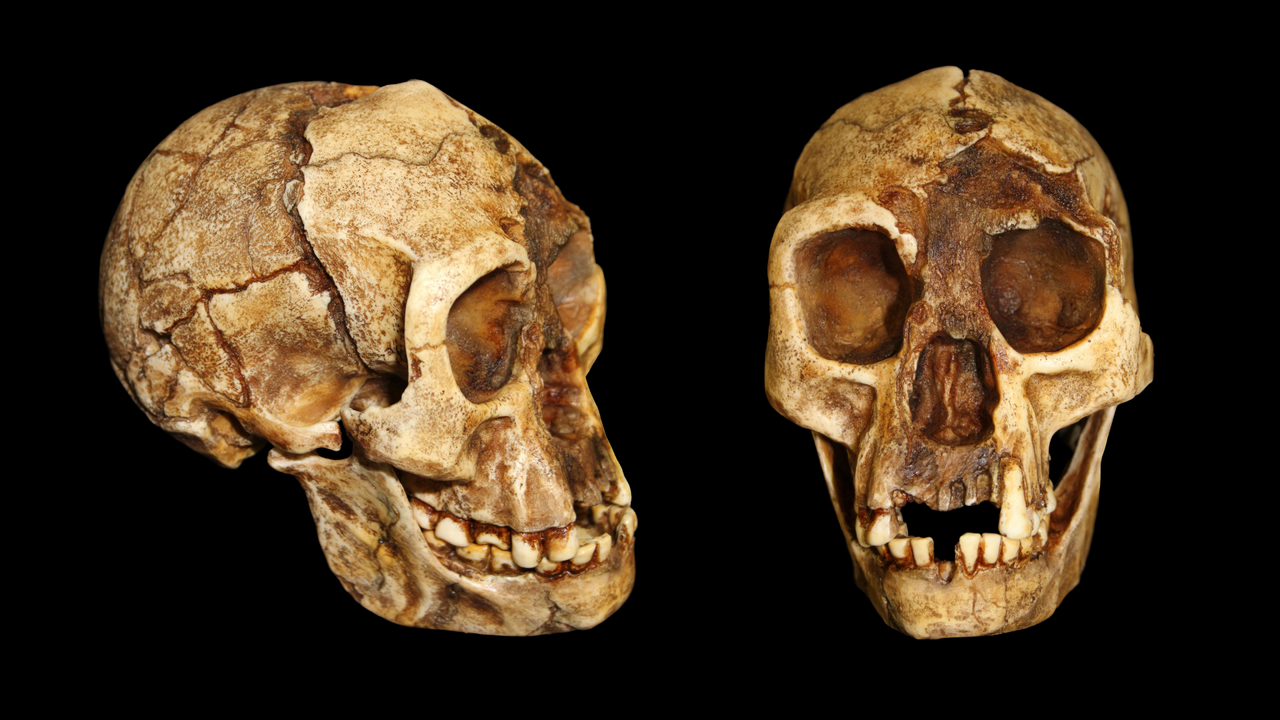
LB 1 was an adult female Homo floresiensis, about 3.5 feet (1 meter) tall, who died between 100,000 and 60,000 years ago on the Indonesian island of Flores.
Kristi Lewton, a biological anthropologist at the University of Southern California, and colleagues published their study of the LB 1 pelvis on Aug. 25 in the American Journal of Biological Anthropology.
The researchers compared hip bones from chimpanzees, gorillas, australopithecines, and both living and extinct human species.
The team created a quantifiable measure of iliac flare and added other measurements of the pelvises of these species.
The pelvis of LB 1 was statistically similar to other Pleistocene human species, such as Homo erectus, and different from australopithecines and apes.
Lewton told Live Science that based on just the hip bones, Homo floresiensis looks generally like humans and other genus Homo species and probably could have moved a lot like humans, but was not a particularly fast biped and was not traveling long distances.
Distinct publishers with included, body-backed reporting in this cluster.
1 article · August 28, 2026
Follow any of these and your For You feed starts watching them — no settings page required.
science
The genus Homo may be a filing convention, and one paper wants the filing redone2 distinct publishers
science
A vaccine communicator's testable claim: hesitancy answers to burden, not to better facts1 distinct publisher
science
A drug-insensitive enzyme in the mouse gut strips 80% of metformin's glucose-lowering effect1 distinct publisher
science
Feeds are triaging patients by engagement, and the proposed defence is literacy, not moderation1 distinct publisher
Evidence-backed comparisons of source perspectives and observed adoption signals. Read the methodology
Which Builder, Operator, and Investor concerns the observed source mix emphasized—not a truth score.
Evidence, demonstrated adoption, hype gap, incentives, and confidence are assessed independently, each on its own current evidence. How these are measured.
Peer-reviewed, corroborated in direction, invisible in detail
Two things hold this up: a journal paper with a printed DOI, and Caley Orr — who had no hand in it — saying his own earlier comparison put LB 1 in the same place. Two things weaken it. Live Science prints not one number, so a reader cannot see how far the hobbit's hip sits from the australopith range, and the whole species-level reading rests on the pelvis of a single adult female.
One echo, no second run of the new ruler
Uptake is currently two data points: the paper is out, and one unaffiliated paleoanthropologist recognises the result from work of his own. Nobody has yet applied the new flare measure to a fresh sample — which is the test that matters most, since the reason for building it was that older methods contradicted one another.
'Than previously thought' is doing quiet work
The opening promises a body 'even more human-like than previously thought' and a mystery that has 'only deepened.' But Orr, quoted further down the same piece, says LB 1's pelvis already came out mostly human-like in work from a year ago, and the study's own conclusion is that both existing origin hypotheses survive intact — a mystery holding still, not growing. Credit where it is due: every caveat is present and prominent. The lean is in the frame, not the facts.
The finding's narrator is also its author
Every affirmative sentence about how the hobbits walked comes from Kristi Lewton, who wrote the paper. The counterweight arrives a few paragraphs later from Orr, who did not — and he is the one who says the meaning stays ambiguous. Around the science sit a newsletter prompt, a human-evolution quiz and three related hobbit headlines, which tells you the mystery angle earns its keep for the publisher. No funding source for the study is stated either way.
Careful hands, single channel
The writing is by a staff journalist with a doctorate in biological anthropology, and the paper is cited outright rather than paraphrased from a press release — which is why the specifics read solidly. Still, the journal result, Orr's earlier comparison and LB 1's 40,000-year dating window all reach us through one outlet's rendering, with nothing else in our coverage to check them against.